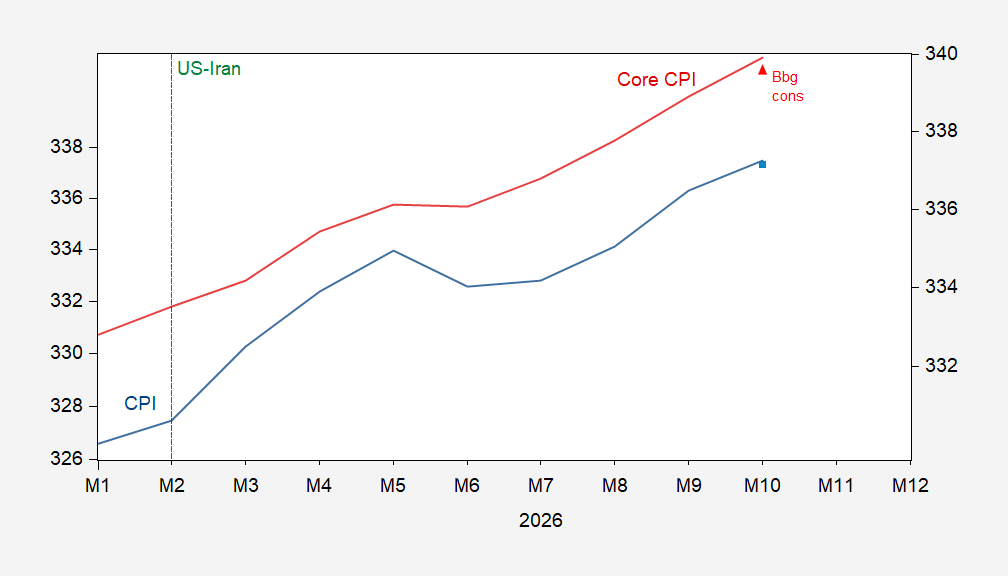
U.S. CPI inflation rose more than expected, with both headline and core measures beating forecasts and shifting interest-rate expectations toward possible Fed tightening.
U.S. inflation came in hotter than markets expected in the latest Consumer Price Index report, delivering an upside surprise versus Bloomberg’s consensus forecast. Headline CPI rose 0.4% month over month, outpacing the 0.3% gain economists had penciled in. Core CPI—which strips out food and energy—also exceeded expectations, increasing 0.3% on the month compared with a 0.2% consensus call.
The figures, based on Bureau of Labor Statistics data and compiled against Bloomberg survey expectations, show both the overall index and the core measure running above the median forecast for the period. In the accompanying comparisons, CPI is plotted alongside Bloomberg’s consensus estimates over the long run (with the index referenced to the 1982–84 base period of 100), illustrating the persistent importance of even small monthly deviations from expectations for markets and policymakers.
A second set of comparisons places the CPI move in a broader inflation landscape by aligning multiple price gauges on a common starting point—setting January 2025 equal to zero and tracking changes in logarithmic terms. That view juxtaposes headline CPI with measures such as a CPI-based wage series, the chained CPI (not seasonally adjusted), CPI excluding shelter, the Personal Consumption Expenditures (PCE) price deflator, the Producer Price Index, an S&P Global GDP deflator series, and the American Institute for Economic Research’s Everyday Price Index. Taken together, the lineup underscores that CPI is only one lens on inflation, but also highlights how closely markets monitor it relative to other widely cited indicators from the BLS, the Bureau of Economic Analysis, S&P Global, and AIER.
The immediate market implication showed up in interest-rate expectations. Following the data, CME futures pricing suggested that investors began assigning a nontrivial chance to additional tightening at year-end. As of 1 p.m. Central Time, the implied probability of a 25-basis-point increase at the Federal Reserve’s December meeting climbed to 9.8%, from effectively zero beforehand. (The referenced move reflects a correction from an earlier misstatement that had cited a larger step.)
While a single monthly report does not define the inflation trend, the combination of above-consensus headline and core readings is enough to shift marginal expectations around the Fed’s next steps—particularly in a market environment where policy is widely viewed as data-dependent and sensitive to renewed inflation pressures.
Why it matters
Even modest upside surprises in CPI can ripple through bond yields, mortgage rates, and equity valuations by altering expectations for the Fed’s policy path. Households and businesses are affected as financing costs and pricing decisions respond to changing rate odds. Investors will now watch upcoming inflation prints and other price gauges—especially those tied to consumption and shelter—to see whether this report signals a broader reacceleration or a one-off bump.