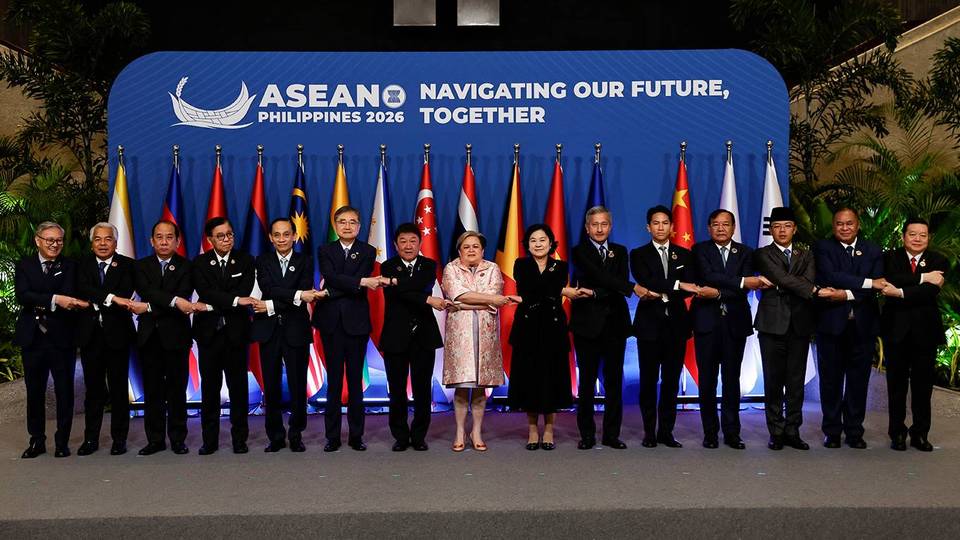
As ASEAN leaders gather for their summit, the bloc’s carefully staged unity masks deepening internal divisions that hinder collective action amid rising great-power rivalry.
As leaders from Southeast Asia prepare to meet for the Association of Southeast Asian Nations’ 49th Summit, the organization is confronting a growing gap between the unity it projects and the divisions that are increasingly difficult to hide. The traditional “family photo” moment—set to take place during the Manila gathering on November 16–18—will offer the familiar image of solidarity. Yet behind the choreography, ASEAN is wrestling with internal rifts that are exposing the limits of its institutions and its ability to act collectively.
Those strains come at an especially symbolic time. With ASEAN approaching its 60th anniversary, expectations for the bloc’s role in shaping regional stability and economic direction are colliding with persistent questions about effectiveness. Member states have found it harder to align around shared priorities, and disagreements are testing the organization’s consensus-driven approach—an operating style that has long been central to ASEAN’s identity but can also slow or dilute decisive responses when the political stakes are high.
The consequences of that institutional weakness are sharper now because the external environment is changing. The global order that once provided a relatively stable backdrop for trade, investment, and diplomacy is increasingly fragmented. As major powers compete more openly for influence, Southeast Asia’s strategic and economic value is rising—and with it, the pressure on ASEAN to demonstrate that it is more than a forum for meetings and statements.
In practical terms, ASEAN’s central challenge is whether it can convert what it does have—its convening power and its ability to bring diverse governments to the same table—into coordinated action. The bloc has often served as a neutral platform where rival interests can be managed without direct confrontation. But the same neutrality can become a vulnerability if the institution cannot move from dialogue to delivery, especially as the region is pulled in competing directions by outside powers.
The risk, observers warn, is that ASEAN’s role could shrink from agenda-setter to stage, becoming a venue where larger geopolitical contests play out rather than an organization capable of shaping outcomes. That would represent a significant shift for a grouping that has long argued for “ASEAN centrality” in regional affairs and used its meetings to anchor broader diplomatic architecture in Asia.
This summit, then, is not only another scheduled gathering. It is a test of whether ASEAN can address its internal fractures strongly enough to remain relevant in a harsher international landscape. With the bloc nearing a milestone anniversary, the symbolism of unity will be easy to produce. The harder task is proving that ASEAN can still act together when it matters most.
Why it matters
ASEAN’s ability—or inability—to act cohesively affects the region’s economic stability, investment climate, and bargaining power amid intensifying great-power competition. If the bloc cannot translate meetings into collective decisions, member states may face stronger external pressure individually rather than negotiating from a unified position. The next signals to watch are whether ASEAN can bridge internal divides and demonstrate practical coordination beyond summit-stage symbolism.