Seven weeks after Orion splashed down and delivered four astronauts back to Earth from the first human voyage around the Moon since the Apollo era, NASA’s Artemis II…
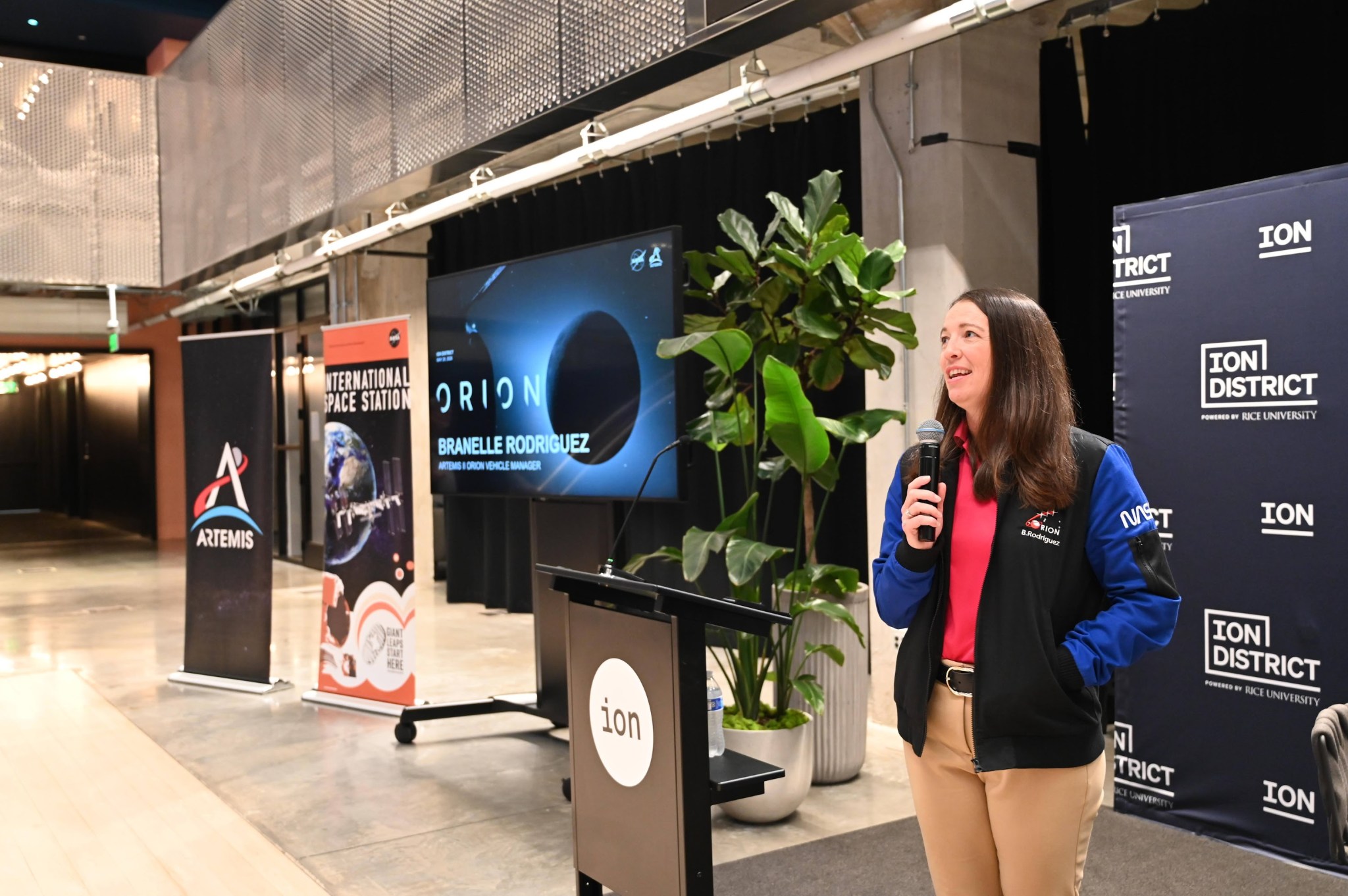
Seven weeks after Orion splashed down and delivered four astronauts back to Earth from the first human voyage around the Moon since the Apollo era, NASA’s Artemis II Orion Vehicle Manager Branelle Rodriguez offered a detailed look at what the mission proved—and how its lessons are already steering the agency’s next steps toward the lunar surface and, ultimately, Mars.
Rodriguez spoke May 28 at the Ion in Houston, a technology and innovation hub in the city’s Ion District that convenes researchers, entrepreneurs, and industry leaders across fields from aerospace to energy. Her appearance was part of the NASA Stories at the Ion speaker series and was introduced by Monte Goforth, acting director of business development and technology integration at NASA’s Johnson Space Center.
As Orion’s vehicle manager for Artemis II, Rodriguez has been responsible for the spacecraft across its full arc: development and production, mission execution, and the post-flight processing now underway after Orion’s return to NASA’s Kennedy Space Center in Florida. She described the emotional weight of the milestone. “This mission was very near and dear to my heart,” she said, adding that the magnitude of the accomplishment still hadn’t fully settled in.
Artemis II launched April 1 atop NASA’s Space Launch System rocket. Over 10 days, Orion carried NASA astronauts Reid Wiseman, Victor Glover, and Christina Koch, along with Canadian Space Agency astronaut Jeremy Hansen, on a crewed journey around the Moon. Using mission imagery and video, Rodriguez guided the audience through major phases of the flight: launch, operations in high-Earth orbit, the lunar flyby, and the spacecraft’s return and reentry to Earth. She also highlighted views captured from Orion, including an Earthrise, close-up perspectives of the Moon’s surface, and a solar eclipse seen from deep space.
Beyond the spectacle, Rodriguez emphasized that Artemis II’s central purpose was verification: the mission served as Orion’s first crewed test in deep space, exercising the vehicle’s life support, crew interfaces, navigation capabilities, and reentry systems. The flight generated performance data NASA will use to refine procedures and hardware for the Artemis missions that follow.
The crew also conducted a manual piloting demonstration, an evaluation of Orion’s handling and proximity operations designed to inform future rendezvous and docking work. Rodriguez recalled the moment the stakes became real during the countdown. “I think it really hit me at T-minus 10 seconds,” she said, describing the transition into “terminal count,” when the launch sequence becomes irreversible.
Rodriguez repeatedly returned to the theme of collaboration, crediting a global network spanning NASA centers, contractors, and international partners. A key example, she said, is the European Service Module supplied by the European Space Agency, which provides Orion with essential functions including power, propulsion, oxygen, and water. At Johnson Space Center, more than 300 people staffed the Orion Mission Evaluation Room, tracking spacecraft health and preparing to respond to issues in real time.
The mission also carried symbolic reminders of public participation. Orion’s zero-gravity indicator—named Rise—was a plush figure created by a student through an Artemis II design competition. Rise carried a memory card containing more than 5.6 million names submitted through NASA’s “Send Your Name with Artemis” campaign. “It is what the crew wanted—to bring all of us with them on this mission,” Rodriguez said. The astronauts also helped design the mission patch, embedding a subtle message: when viewed from a distance, the artwork reads “all,” a nod to the many hands behind the flight.
Looking forward, Rodriguez pointed to Artemis III as the next major proving ground. The mission is slated to test key rendezvous and docking operations between Orion and commercial human landing systems in low Earth orbit, advancing NASA’s plans to return astronauts to the Moon. She noted that on June 9, NASA announced the Artemis III crew at Johnson Space Center in Houston.