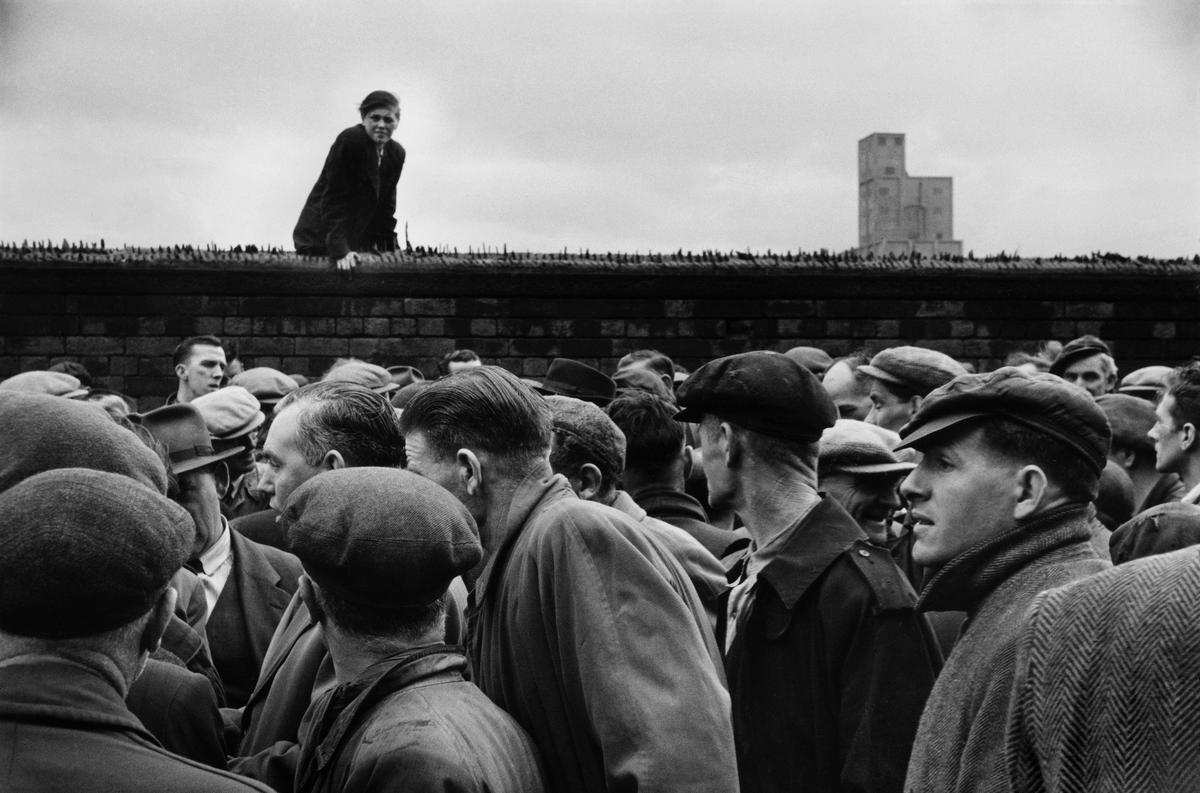
It’s no accident that equality comes first among the ‘self-evident’ truths articulated in the United States Declaration of Independence.
It’s no accident that equality comes first among the ‘self-evident’ truths articulated in the United States Declaration of Independence. The claim that ‘all men are created equal’ serves there not simply as an abstract premise from which revolutionary consequences ought to follow, but as a concrete practical foundation on which the American colonists could claim to stand as equals with the greatest king and hold him to account. Still impressed by his own handiwork50 yearslater, Thomas Jefferson even prophesied that the ‘palpable truth’ of equality enshrined in the Declaration would one day unite all of humankind. Yet today, it’s evident that the word ‘equality’ means very different things to different people. What once seemed capable of providing common ground is now just another source of controversy. What explains this shift? I suspect that the deceptively simple, conceptual language of ‘equality’ has itself played a substantial role. A better understanding of ‘equality talk’ – as the application of this language to human beings and their relations – might therefore shed some light on our predicament. Let’s begin by examining a group of people that generally prides itself on thinking (and speaking) more clearly than most: professional philosophers. What aretheydoing when they talk about equality? Often, they’re saying something about human beings: about what we’re fundamentally like, and how we should be treated morally, politically and socially. When an academic philosopher says that ‘all people are equal’, she’s generally saying that, despite differences of race and gender, economic class or individual merit, every person is somehowthe samein some fundamental respect(s). While some philosophers will stress the human capacity for reason and moral agency, others emphasise our mutual vulnerability to suffering and violent death. Still, all generally agree that thissameness– whatever its underlying basis – ought to matter for our social and political arrangements, such that any persistent inequalities between human beings must require some justification or redress. But here, a non-philosopher might wonder why the professionals insist on using the technical language of ‘equality’ as opposed to something more straightforward like ‘sameness’? One reason, I think, is that they are trading on the former concept’s mathematical resonances of quantitative precision and transcendent truth. Those resonances, in turn, make the problem ofinequalityseem relatively tractable – as something the existence of which can be measured, hence agreed upon. While other political values, like liberty, resist reduction to a common measure, the quantitative logic of equality thus promises an objective standard against which social progress can be judged. The distinctly mathematical aspect of modern ‘equality talk’ isn’t new. Consider the Declaration’s language of ‘self-evidence’. This was an allusion to Euclid’sElements(c300 BCE),in which the transitive property of equality – ‘things that are equal to the same thing are also equal to one another’ – comes first among the so-calledaxiomata, or ‘worthy notions’. The truth of these geometric propositions could, in turn, be accepted without proof, and so serve as a shared starting point from which to reason to less-obvious conclusions. If like cases are to be treated alike as a matter of logic, then ‘equals’ ought to be treated ‘equally’ as a matter of politics Two hundred years after the Declaration, we likewise find the philosopher Ronald Dworkin inTaking Rights Seriously(1977) describing the right of all persons to equality as ‘axiomatic’, and thereby taking the basic equality of human beingsoffthe table as a topic of political controversy.Let metaphysicians and theologians quarrel about its basis, then, or whether nonhuman animals or artificial intelligence ought to count equally as moral persons. Political philosophers could get on with the altogether more important business of determining what this equality implied for our social, political and economic relations. Much like Jefferson, Dworkin would alsolaterlend his axiom world-historical significance, as providing ‘a kind of plateau in political argument’ characteristic of modernity. By this, Dworkin meant that most contemporary political ideologies – from liberalism to utilitarianism, and libertarianism to communism – must begin from a shared premise, that all ‘members of the community matter, and matter equally’. And so, whatever their differences, political opponents ought to recognise themselves as building upon a common foundation. Today, Dworkin’s historical optimism about equality as a universal premise seems harder to sustain. Nevertheless, his ‘egalitarian plateau’ image remains popular among academic philosophers, forwhombasic equality has come to mark an indelible ‘divide in moral thinking between (1) a premodern world in which nobles [were] regarded as having greater worth than peasants … and (2) a modern world that repudiates these crude prejudices.’ Moreover, if like cases are to be treated alike as a matter of logic, then surely ‘equals’ ought to be treated ‘equally’ as a matter of politics, too – for instance, by distributing to each the same amount of welfare, rights or resources. Dworkin’s Oxford colleague, the analytic MarxistG A Cohen,couldthussimply ‘take for granted that there is something which justice requires people to have equal amounts of.’The only question remaining was that posed byAmartya Sen: ‘Equality ofwhat?’ (My emphasis.) And yet, the idea thatunequaltreatment might sometimes be required to respect a person’s basic equality was also intuitive to many late-20th-century liberals, who supported policies like affirmative action. Dworkin himself framed this intuition influentially in terms of a distinction between treating people ‘equally’ – by applying the same standards or distributing the same amount to everyone – and treating them ‘as equals’, in a way responsive to their differences. This insight may, at first, sound similar to the much older, Marxist principle, ‘From each according to his ability, to each according to his needs.’ But as the historian Darrin McMahon observed inEquality(2023), Marx and Engels were themselves consistently critical of equality, dismissing it as a just another ‘popular prejudice’ to be dispelled by the coming communist revolution. In any case, it is Dworkin’s distinction, not Marx’s, that has since become central to contemporary theories of social or ‘relational’ egalitarianism, especially thoseassociatedwith the philosopher Elizabeth Anderson. On this view, the point of equality is not to ensure a quantitatively identical distribution ofstuff, whether of rights or resources, but rather the realisation of a just society in which every personcan stand as an equal, without any hierarchical relations of inferiority or superiority. But the devil, as ever, is in the details, with relational egalitarians saying surprisingly little in positive termsaboutwhat relating as ‘equals’ actually looks like – and, specifically, when and what forms ofunequaltreatment might be involved. Courtesy theInteraction Institute for Social Change/Angus Maguire One encounters a similar difficulty in recent debates pitting ‘equity’ against‘equality’ as an approach to social justice. Proponents of the former insist that, unlike the latter, equity rejects a one-size-fits-all approach by taking certain differences – for instance, of race, disability or socioeconomic circumstances – into account. When pressed, however, equity’s defenders also tend to define ‘equitable’ treatment in strikingly Dworkinian terms, forinstanceas placing the disadvantaged on an ‘equal footing’ with the privileged.The result has been an odd convergence between equity’s progressive proponents and their conservative critics, with each presenting their preferred approach as the truly egalitarian one, with one side insisting that equal standing requires unequal treatme