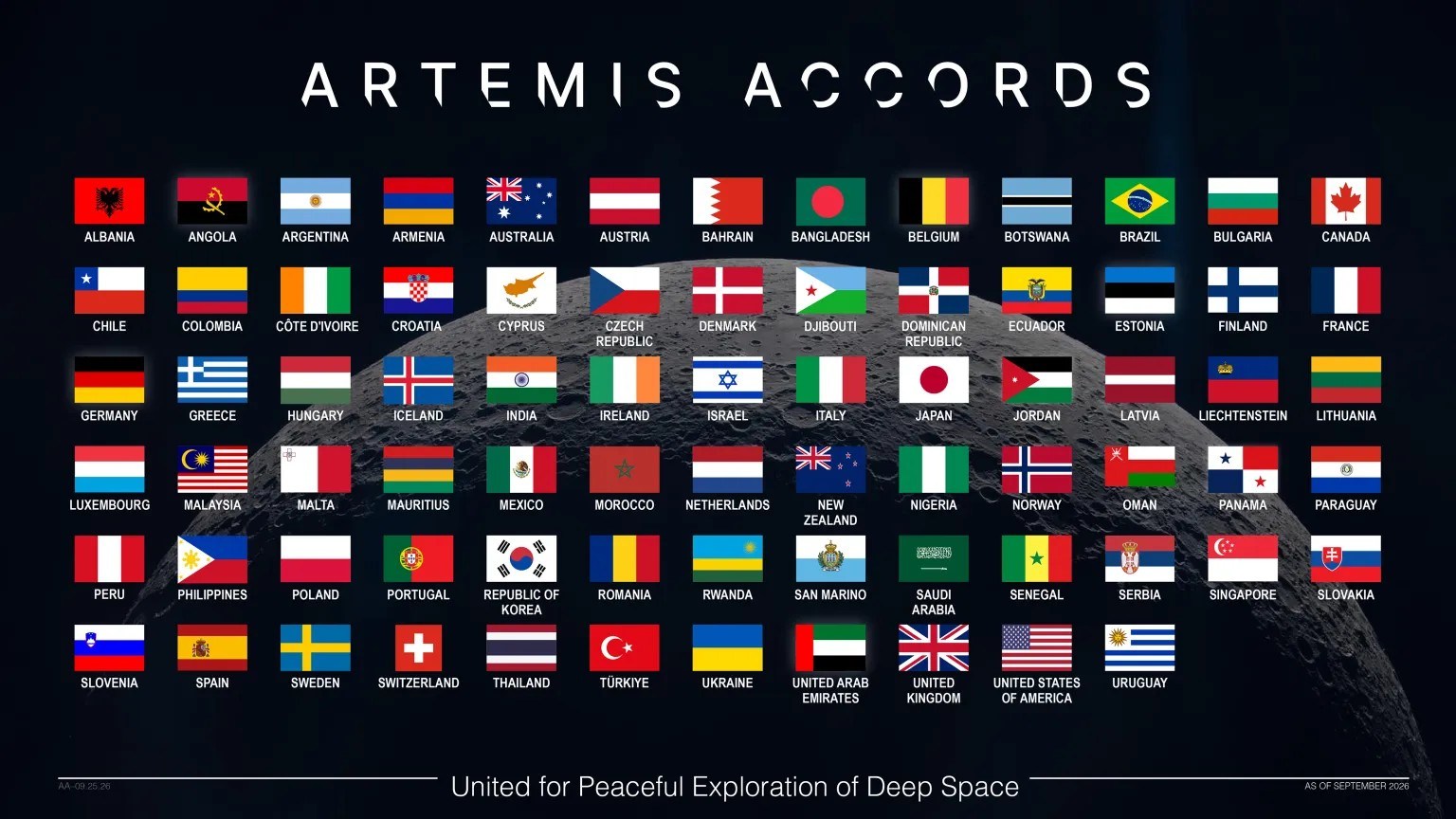
NASA says the Artemis Accords—its framework for coordinating civil space exploration—has grown again, with Albania, Croatia, Côte d’Ivoire, and San Marino becoming the newest signatories.
NASA says the Artemis Accords—its framework for coordinating civil space exploration—has grown again, with Albania, Croatia, Côte d’Ivoire, and San Marino becoming the newest signatories. Their additions raise the total to 76 participating nations, a milestone the agency is presenting as evidence of accelerating international alignment around shared rules for activity on and around the Moon.
NASA Administrator Jared Isaacman framed the expansion as part of a broader push to build a coalition committed to “peaceful” and “responsible” exploration. He noted that close to one-third of current signatories have joined since the start of President Trump’s second term, as the administration directs NASA to put Americans back on the lunar surface while preparing for future missions to Mars. The pace of new commitments, NASA said, represents one of the fastest periods of growth in international cooperation for civil space endeavors.
By NASA’s accounting, the Accords now include nearly 40% of the world’s nations. The agency also emphasized continuity with existing space law: almost two-thirds of the countries that signed the landmark 1967 Outer Space Treaty have also signed on to the Artemis Accords.
What began in 2020 as a U.S.-led initiative—launched by the United States, through NASA and the U.S. Department of State, together with seven other countries—has evolved from an informal set of partners into a more structured community. In 2024, signatories adopted a formal “Signatories Group Method of Operations,” establishing a regular cadence for coordination. Under the system, participating nations meet twice each year: once for a technical workshop and once for a Principals’ Meeting held alongside the International Astronautical Congress (IAC). Additional virtual sessions are scheduled throughout the year to support implementation.
NASA says that structure is producing practical outcomes. Countries in the group have advanced shared recommendations intended to improve safety and predictability as lunar activity increases, including guidance on noninterference between missions, interoperability of systems, sharing of scientific data, and approaches to registration practices.
Two major workshops held this year focused on tightening technical alignment across planned missions. Participants reviewed forthcoming lunar landers and orbital projects and joined hands-on sessions centered on open science and real-world tools for making lunar data easier to locate, access, and reuse. According to NASA, experts from dozens of nations worked through examples ranging from releasing lunar science datasets to adopting common standards aimed at reducing operational conflicts and interference as multiple spacecraft operate in the same environments.
The next major gathering is scheduled for the Artemis Accords Principals’ Meeting at the IAC in Antalya, Türkiye, beginning Monday, Oct. 5. NASA Deputy Administrator Matt Anderson and Major General Roberto Melgar Sheen, head of the Peruvian Space Agency (CONIDA), are set to co-chair the meeting. The agenda will include discussions on how to better support emerging space nations and how to distribute recommendations aimed at mitigating lunar debris.
NASA also pointed to ongoing efforts to translate the Accords’ principles into participation opportunities. With the creation of the Moon Base, the agency says it has invited every signatory nation to take part in the return-to-the-Moon effort through contributions such as scientific payloads, technology demonstrations, CubeSats, and other capabilities.
NASA expects additional countries to join in the months and years ahead, arguing that broader adoption of common operating principles will be key to keeping future exploration safe, coordinated, transparent, and peaceful as missions expand from the Moon toward Mars and beyond.