NASA and SpaceX plan the next ISS cargo resupply with a Dragon capsule carrying over 6,300 pounds of research, provisions and hardware, including retina, heart, glass and brain studies.
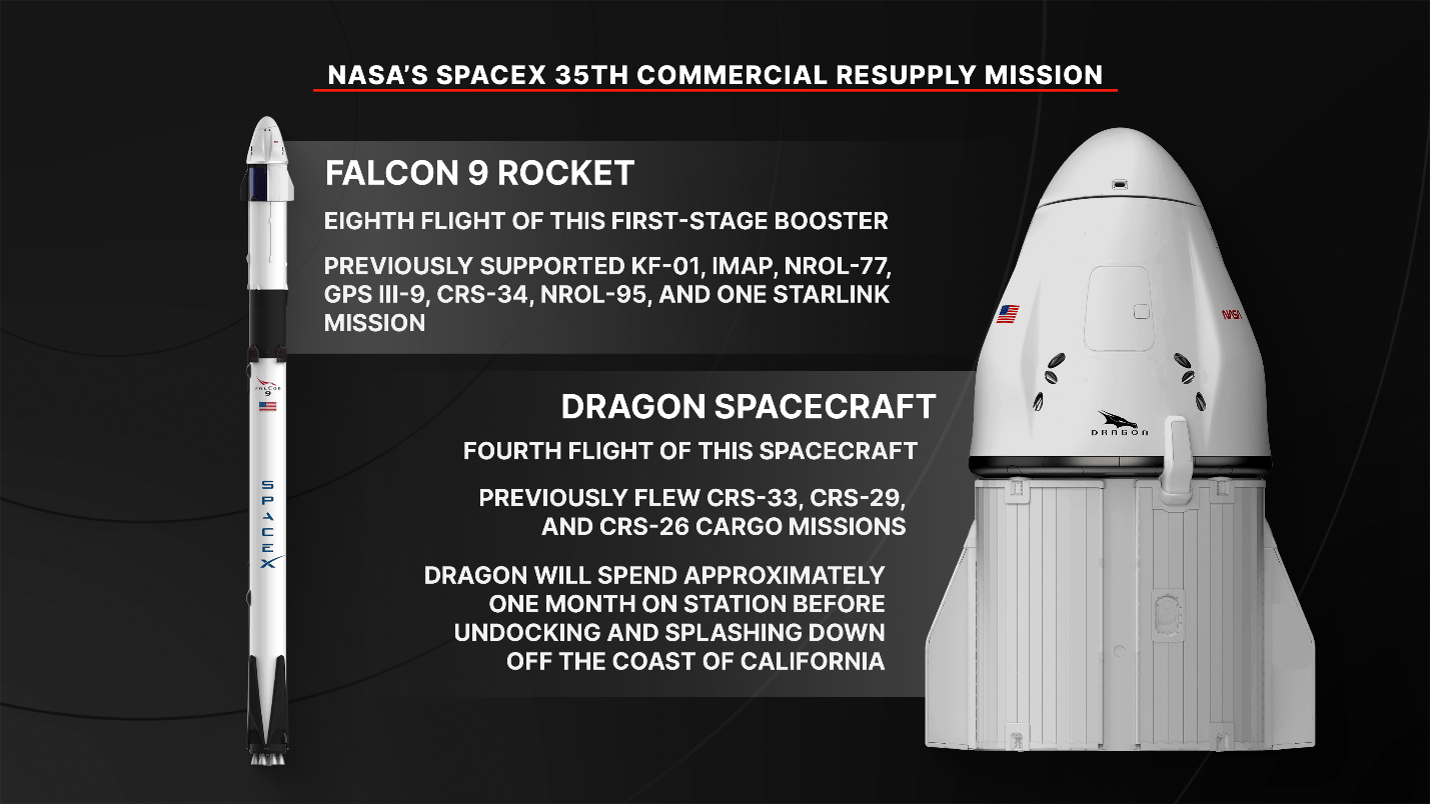
NASA and SpaceX are preparing to send the next load of research and hardware to the International Space Station, with the 35th Commercial Resupply Services mission set to launch no earlier than Tuesday, Oct. 13. The company’s Dragon cargo capsule will ride a Falcon 9 rocket from Space Launch Complex 40 at Cape Canaveral Space Force Station in Florida, carrying more than 6,300 pounds of scientific investigations, crew provisions, and station equipment.
After reaching orbit, Dragon is expected to make an automated rendezvous with the station and dock on its own to the space-facing port of the Harmony module. NASA plans to provide live launch and docking coverage across its streaming platforms.
The flight continues a logistics pipeline that has become essential to the station’s research output. Over more than 25 years of continuous operations, the International Space Station has hosted researchers from over 110 countries and supported more than 4,000 microgravity experiments. NASA says work performed in orbit not only yields practical benefits on Earth, but also helps the agency prepare for long-duration exploration—including Artemis missions to the Moon and, eventually, crewed journeys to Mars.
Alongside food and supplies for the crew, Dragon is bringing several prominent experiments.
One, called LambdaVision-1, will examine whether microgravity can improve the manufacture of artificial retinas. The approach builds a synthetic retina layer by layer; in space, reduced settling may allow thinner layers to form more evenly and remain more stable. If the process produces better-performing implants, the technology could one day aid patients with retinal diseases that currently lack effective treatment options.
Another investigation, Stellar Spheroids, focuses on how microgravity influences 3D models of human heart tissue. Researchers will track growth and function of these engineered tissues and evaluate whether the space environment supports the development of more advanced vascular networks. Improved heart-tissue models could strengthen disease research and enable larger-scale drug testing during future missions.
A materials science experiment, ELF–Unconventional Glass 2, will explore how glass forms when gravity-driven effects are minimized. Scientists will observe the behavior of molten glass in orbit, then return the solidified samples for detailed laboratory analysis on Earth. The goal is to better understand and potentially develop “unconventional” glasses with higher strength, enhanced optical performance, and greater durability—traits that could be valuable for spacecraft, habitats, and other exploration systems.
Also onboard is MINDS, a study using brain organoids to probe inflammation mechanisms associated with neurodegenerative disease. The project employs “organoid villages,” combining cells derived from multiple people to better capture patient diversity. Findings could help identify new therapeutic targets for conditions including Alzheimer’s, Parkinson’s, and multiple sclerosis.
NASA astronauts Anil Menon and Jessica Watkins will monitor Dragon’s arrival. The spacecraft is slated to remain attached to the station for about a month before returning to Earth with a Pacific Ocean splashdown, delivering research results and key hardware for ground teams.
Beyond experiments, Dragon is transporting the final pair of International Space Station Roll-Out Solar Arrays (IROSA), completing the station’s power-system augmentation needed for critical operations, including preparations that support a safe, controlled deorbit. The manifest also includes a collapsible contingency urinal demonstration and supporting hardware tied to NASA’s Artemis III mission, as well as a large foam clamshell that will fly empty on the way up so Dragon can bring home a failed Canadarm2 robotic arm joint that was replaced during a June 30 spacewalk. Additional items launching include a toilet dose pump, a toilet pretreat quality sensor, and a robot micro-conical tool used for station maintenance tasks.
When Dragon departs in mid-November, it is expected to return the failed Canadarm2 joint for analysis and refurbishment, a spacesuit for refurbishment on the ground, a fluid- and pressure-control pump assembly from the urine processor, and a filtration unit from the water processor assembly.
Why it matters
Cargo missions like this one are the ISS’s lifeline, keeping a permanent laboratory in orbit stocked with experiments and replacement parts. The research heading up targets medical therapies and advanced manufacturing techniques that could translate to Earth, while also building capabilities needed for Artemis and later Mars missions. With major hardware—including the final IROSA pair—on the manifest, the success of this flight also feeds directly into the station’s long-term operations and end-of-life planning.