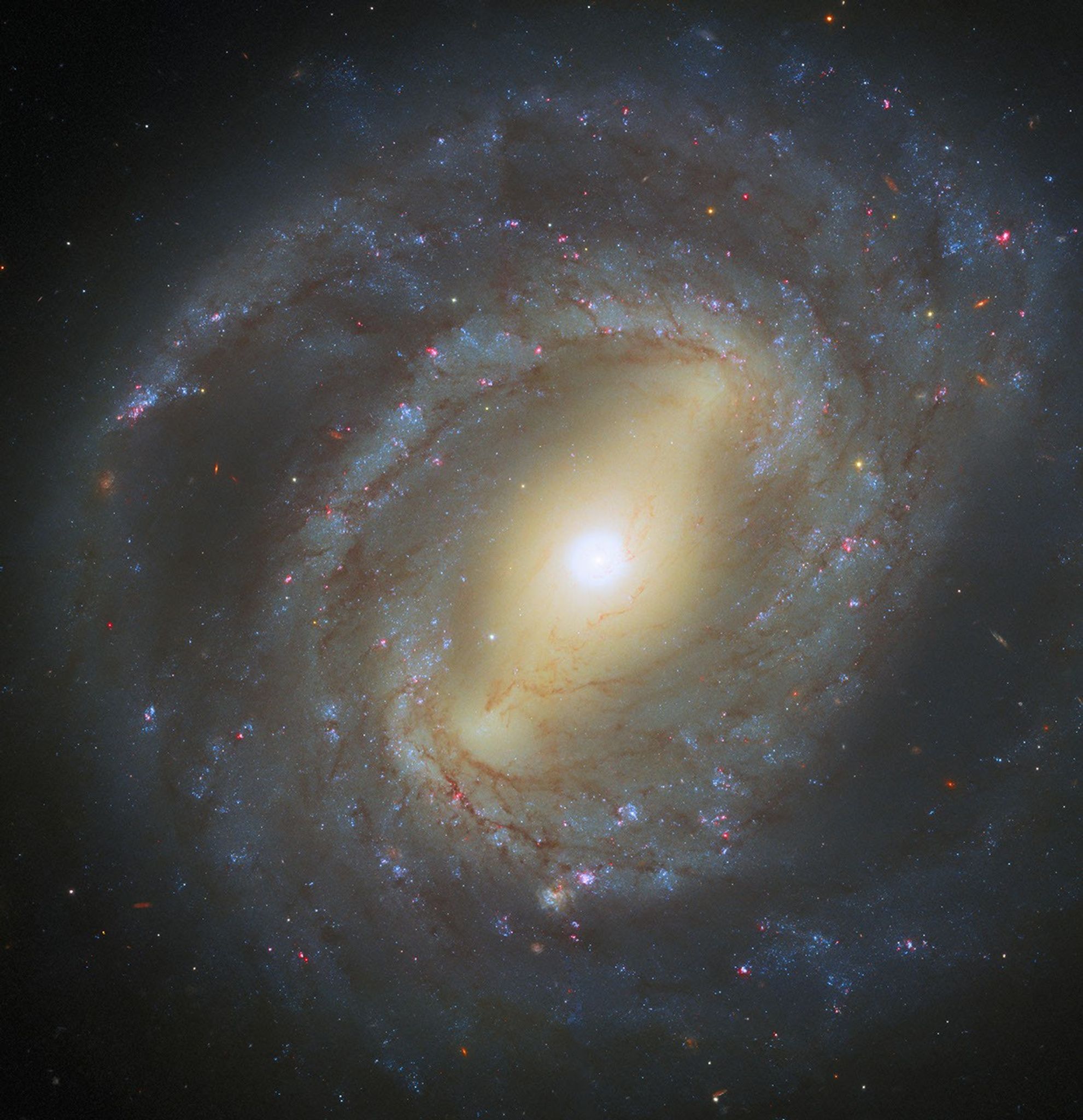
A new Hubble image highlights barred spiral galaxy NGC 4394 in the Virgo Cluster, offering a proxy view of the Milky Way. Astronomers are probing how such bars form and evolve.
A luminous barred spiral galaxy is the focus of a new image from the NASA/ESA Hubble Space Telescope. The target, NGC 4394, lies in the constellation Coma Berenices (Berenice’s Hair) and sits about 55 million light-years from Earth—close by extragalactic standards. It is also a member of the Virgo Cluster, the nearest major galaxy cluster to the Milky Way and home to more than 1,000 galaxies.
NGC 4394’s most striking feature is the straight, bright lane of stars cutting across its center: a galactic bar. Framed by sweeping spiral arms, the system offers astronomers something like a proxy view of our own Milky Way from above, a perspective we cannot obtain from inside our galaxy. In a cosmos where many structures curve and billow—shaped by cycles of stellar birth and death—the clean geometry of a bar stands out.
Bars, however, are far from rare. Astronomers estimate that roughly 65% of nearby spiral galaxies host them. Hubble has previously captured dramatic examples in galaxies such as NGC 5728, NGC 685, and NGC 613. The ongoing question is not whether bars exist, but how they arise—and why their prevalence appears to change with cosmic time.
Leading ideas link bar formation to instabilities in a galaxy’s rotating disk. A disk can be destabilized by gravitational tugs from passing galaxies, interactions among its own stars, or other dynamical effects. When that happens, stars that once followed near-circular paths can shift into elongated orbits. Collectively, those stretched trajectories build the characteristic bar-shaped structure seen in NGC 4394 and many other spirals.
Observations also suggest that barred spirals are more common today than they were several billion years ago. Yet bars may not be permanent fixtures. As a bar grows in mass, research indicates it can become unstable itself—hinting that today’s abundance of stellar bars may represent a phase rather than a final state.
Beyond its overall shape, NGC 4394 may share a more subtle trait with the Milky Way: both galaxies might contain a LINER, short for low-ionization nuclear emission-line region. LINERs are zones near galactic centers where spectra show signatures from specific ionized or neutral elements. The physical cause remains uncertain, but astronomers suspect either activity from a feeding supermassive black hole, bursts of intense star formation, or some combination of the two.
Hubble has visited this patch of sky before. A decade ago, NGC 4394 appeared in an image released from an observing program (No. 10515; principal investigator Peng) that primarily targeted its neighbor, Messier 85. While one instrument studied Messier 85’s unusual population of star clusters, Hubble’s Advanced Camera for Surveys simultaneously captured a nearby “parallel” field that included NGC 4394.
The newly released view also draws on data from a more recent effort (No. 18103; principal investigator Thilker) aimed at understanding how star formation shuts down in galaxies embedded in dense cluster environments—and how that shutdown differs from what happens in more isolated “field” galaxies. For that project, astronomers used Hubble’s Wide Field Camera 3 and its broad wavelength coverage to estimate the ages of individual star clusters. NGC 4394 was one of 40 galaxies examined with this approach.
Why it matters
NGC 4394 offers a nearby laboratory for probing how galactic bars form, evolve, and potentially dissolve—processes tied to how galaxies move gas, build stars, and reshape their centers. The new Hubble data also feed into a larger effort to understand why star formation ends in crowded environments like the Virgo Cluster. Watch for follow-up work connecting bar dynamics, central activity such as LINERs, and the broader quenching of star formation.