NASA’s Psyche spacecraft has successfully swung past Mars, using the planet’s gravity to reshape its path toward a far more unusual destination: a metal-rich asteroid in the main asteroid belt.
NASA’s Psyche spacecraft has successfully swung past Mars, using the planet’s gravity to reshape its path toward a far more unusual destination: a metal-rich asteroid in the main asteroid belt.
The flyby occurred May 15, when Psyche skimmed within 2,864 miles (4,609 kilometers) of the Martian surface. Rather than firing thrusters, the mission relied on Mars’ gravity to accomplish two key tasks for free—boosting the spacecraft’s speed and slightly tilting its trajectory. Navigation data show the maneuver delivered roughly a 1,000 mile-per-hour increase in velocity and shifted Psyche’s orbital plane by about 1 degree relative to the Sun, setting up the long cruise to the asteroid Psyche. The mission’s current timeline still targets arrival in summer 2029.
Immediately after the encounter, engineers verified the outcome by studying radio tracking from NASA’s Deep Space Network, the agency’s worldwide system of antennas used to communicate with spacecraft across the solar system. Don Han, navigation lead for Psyche at NASA’s Jet Propulsion Laboratory in Southern California, said that even with high confidence in the pre-flyby calculations, watching the Doppler tracking signals update in real time during the close pass was a standout moment—and ultimately confirmed the spacecraft was on the right trajectory.
The Mars encounter also served as an important rehearsal for operations at the asteroid. In the days leading up to closest approach, the spacecraft powered on its full instrument suite for calibration work, including its cameras, magnetometers, and gamma-ray and neutron spectrometer.
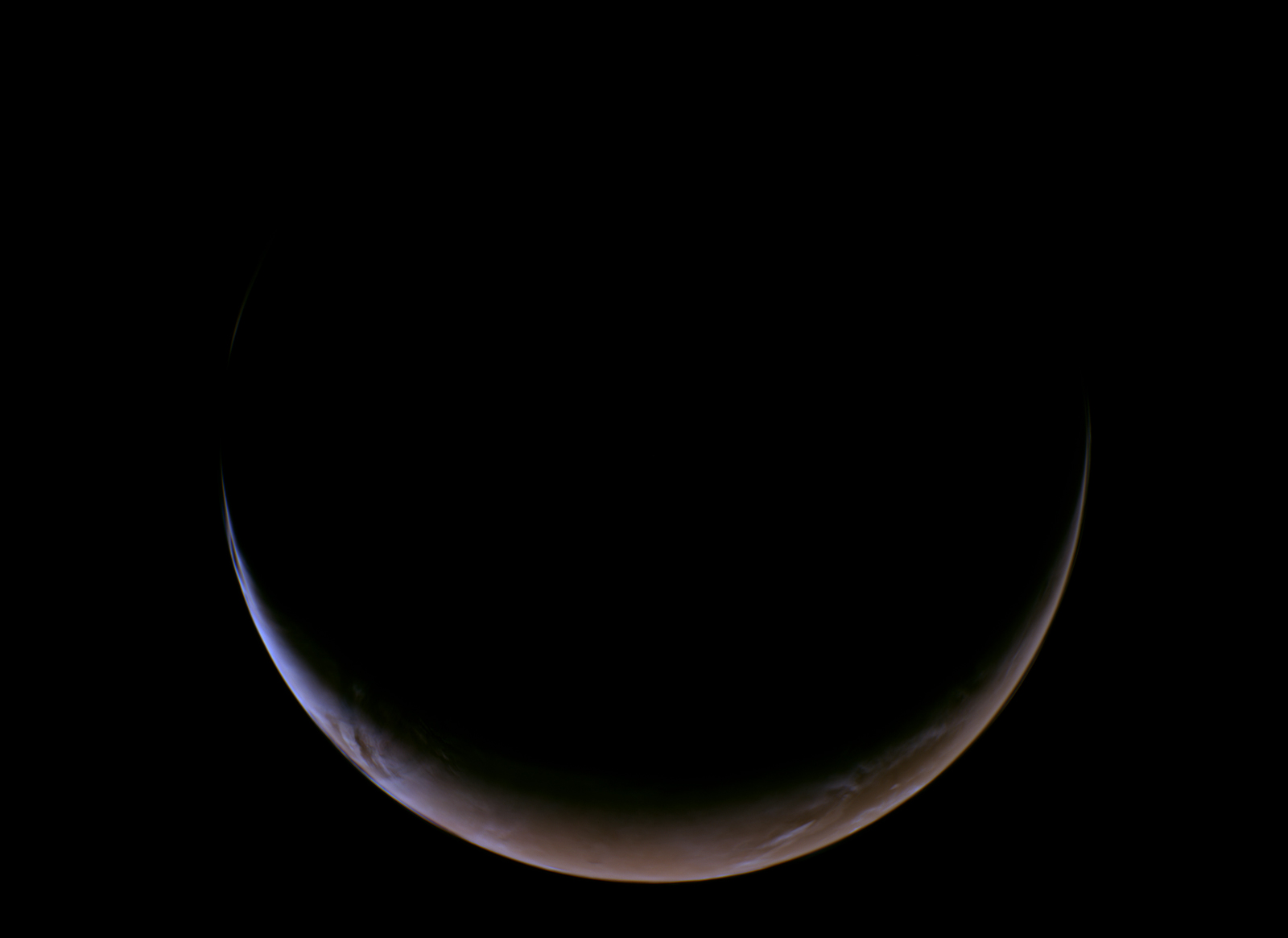
For the imaging team, Mars offered both a technical test and an unexpected view. Psyche approached the planet at a high phase angle, meaning the sunlit portion of Mars appeared as a slim crescent rather than a full disk. Multispectral images showed that the crescent looked brighter and wrapped farther around the planet than expected—an effect attributed to sunlight scattering strongly through Mars’ dusty atmosphere. Around closest approach, as Psyche crossed from the planet’s night side into daylight, the spacecraft captured rapid-fire images of the surface and atmosphere.
Jim Bell, the mission’s imager instrument lead at Arizona State University in Tempe, said the spacecraft collected thousands of pictures during approach and at closest passage. Beyond their scientific interest, the images provide a rich dataset for checking camera behavior and refining early versions of image-processing software intended for use once Psyche reaches its asteroid target. Bell added that additional calibration imaging of Mars will continue for the rest of the month as the planet recedes.
Several other Mars missions supported the flyby campaign with complementary observations and navigation information, helping Psyche’s team cross-check measurements. Those contributors included NASA’s Mars Reconnaissance Orbiter, the 2001 Mars Odyssey orbiter, and the Curiosity rover, along with the European Space Agency’s Mars Express and ExoMars Trace Gas Orbiter. Bell, who also leads the Mastcam-Z imaging investigation on NASA’s Perseverance rover, was among the participants coordinating those parallel datasets.
Psyche’s other instruments took advantage of the close pass as well. Early readings from the magnetometers may have picked up Mars’ bow shock—the boundary where the solar wind is abruptly slowed and deflected by the planet’s interaction with space plasma. Meanwhile, the gamma-ray and neutron spectrometer team began collecting calibration data, comparing their measurements against decades of existing Mars observations.
With Mars now behind it, Psyche will soon resume thrusting with its solar-electric propulsion system and continue its journey to the main asteroid belt between Mars and Jupiter. The spacecraft is expected to arrive in August 2029 and enter orbit around asteroid Psyche, which scientists suspect may be the exposed, partial core of a planetesimal—an early planetary building block. Once there, the mission plans to study the object from a sequence of circular orbits at varying altitudes.