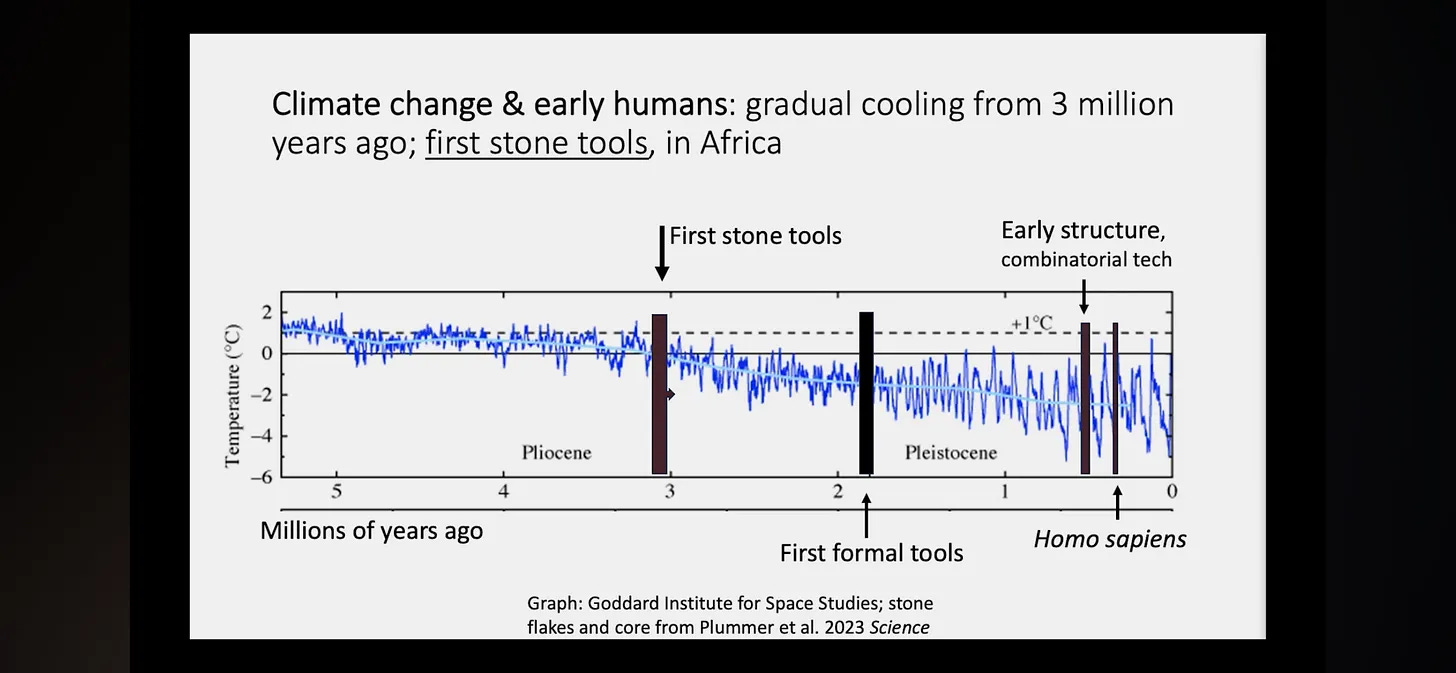
Ice-age climate swings began dominating Earth’s rhythm about 1.75 million years ago, fueling debate over whether volatility drove human evolution or merely reinforced existing hominin advantages.
Ice-age “climate vibrations” — the large, repeated swings between colder and warmer conditions — began to dominate Earth’s rhythm roughly 1.75 million years ago. Their arrival in the Pleistocene did not come out of nowhere: it followed an extended, about one–million-year cooling trend that gradually pushed the planet into a regime where massive glaciations could repeatedly advance and retreat.
That timing has become central to a debate about human origins. Archaeologist Larry Barham and collaborators argue that these intensified oscillations were not just background noise but a significant force shaping the evolutionary pathway that eventually produced Homo sapiens. The idea, often framed as a “versatility” hypothesis, holds that increasingly unstable climates favored hominins capable of flexible behavior — including the capacity to cope with changing habitats, food sources, and ecological pressures.
But the climate-driven story has prominent skeptics. Economist and historian Brad DeLong, responding to the discussion, contends that claims of humans evolving because of repeated climate shocks can blur basic evolutionary logic. Over the last two million years, he notes, the number of major glacial periods is limited — on the order of nine or so. Each transition into or out of an ice age can dramatically remodel landscapes and ecosystems, creating obvious selection pressures on animals living through them. Yet evolving traits specifically tuned to a future of frequent shocks is a much taller order, he argues: natural selection does not easily “plan ahead” for a world of regular surprises.
DeLong allows one possible route by which climate variability could matter: a single evolutionary shift toward heavier reliance on socially transmitted learning and culture might arise for other reasons, and then repeated climatic upheavals could reinforce and expand it. In that framing, climate cycles act less like the original spark and more like a mechanism that strengthens an already-present advantage. However, he cautions that this scenario depends on a contingent, “lucky” evolutionary break rather than a straightforward, general pressure that should have produced similar outcomes across many large mammals.
That comparison to other species is key to his critique. If the benefits of behavioral flexibility during major environmental disruptions apply broadly — and they do — why did no other lineage develop an equivalent trajectory toward cumulative technology? DeLong points out that some animals, such as baboons, did become more generalist in response to variable conditions, but they did not create Acheulean hand axes — the iconic stone tools associated with early humans and their relatives.
In other words, even if climate variability played a role, DeLong argues it cannot be the full explanation. It must have interacted with pre-existing biological, cognitive, or social foundations that were already “set up” in the hominin line. Under this view, climate functions more as an amplifier than an originating cause.
He also flags a deeper concern: evolutionary storytelling about social behavior can drift into speculative sociobiology if it is not anchored by testable mechanisms. One such mechanism, he suggests, is the relative speed of environmental change. Cultural adaptation can outcompete genetic adaptation when conditions shift at an intermediate pace: too slow, and genetic evolution can track the environment cheaply through instinct; too fast, and inherited cultural knowledge becomes obsolete.
The glacial cycles that define the late Pleistocene occurred roughly every 41,000 years, shifting to about 100,000-year pacing after roughly one million years ago. With hominin generation times around 20–25 years, DeLong argues, the crucial question is empirical: do those cycle lengths fall into the “intermediate” zone where culture would be strongly favored over genes?
Why it matters
How much ice-age instability shaped human flexibility bears directly on why our lineage developed cumulative culture and technology while others did not. If climate was an amplifier rather than the root cause, researchers must identify the earlier traits that made hominins uniquely responsive to environmental swings. The next step is turning broad narratives into measurable tests — including whether the tempo of glacial cycles matches the conditions under which cultural evolution should dominate genetic change.