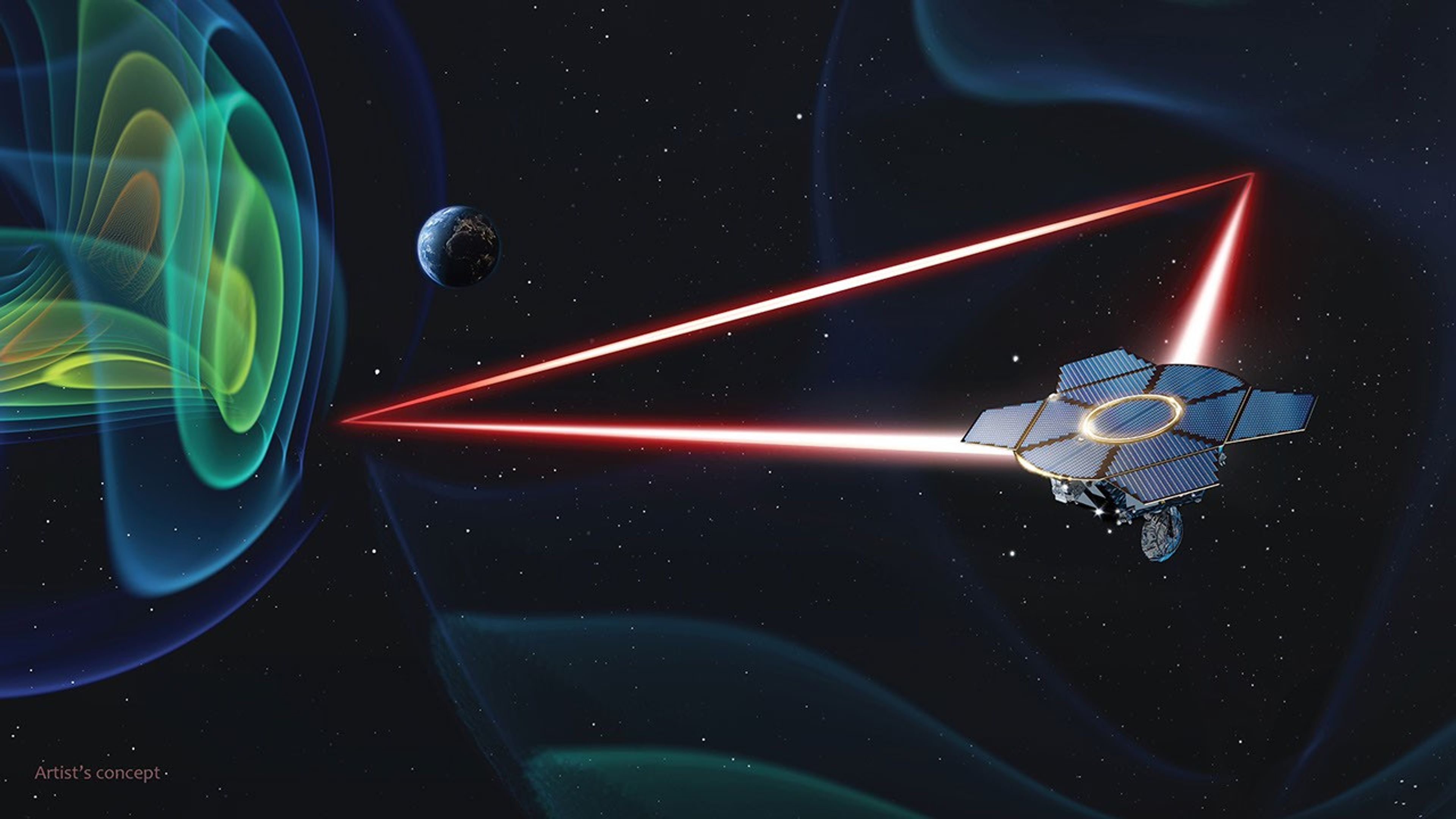
NASA has tapped L3Harris to build an engineering test unit telescope for ESA-led LISA, a space observatory that will use lasers to detect low-frequency gravitational waves.
NASA is moving closer to delivering a key piece of hardware for the Laser Interferometer Space Antenna (LISA), a planned space-based observatory that will listen for gravitational waves—subtle distortions in space-time generated by some of the universe’s most violent events. The agency has selected L3Harris Technologies to design, build, and integrate a new “Engineering Test Unit” telescope, a major milestone that bridges earlier prototypes and the eventual production of flight-ready instruments.
LISA, led by the European Space Agency, is targeted for launch in the mid-2030s. NASA is one of the mission’s core partners, providing the telescopes along with other essential components and scientific and engineering support as part of a broader effort to deepen understanding of how the universe operates.
The mission’s architecture is ambitious: three spacecraft will fly in an Earth-trailing orbit, spaced to form a giant triangle with sides about 1.6 million miles (2.5 million kilometers) long. Each satellite will carry two telescopes. Using infrared lasers, the instruments will send and receive beams between neighboring spacecraft, allowing the constellation to track extraordinarily small changes in separation—signals that can betray the passage of a gravitational wave.
According to Ira Thorpe, NASA’s project scientist for LISA at the agency’s Goddard Space Flight Center in Greenbelt, Maryland, those distance shifts are far smaller than the width of a helium atom. Yet measuring them should open access to a “sea” of low-frequency gravitational waves that ground-based detectors cannot reach. With that new window, LISA is expected to observe collisions involving supermassive black holes from billions of light-years away, survey compact binaries in the Milky Way—such as paired white dwarfs, neutron stars, and stellar-mass black holes—and potentially provide fresh clues about gravity itself.
The telescope design is notable for its material choice. Each unit is to be made entirely from Zerodur, an amber-toned ceramic-glass composite favored in precision optics because it maintains its shape across large temperature swings—an essential property for an instrument that must hold alignment while operating in space.
This latest Engineering Test Unit builds directly on earlier hardware. In 2024, L3Harris delivered a prototype telescope to NASA that served as an engineering development model. “We’ve put the prototype through rigorous testing, and we’re bringing everything we’ve learned into this new telescope,” said Ritva Keski-Kuha, who leads NASA Goddard’s LISA Telescope program. She added that the new instrument will be NASA’s final pre-flight unit and the agency’s first optical telescope delivery to ESA. Complementing that effort, the team delivered a separate structural model in June—a version built from metal rather than glass—to validate mechanical and integration aspects.
Gravitational waves were first anticipated in 1916 as part of Albert Einstein’s general theory of relativity and were directly detected for the first time in 2015 by ground-based observatories. Produced when massive objects accelerate—such as orbiting stars—they propagate at light speed and pass through matter largely unimpeded, making them powerful probes of otherwise hidden cosmic processes.
LISA’s measurement approach also hinges on “proof masses”: inside each spacecraft will be a free-floating gold-platinum cube. The spacecraft will effectively fly around this cube, controlling the local environment so the mass follows a path governed only by gravity. ESA’s LISA Pathfinder mission demonstrated in 2016 that non-gravitational disturbances on these proof masses can be suppressed to the levels required for gravitational-wave science.
Beyond the telescopes, NASA’s planned contributions include the laser system, tools to neutralize electric charge that can accumulate on the proof masses, data-analysis efforts to separate and interpret overlapping gravitational-wave signals, and additional technical expertise. Goddard engineers have also delivered a first prototype laser for the ESA-led initiative.
Why it matters
LISA is poised to extend gravitational-wave astronomy into a frequency range inaccessible from Earth, enabling observations of supermassive black-hole mergers and dense stellar binaries across the cosmos. The telescope work now underway is a practical step toward flight hardware, helping reduce technical risk ahead of the mid-2030s launch window. The coming years will show whether key subsystems—optics, lasers, and proof-mass control—can meet the mission’s extreme precision demands at full scale.