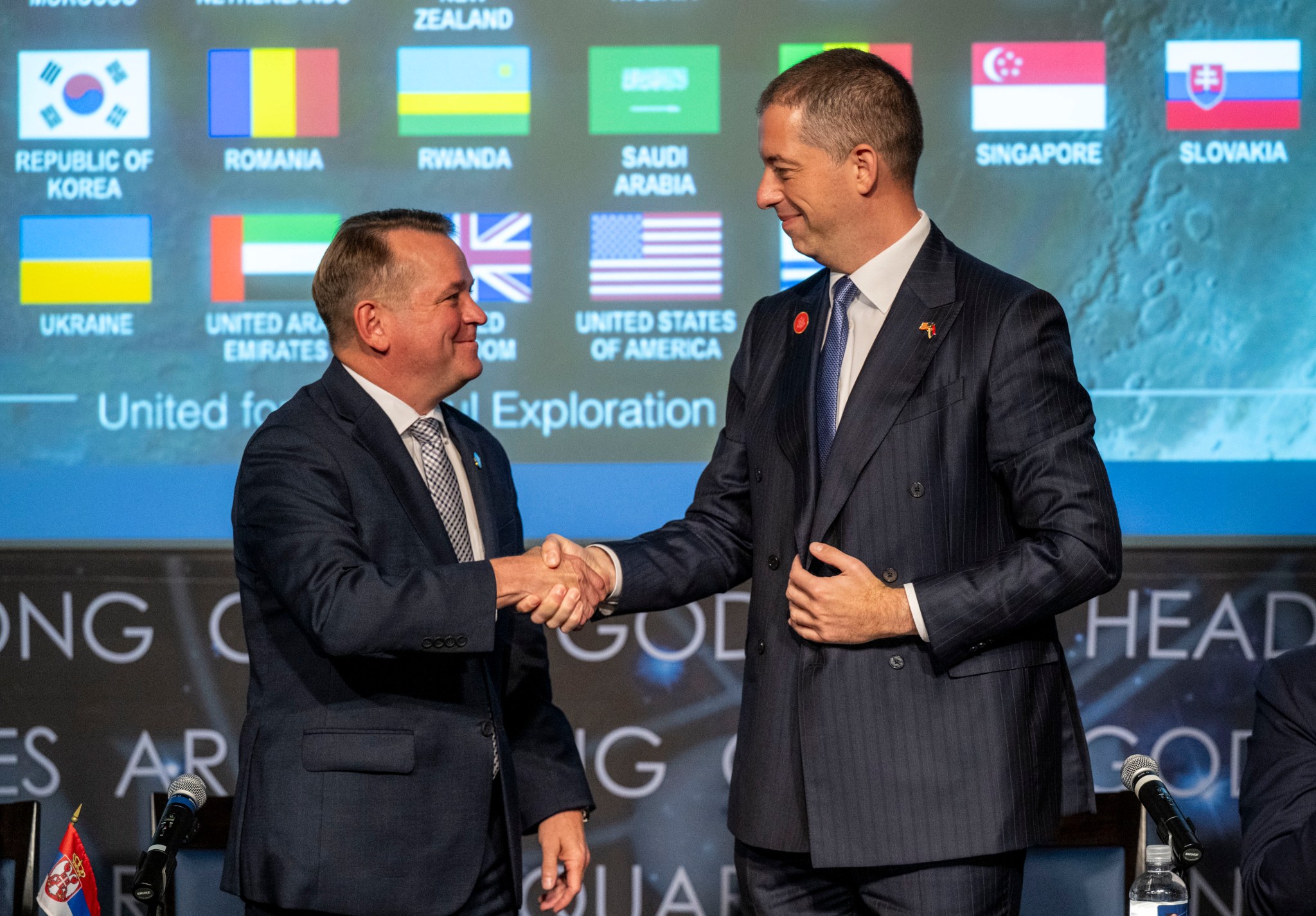
Serbia has become the newest nation to endorse the Artemis Accords, signing the U.S.-led framework for cooperation in space during a ceremony Thursday at NASA Headquarters in Washington, D.C.
Serbia has become the newest nation to endorse the Artemis Accords, signing the U.S.-led framework for cooperation in space during a ceremony Thursday at NASA Headquarters in Washington, D.C. The move makes Serbia the 69th country to join the growing group of governments that say they are committed to conducting space exploration in a peaceful, transparent, and responsible manner.
NASA Deputy Administrator Matt Anderson marked the moment by highlighting a long-running link between Serbia and America’s human spaceflight efforts—one that stretches back to the Apollo era. Anderson noted that Serbian engineers contributed to some of NASA’s most consequential achievements during that period, pointing in particular to Milojko “Mike” Vučelić, who received the Presidential Medal of Freedom for his critical role in helping return the Apollo 13 astronauts safely to Earth after the mission’s near-disastrous failure.
Beyond Vučelić’s individual recognition, NASA emphasized that Serbian American engineers were involved across a broad range of Apollo program work, including systems engineering, propulsion, power systems, spacecraft docking, electronics reliability, and mission coordination. Their technical contributions supported essential capabilities from analyzing lunar landing conditions to ensuring spacecraft could dock safely—tasks central to the success and safety of the missions.
Serbia’s Foreign Minister Marko Đurić signed the Accords on behalf of the country. In remarks at the event, Đurić invoked the enduring cultural pull of space exploration and tied Serbia’s participation to a national tradition of scientific accomplishment, citing figures such as Nikola Tesla and Milutin Milanković. He also referenced David Vujic—an Apollo-era pioneer—and the “Serbian Seven,” a group of Serbian engineers and technicians whose work at NASA helped enable the Moon landing. Đurić framed Serbia’s decision as both a tribute to earlier generations and a commitment to future ones, urging continued pursuit of new frontiers in exploration and inspiration.
NASA says the Accords are designed not only as a statement of shared values, but also as a practical pathway for collaboration. By signing, countries position themselves for potential roles in upcoming Artemis-related activities, including contributions of science and technology payloads for a U.S.-led lunar outpost—described by NASA as a Moon Base—as well as CubeSats and other elements that could fly on future Artemis missions as humanity returns to the lunar surface.
Several officials attended the signing ceremony, including Serbia’s ambassador to the United States, Dragan Šutanovac; Marija Gnjatović, state secretary in Serbia’s Ministry of Science, Technological Development and Innovation; and Wesley Brooks, the U.S. Department of State’s assistant secretary for Oceans and International Environmental and Scientific Affairs.
The Artemis Accords were established in 2020 through a partnership between NASA and the U.S. Department of State alongside seven founding nations, amid intensifying interest in lunar activity from both governments and private industry. The Accords introduced what NASA described as the first set of practical principles aimed at improving safety and coordination for exploration of the Moon, Mars, and beyond.
NASA also linked the Accords to U.S. policy direction that, five years later, called for the agency to build a sustained lunar outpost. With the planned Moon Base, NASA says it intends to apply the Accords’ principles in practice, inviting all signatory nations to participate. The agency expects additional countries to join in the coming months and years as it advances its vision of a safe, peaceful, and prosperous future in space.