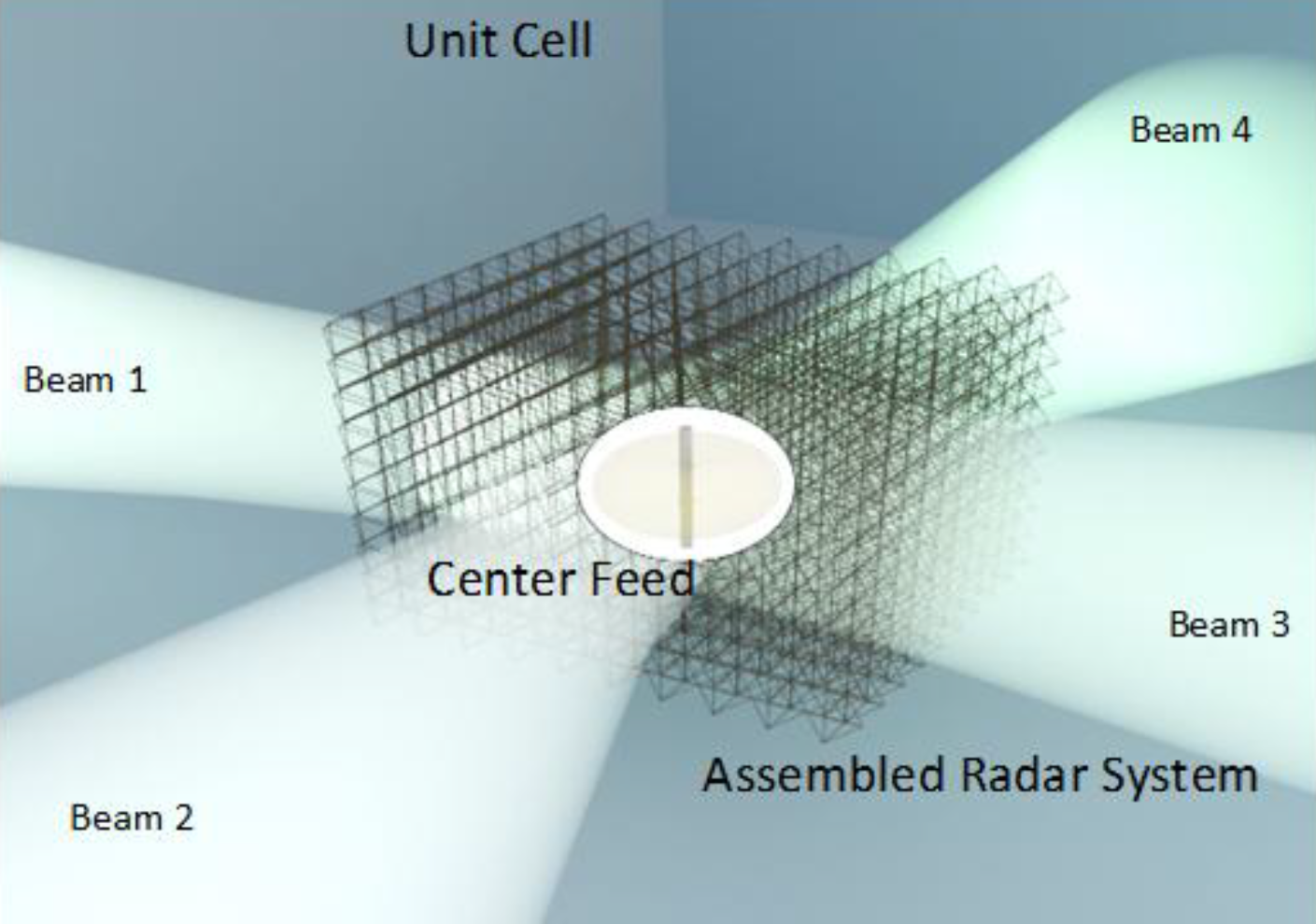
As Earth’s orbits grow more crowded with satellites and spacecraft, the need to reliably track and characterize objects in space—known as space situational awareness SSA —is becoming more urgent.
As Earth’s orbits grow more crowded with satellites and spacecraft, the need to reliably track and characterize objects in space—known as space situational awareness (SSA)—is becoming more urgent. Existing systems can already deliver impressive performance. The U.S. Space Surveillance Network, for instance, can detect objects roughly four inches across, aided by upgrades such as the Space Fence. But that capability comes with a major constraint: achieving it depends on enormous ground-based radar installations, including arrays that reach kilometer scales, and those systems are best suited to monitoring targets in low Earth orbit (LEO).
The difficulty intensifies beyond LEO. As interest expands toward cislunar space—the vast region between Earth and the Moon—the distances involved make traditional ground-based approaches increasingly impractical. This is not merely an engineering inconvenience; it is rooted in the physics of coherent radar. For a given level of detection performance, the size of the radar aperture must increase in direct proportion to the distance to the target. Push the sensing range outward, and array dimensions quickly become unwieldy. In that context, it can be more practical to reduce the distance between sensor and target than to keep enlarging ground arrays—an argument that points toward shifting SSA capabilities into space.
Space-based radar platforms bring clear advantages because they can operate closer to the region of interest. Yet cislunar monitoring still demands very large apertures to provide adequate sensitivity and resolution. That requirement collides with a key limitation of today’s deployable space structures: reliably deploying antennas much larger than about 100 meters remains difficult. Modern membrane, mesh, and inflatable antennas are typically designed to fit entirely inside a single launch fairing, effectively capping their size and complexity.
A proposed approach seeks to bypass those constraints by building the antenna in space rather than deploying it in one piece. The concept pairs two technologies: robotic in-space assembly of mechanically stable structures, and reconfigurable volumetric electromagnetic metamaterials. Robotic assembly offers a way to construct large, precise, modular structures without being limited by launch vehicle volume. Metamaterials—engineered arrangements of repeating electromagnetic “unit cells”—provide a compatible platform for tailoring antenna behavior, including advanced beam control, across large apertures.
Both the mechanical structure and the electromagnetic design rely on a unit-cell-driven modular philosophy. In principle, repeating elements can be scaled to produce antenna platforms that remain robust both structurally and electromagnetically while growing to sizes that would be impractical to launch in one piece. A key payoff is operational: such volumetric antenna systems could steer beams across wide fields of view without relying on slow mechanical pointing of the entire antenna.
The planned work aims to demonstrate the feasibility and scalability of a reconfigurable volumetric metamaterial operating in S-band, focusing on beam-steering performance. It includes developing metamaterial design methods capable of omnidirectional beam forming and producing early designs for a reconfigurable unit cell compatible with robotic assembly. The overall metamaterial design strategy will build on a numerically efficient dipole model that has already been validated at smaller scales, while detailed element design will use established full-wave electromagnetic simulations.
System concepts will also incorporate realistic assembly constraints informed by the Automated Reconfigurable Mission Adaptive Digital Assembly Systems (ARMADAS) project, which has demonstrated robotic assembly methods. Although the immediate motivation is SSA, the same large-aperture challenge appears across space missions, from low-frequency radiometry for Earth observation to deep-space communications. Because resolution and sensitivity improve as apertures grow, scalable antenna architectures that reduce cost, size, weight, and power demands could offer broad benefits across NASA programs.