Over the last week on Mars, NASA’s Curiosity rover delivered a reminder that “ingenuity” and “perseverance” are not just the names of newer Mars 2020 vehicles—they’re…
Over the last week on Mars, NASA’s Curiosity rover delivered a reminder that “ingenuity” and “perseverance” are not just the names of newer Mars 2020 vehicles—they’re also essential traits for keeping an aging rover productive on a rugged landscape.
The week’s work began with an engineering challenge that could have sidelined key science operations: Curiosity’s drill needed to be freed from a target rock dubbed “Atacama.” Engineers and scientists choreographed a precise sequence of arm movements—twisting, bending, and rotating with a slab of rock still attached—to coax the drill loose. A time-lapse captured the careful, step-by-step “dance” of the robotic arm that ultimately resolved the issue.
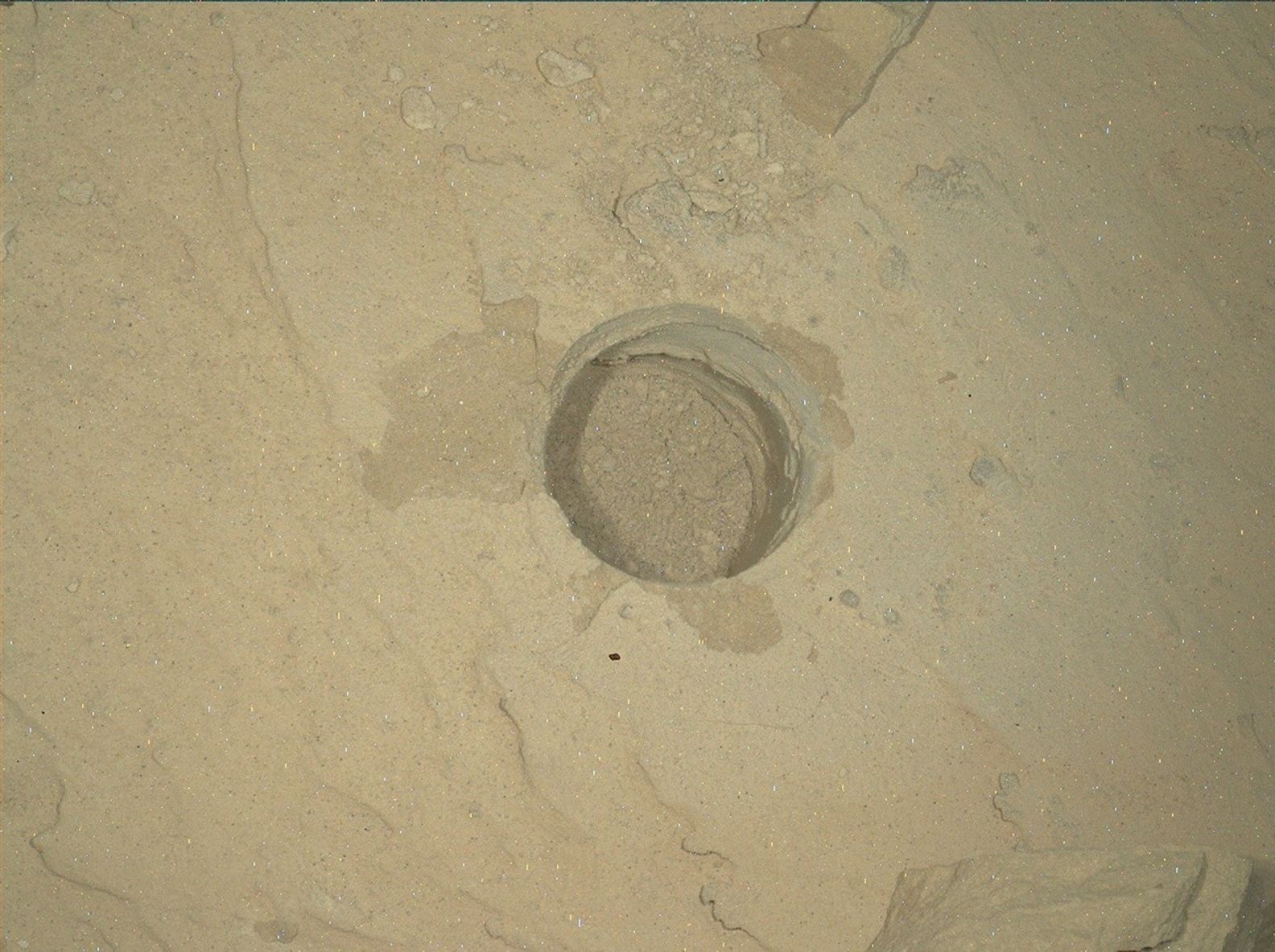
Once the drill was liberated, the team moved quickly to document the hardware and the disturbed worksite. Mastcam and ChemCam’s Remote Micro-Imager photographed the drill assembly, while the Mars Hand Lens Imager (MAHLI) took close-up views into the now-empty drill hole. The incident also created an unexpected scientific opportunity: when the Atacama slab fell back, it exposed fresh fracture surfaces and revealed sand that had been sheltered beneath the rock.
Curiosity’s instruments capitalized on these newly uncovered materials. ChemCam fired its laser in two LIBS (Laser-Induced Breakdown Spectroscopy) raster patterns on a clean break face at targets named “Tamarugal” and “Tamarugo,” then performed another LIBS raster on a light-toned patch of bedrock that had been hidden under Atacama at “Colchane.” Nearby, MAHLI and the Alpha Particle X-ray Spectrometer (APXS) examined sand at “Yerba Loca,” sampling material close to Colchane to help characterize local sediments.
The rover also kept its eyes on the broader terrain. Mastcam and ChemCam gathered images of large buttes rising above the current and planned driving routes. Mastcam documented polygonal fracture patterns at “Cerro Elefantes” and “Azul Pampa,” and conducted a change-detection survey to look for wind-driven movement in sandy areas at “Playa los Metales.” ChemCam added a passive spectroscopy observation of light-toned features on the “Paniri” butte, and investigated a potential meteorite with a LIBS raster at “Isla Mocha.”
While engineering evaluations continued, Curiosity drove uphill toward a scientifically valuable boundary where two distinct rock types meet—a contact that can signal shifting formation environments, a gap in the geological record, or both. The rover’s close-up and chemical tools—MAHLI, APXS, and ChemCam—worked in tandem on the lighter-toned, layered “Toro” target and the darker, flaky “Inca de Oro” target. Mastcam supported the study with multiple mosaics designed to capture the structures and transitions along the contact zone.
Throughout the week, Curiosity maintained steady monitoring of Martian conditions. The REMS weather station, RAD radiation instrument, and DAN subsurface probe continued regular measurements around the rover, while Navcam and Mastcam watched for clouds, dust devils, and atmospheric dust.
With engineers confirming the drill and arm were healthy, Curiosity pressed on toward a new workspace featuring a larger rock block—an inviting candidate for the rover’s next drilling attempt. Despite the setbacks and the careful recovery, operations continued with the same steady momentum that has defined Curiosity’s long mission across Mars.