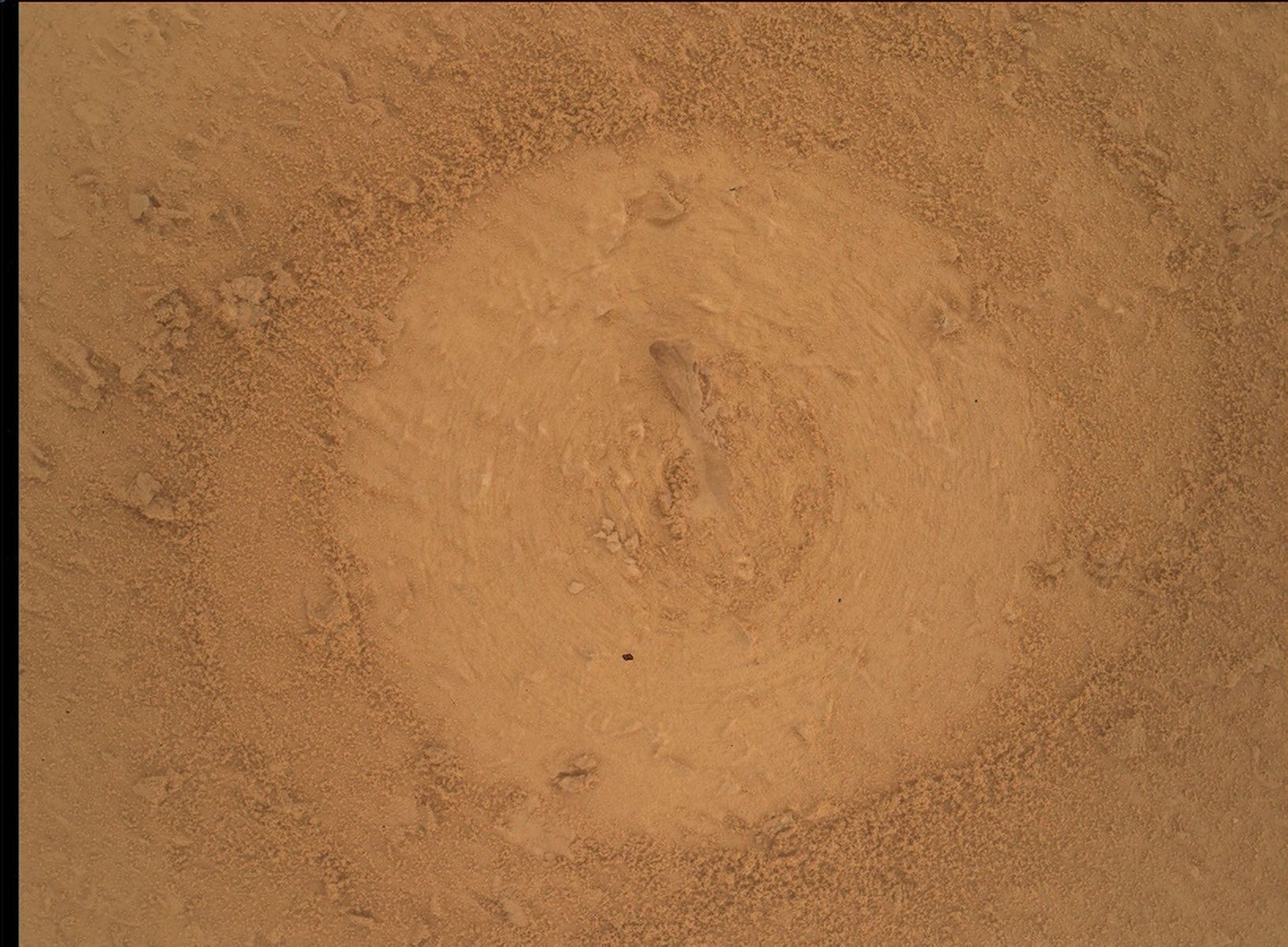
NASA’s Curiosity rover has entered the Cache Creek region on Mount Sharp and drilled its 48th rock sample, as scientists await mineral results to probe ancient lake chemistry.
Long before NASA’s Curiosity rover touched down in Gale crater, mission planners mapped the landing region into a grid of rectangular “quads” and assigned each one a name. The convention draws from small towns linked to notable geology on Earth. Within each quad, individual science targets—bedrock patches, boulders, soils, and mesas—receive informal names that match the quad’s theme.
Curiosity has now traveled well beyond those pre-landing map squares. Over roughly 14 years on Mars, the rover has logged about 38 kilometers (24.6 miles) of driving and climbed more than 1 kilometer (0.6 miles) in elevation as it makes its slow ascent of Mount Sharp, the layered mountain rising from Gale crater’s center.
In the latest stretch of operations (sols 5022–5028), the rover entered a newly defined region called the Cache Creek quad. The name is borrowed from an area in British Columbia, Canada, known for an unusual mix of rock types and deposits: exposures of oceanic crust, marine sediments, volcanic rocks, and glacial materials all occur there. The Canadian Cache Creek area also includes lakes with distinctive chemistry—an Earth analog researchers use to think about ancient Martian lakes and the processes that may have shaped them. Historically, it sits near the southern end of the 1860s Gold Rush Trail, when prospectors streamed through in hopes of striking it rich.
On Mars, Curiosity’s “paydirt” is mineralogical evidence. This week the rover successfully drilled into its 48th rock target in Gale crater, a site dubbed “Basque Lakes” within the Cache Creek quad. The team is now awaiting results from CheMin, the rover’s X-ray diffraction instrument, which can identify and quantify minerals in powdered rock. Those findings—scheduled for analysis during the weekend plan—could illuminate how the Basque Lakes outcrop formed and how it was later altered, including whether its mineral suite resembles materials associated with chemically unusual lakes on Earth.
The decision to drill was supported by a rapid set of close-up investigations. Contact science included placing the APXS instrument directly against the target to measure elemental chemistry, while the MAHLI camera was positioned within about 1 centimeter (0.4 inches) to capture fine-scale textures. ChemCam added remote compositional information by firing its laser at the prospective drill site. MAHLI also documented the target after engineers performed a pre-load test to confirm the rock’s stability for drilling.
Even with major power limitations tied to drilling and laboratory work—and with an aging rover—the team scheduled additional science. Mastcam recorded the broader setting around the new drill site to provide geologic context. ChemCam analyzed a nearby bedrock target called “Peace River,” and used both imaging and passive spectroscopy to examine the fresh drill hole and the surrounding tailings. The instrument also collected remote images of an intriguing, chaotic-looking pile of blocks at the base of a nearby butte named “Cordillera.” Meanwhile, Navcam and Mastcam continued routine monitoring of Gale crater’s atmospheric and environmental conditions.
Work on the Basque Lakes sample is expected to continue next week as Curiosity delivers material to SAM, the rover’s chemistry lab, for further analysis. The rover will likely remain at this location for about another week before discarding the sample and driving on to continue its exploration of Mount Sharp and Gale crater.
Why it matters
Each new drilled sample helps scientists reconstruct Mars’ environmental history—especially the role of water in altering rocks and creating potentially habitable settings. CheMin and SAM results from Basque Lakes could refine the timeline and chemistry of ancient lake or groundwater activity in Gale crater. The next key milestone is whether mineral detections point to prolonged water-rock interaction or more fleeting, localized alteration.