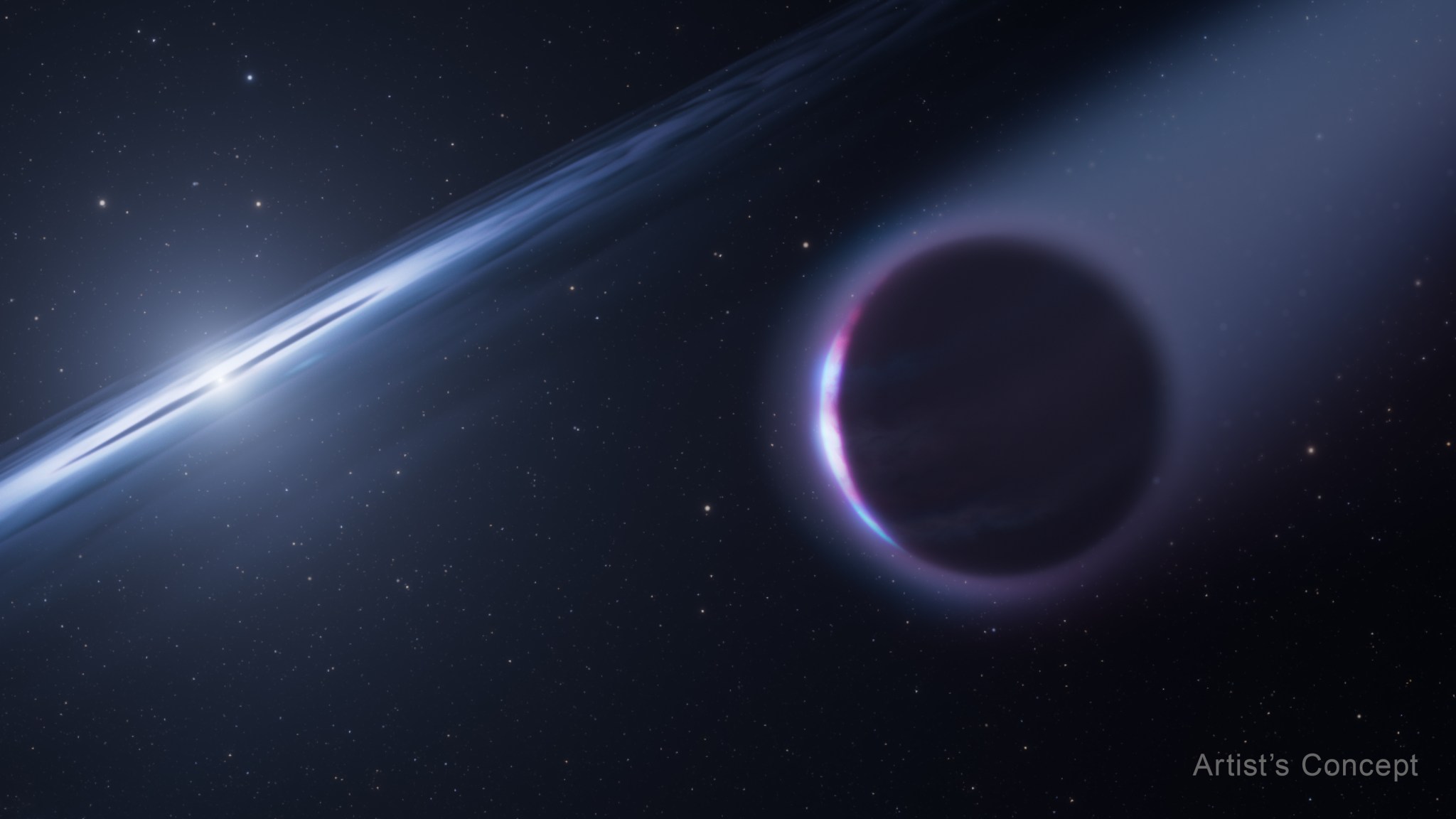
Hubble data reveal an unexpected chemical signature around white dwarf HS 0209+0832, hinting a planet may have formed later from the star’s cast-off debris.
Astronomers piecing together observations from NASA’s Hubble Space Telescope say they have found an unexpected chemical signature around the white dwarf star HS 0209+0832—evidence that points to an unusual possibility: a planet that formed after the star died.
The research hinges on what the team describes as a striking chemical clue detected in material associated with HS 0209+0832. Rather than matching what scientists typically expect from planets that coalesce alongside a young star, the chemistry appears inconsistent with a conventional, “first-generation” world. Instead, it suggests that any planet present could be a “second-generation” object—one assembled later, from the remnants the star itself shed.
HS 0209+0832 is a white dwarf, the compact stellar core left behind when a Sun-like star exhausts its nuclear fuel. After burning through its internal reserves, such a star can no longer sustain the fusion reactions that once supported it against gravity. In its final stages, it loses its outer layers—expelling a surrounding envelope of gas and dust into space—while the dense, hot core remains.
In the scenario proposed for HS 0209+0832, that expelled material did not simply disperse. Over time, the cast-off gas and dust may have collected into a disk capable of forming new planetary bodies. If a planet emerged from this recycled debris, it would not share the same chemical “starting ingredients” as planets that formed at the same time as their star. That difference is central to the team’s interpretation: the unusual chemical makeup serves as a forensic marker, pointing to a world that formed from stellar leftovers rather than the primordial building blocks of a newborn system.
NASA released an artist’s concept on Oct. 5, 2026, illustrating this possible explanation. The image portrays HS 0209+0832 as the dead stellar core it is, and visualizes the idea that a later-forming planet could arise from the material the star lost during its transformation into a white dwarf.
While the case is framed as a kind of astronomical detective story, the implication is straightforward: the chemical evidence, derived from Hubble data, may be best explained if HS 0209+0832 hosts a second-generation planet—an object forged not in the system’s youth, but in its aftermath.
Why it matters
If confirmed, a second-generation planet around HS 0209+0832 would show that planet formation can restart after a star’s demise, using recycled material rather than the original protoplanetary disk. That would broaden where—and when—astronomers should look for planets, including around white dwarfs once thought to be largely barren. The next step will be testing whether additional observations support the proposed chemistry-driven interpretation and whether similar signatures appear around other stellar remnants.