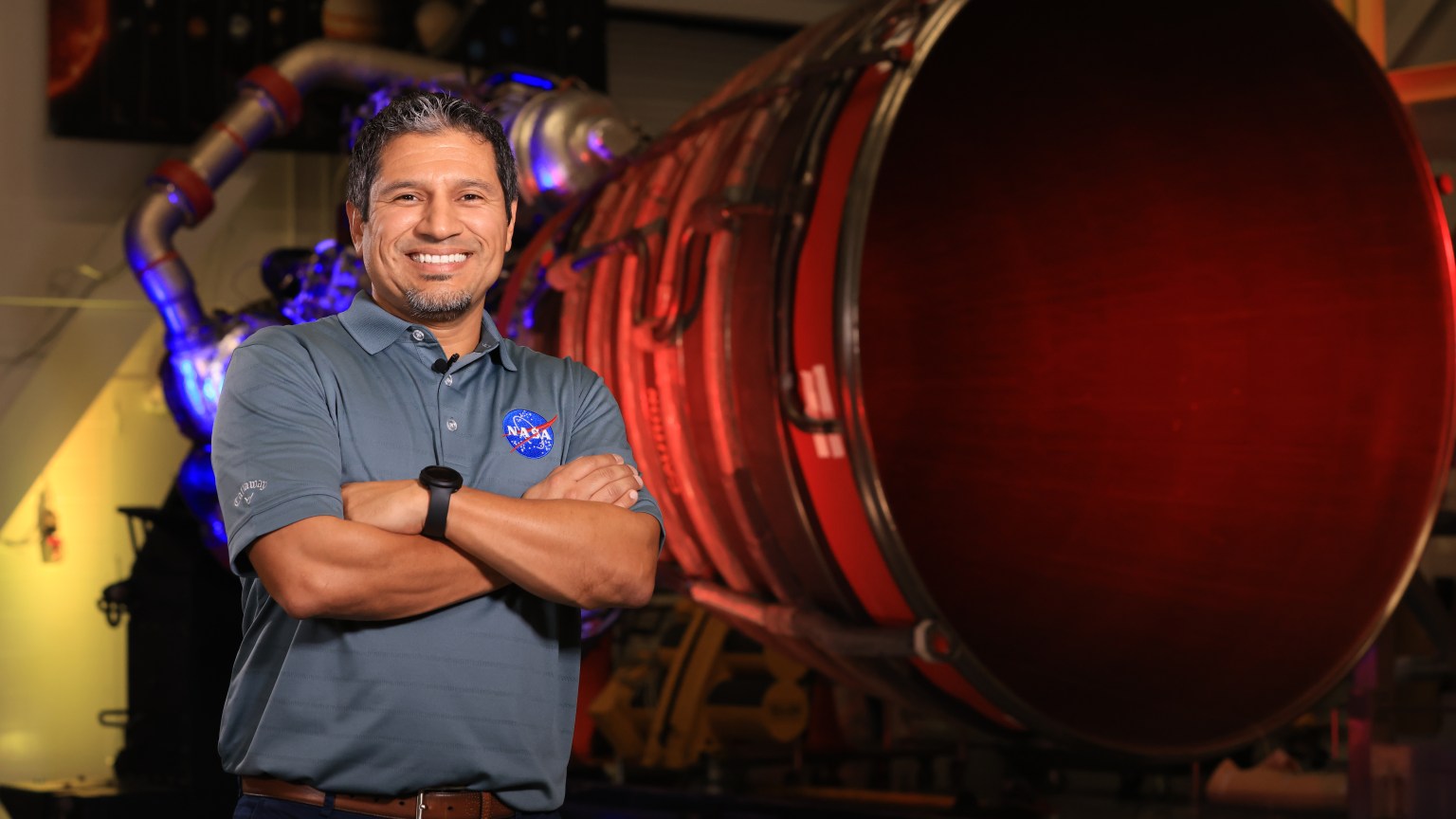
Elkin Norena has spent his career at the point where NASA’s biggest ambitions meet the unforgiving reality of launch day.
Elkin Norena has spent his career at the point where NASA’s biggest ambitions meet the unforgiving reality of launch day. Over more than a decade of spaceflight work, he helped send more than a dozen space shuttle crews into low Earth orbit on missions that shaped modern human spaceflight—assembling major elements of the International Space Station, completing the shuttle era’s final servicing visit to the Hubble Space Telescope, and supporting research that produced benefits back on Earth.
Now Norena is applying that experience to NASA’s return-to-the-Moon campaign. He serves as the manager of the Resident Management Office for the Space Launch System (SLS) at NASA’s Kennedy Space Center in Florida. In that role, he provides on-the-ground support for the Exploration Ground Systems team, the group responsible for the detailed work of preparing, stacking, testing, and ultimately launching the SLS rocket and the Orion spacecraft. Norena also functions as the “eyes and ears” of the SLS Program at Kennedy, maintaining a direct line of communication back to the program’s management at NASA’s Marshall Space Flight Center in Huntsville, Alabama.
His current focus is helping ready America’s heavy-lift rocket and Orion for Artemis II, the first crewed mission in NASA’s Artemis program. Artemis II is planned to carry an international quartet of astronauts on a flight that will loop around the Moon and return safely to Earth, a key step toward later missions intended to place astronauts on the lunar surface.
For Norena, the assignment is the continuation of a lifelong goal born far from Florida’s Space Coast. As a student in New Jersey, he remembers watching a space shuttle launch during class—an experience that, he says, made a lasting impression. Seeing the power of liftoff and the astronauts heading into the unknown, he decided he wanted to be part of space exploration, even dreaming of becoming an astronaut.
That ambition guided the Colombia native to the University of Central Florida in Orlando, where he studied computer engineering within sight of the same launch pads he had once watched on television. After graduating, he joined United Space Alliance, a NASA contractor at Kennedy. In 2008, he became a NASA civil servant at the center, working directly on the shuttle system that had sparked his interest years earlier.
Norena began in the Space Shuttle Program as an electrical engineer before moving into the firing room, where he supported 17 shuttle missions as a flight termination engineer. The work, he says, was exhilarating—and deeply meaningful—because those flights contributed to the construction of the International Space Station.
With that background, Norena became one of the original members of the SLS team. He contributed to the teams that supported the successful Artemis I mission and the continued development of Artemis II, and he now plays an important role in preparations for the upcoming Artemis III mission.
Away from the high-stakes environment of launch operations, Norena’s life centers on his teenage daughters and their activities. He also pursues space in a different way: as an avid astrophotographer. He has traveled across the western United States—Utah, New Mexico, Arizona and beyond—chasing dark skies to photograph the Milky Way, and he names Dry Tortugas National Park, past Key West, as a favorite closer-to-home location.
For Norena, Artemis II represents more than another launch milestone. It is, he says, a historic handoff from the eras that inspired him—Apollo and the shuttle—to a new generation. NASA helped build a permanent presence in orbit with the space station, he notes, and the shuttle advanced exploration and technology on many fronts. “Now,” he argues, “it’s our turn” to return to the Moon—and this time with the intent to remain there.