Drilling on Mars has a way of pinning NASA’s Curiosity rover in place, and the mission’s 47th successful borehole—named “Campo Marte”—did just that.
Drilling on Mars has a way of pinning NASA’s Curiosity rover in place, and the mission’s 47th successful borehole—named “Campo Marte”—did just that. For the science team, those enforced pauses are far from idle time: they become opportunities to extract as much information as possible from a single patch of terrain before the rover drives on. After spending multiple shifts coordinating science operations at this location, I’ve found myself unusually attached to the site. Now, as Curiosity prepares to head uphill again on Mount Sharp toward its next study area, Campo Marte is getting a fitting send-off: a dense final week of analysis and imaging.
The drilling itself was completed successfully, as reported previously by colleague Abigail Fraeman. The work since then has focused on what comes after a hole is made—understanding the material brought up from inside the rock and what it can reveal about ancient environments. Curiosity’s CheMin instrument has been running to determine mineral composition, while the SAM suite has been examining gases released from the collected material to characterize volatile components.
Around those core laboratory measurements, the rover’s remote-sensing and contact instruments have been documenting the site in detail. ChemCam, APXS, MAHLI, and Mastcam have all been used to record the drill hole, the surrounding debris, and the powdered “fines” produced during drilling. The team has also been assessing how much usable sample was collected overall—an important practical detail for planning what can be delivered to the rover’s internal instruments.
Campo Marte has also served as a springboard for broader geological detective work in the immediate area. ChemCam conducted a precision targeting exercise on finely laminated sedimentary rocks, selecting two tiny, millimeter-scale points—“Corcovado” and “Junakas”—in adjacent layers about 3 meters (10 feet) away. By comparing the chemistry of these near-neighbor layers, scientists hope to learn whether the sediments formed under changing conditions (which could produce chemical differences) or whether they record a more uniform setting.
Additional ChemCam targets are expanding that context. “Palcaya” is being used to build a fuller chemical profile of the layered bedrock, while “Alcamachi,” a dark, loose rock fragment, is of interest because its appearance hints it may differ compositionally from surrounding materials. A separate dark target, “Magallanas,” sits too far away for ChemCam’s laser work, but is still being examined spectroscopically.
The rover’s long-distance imaging has been equally ambitious. ChemCam’s Remote Micro-Imager (RMI) planned three extended mosaics aimed at capturing sedimentary structures—both relatively young and older features—in the surrounding landscape. One mosaic may even set a mission record: 24 frames stitched into a single strip, designed to follow a small ridge whose textures could preserve clues to how the layers were deposited.
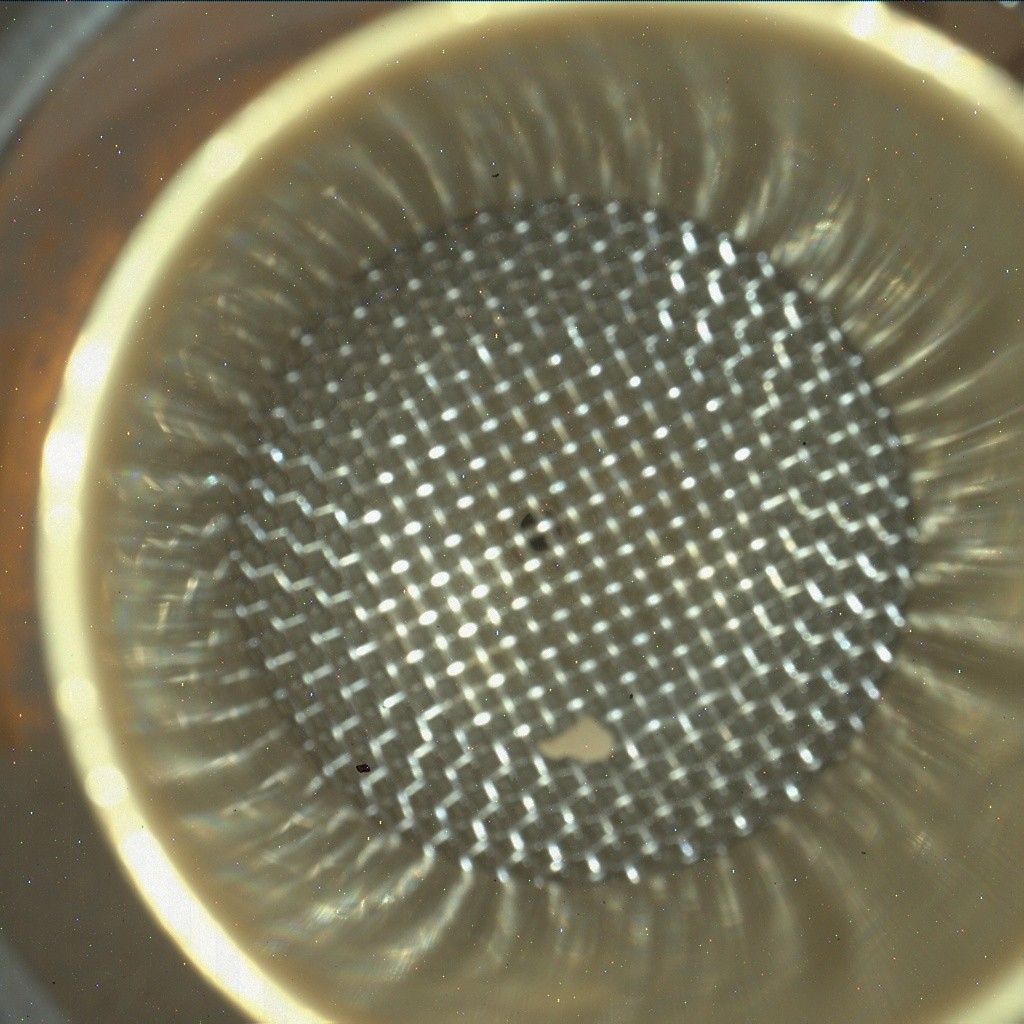
Mastcam has continued building a comprehensive visual survey of the region, including higher-resolution mosaics of areas where remaining sample was dropped and of the drill workspace itself. These images help determine whether any material lingered in the drill mechanism and was successfully shaken loose, ensuring the system is ready for the next collection. MAHLI has also been inspecting the sample inlets to confirm cleanliness and readiness—an image of the CheMin inlet even includes a tiny hitchhiking stone that the CheMin team has jokingly adopted as “our pet rock.”
APXS, meanwhile, has leaned heavily into the opportunity presented by fresh drill fines. The instrument devoted unusually long measurement times to the Campo Marte material, deliberately boosting counting statistics beyond standard levels to strengthen the chemical dataset before Curiosity says goodbye and rolls on.