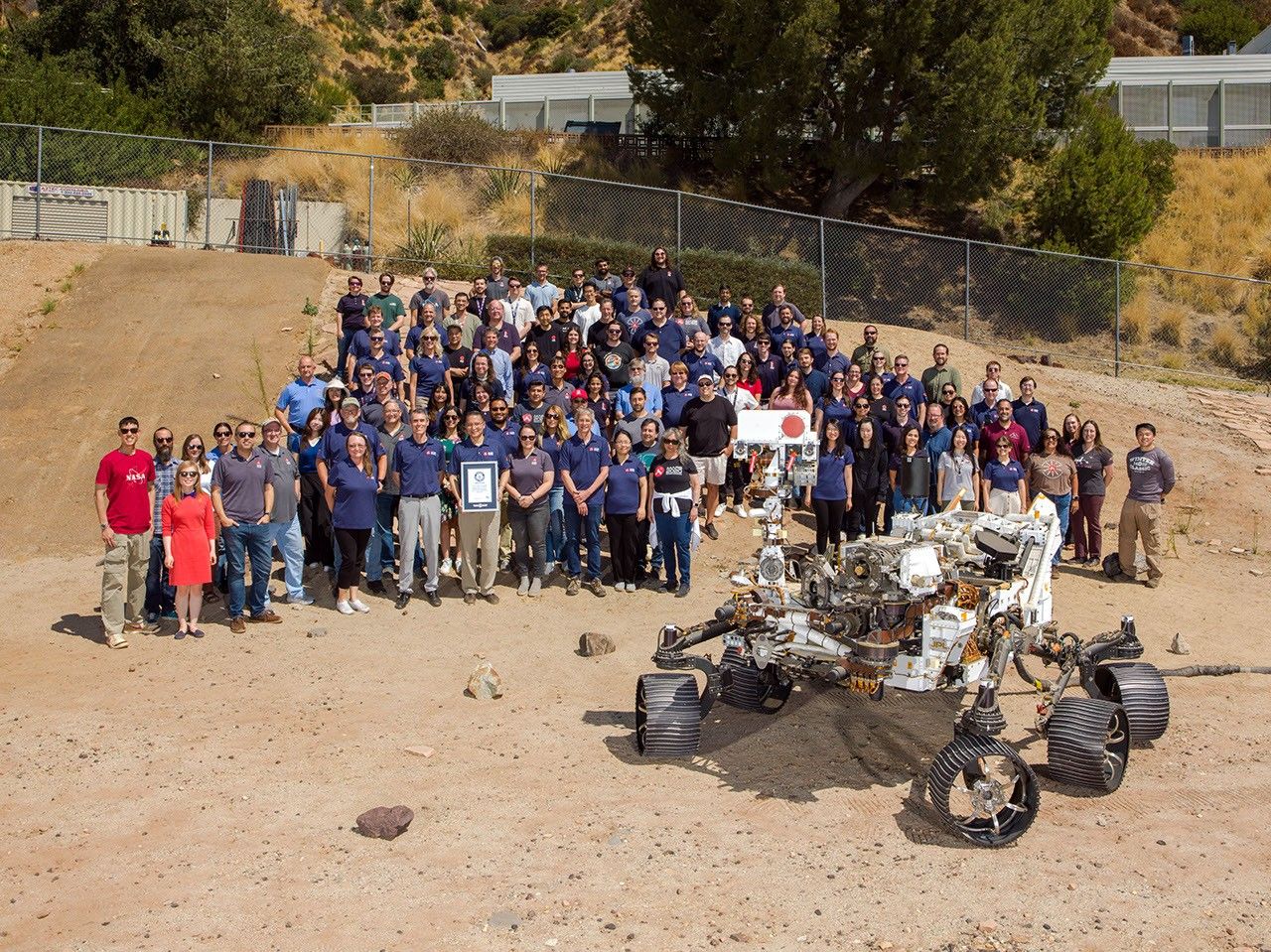
NASA’s Perseverance rover has earned a Guinness World Records title for the longest distance driven on Mars, with the team celebrating at JPL’s Mars Yard.
NASA’s Perseverance Mars rover team has marked a new milestone with official recognition from Guinness World Records for setting a distance record on the Red Planet.
Engineers and scientists from the mission gathered at the Mars Yard at NASA’s Jet Propulsion Laboratory (JPL) in Southern California to commemorate the achievement. In a group photo, the team posed with the Guinness certificate acknowledging the record-setting traverse by Perseverance—NASA’s flagship rover for the Mars 2020 mission.
Standing prominently in front of the assembled personnel was OPTIMISM, a full-size engineering replica of the rover whose name is short for “Operational Perseverance Twin for Integration of Mechanisms and Instruments Sent to Mars.” The vehicle is not a museum piece: it is an essential tool used on Earth to rehearse and refine the rover’s work on Mars. Teams employ OPTIMISM to test mobility strategies, evaluate terrain challenges, and map out driving paths and science operations before those commands are sent across tens of millions of miles to Perseverance on Mars.
The Mars Yard itself serves as a realistic proving ground, allowing the mission to simulate conditions the rover encounters while exploring. By running planned activities through OPTIMISM first, the team can reduce risk, improve efficiency, and help ensure that Perseverance’s time on the Martian surface is spent productively—whether that means moving to a new location, positioning instruments, or carrying out a science campaign.
JPL built Perseverance and continues to lead day-to-day rover operations for NASA. The laboratory is managed by the California Institute of Technology (Caltech) on behalf of the agency. Perseverance is operated for NASA’s Science Mission Directorate in Washington as part of NASA’s broader Mars Exploration Program portfolio.
More information about the Perseverance mission is available through NASA’s Mars 2020 mission resources: https://science.nasa.gov/mission/mars-2020-perseverance/
Why it matters
Distance on Mars is not just a bragging right—covering more ground can expand the range of terrains and geologic features accessible to scientific instruments, potentially improving the odds of major discoveries. The methods used to plan these traverses, including testing with the OPTIMISM rover on Earth, also shape how future robotic missions will operate more safely and efficiently. With Perseverance continuing its exploration, the next watch point is how the team balances ambitious drives with the detailed science work needed to meet the mission’s goals.