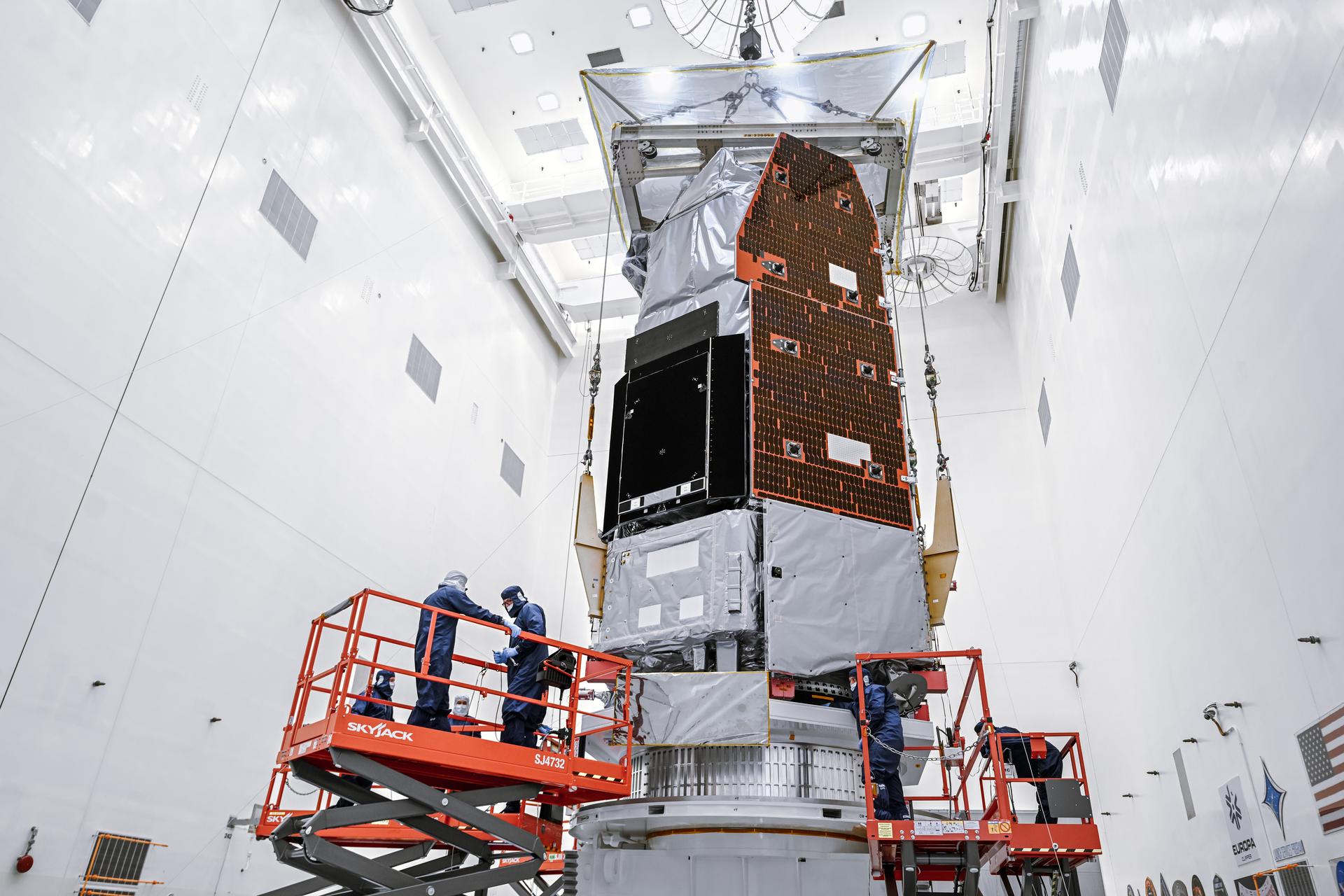
NASA will brief reporters later this month on the status and scientific ambitions of the Nancy Grace Roman Space Telescope, the agency’s next major astrophysics…
NASA will brief reporters later this month on the status and scientific ambitions of the Nancy Grace Roman Space Telescope, the agency’s next major astrophysics observatory, ahead of its planned launch from Florida.
The virtual media briefing is set for 2 p.m. EDT on Wednesday, July 29, and will offer a mission preview and updates as Roman approaches liftoff. NASA says the telescope is scheduled to launch Sunday, Aug. 30, from the agency’s Kennedy Space Center. The event will be carried live online via NASA’s streaming platforms, with viewing information available at https://www.nasa.gov/live.
NASA officials and mission representatives will participate in the briefing to outline what Roman is designed to do and where the project stands in preparation for launch. Journalists who want to ask questions by phone must RSVP no later than two hours before the event begins, contacting Rob Garner at rob.garner@nasa.gov. NASA also notes that its media accreditation policy is available online.
Named for Nancy Grace Roman, NASA’s first chief astronomer, the Roman Space Telescope is built to survey the universe with a wide-field, deep-viewing capability—capturing expansive, high-resolution panoramas intended to reveal objects and structures at scales not previously accessible in such breadth. NASA says the observatory’s imagery and survey data are expected to transform researchers’ understanding of the cosmos, opening what the agency describes as a new era of large-scale sky mapping.
A key promise of the mission is the ability to uncover vast numbers of celestial objects in systematic surveys, helping scientists probe some of astronomy’s biggest unanswered questions, including aspects of the universe that cannot be observed directly. By repeatedly scanning wide regions of the sky in depth, Roman is intended to assemble rich catalogs that can be used to study cosmic phenomena and the underlying physics shaping the universe.
Roman is also slated to demonstrate advanced technology relevant to the search for worlds beyond the solar system. NASA says the mission will include a technology demonstration featuring the most advanced system ever flown in space for directly imaging planets around nearby stars—an important milestone toward future observatories aimed at finding signs of life on other worlds.
The telescope is managed by NASA’s Goddard Space Flight Center with participation from the Jet Propulsion Laboratory in Southern California; Caltech/IPAC in Pasadena, California; the Space Telescope Science Institute in Baltimore; and an extended science team drawn from multiple research institutions. NASA’s primary industry partners on the mission include BAE Systems Inc., L3Harris Technologies, and Teledyne Scientific & Imaging.
International contributions are also part of the program. NASA lists the European Space Agency (ESA), the Japan Aerospace Exploration Agency (JAXA), France’s CNES (Centre National d’Études Spatiales), and Germany’s Max Planck Institute for Astronomy among organizations providing support.
Additional information about the Roman Space Telescope is available through NASA’s mission resources. Media contacts listed by the agency include Alise Fisher at NASA Headquarters (alise.m.fisher@nasa.gov, 202-358-2546) and Claire Andreoli and Rob Garner at Goddard (claire.andreoli@nasa.gov, 301-286-1940; rob.garner@nasa.gov, 301-286-5687).