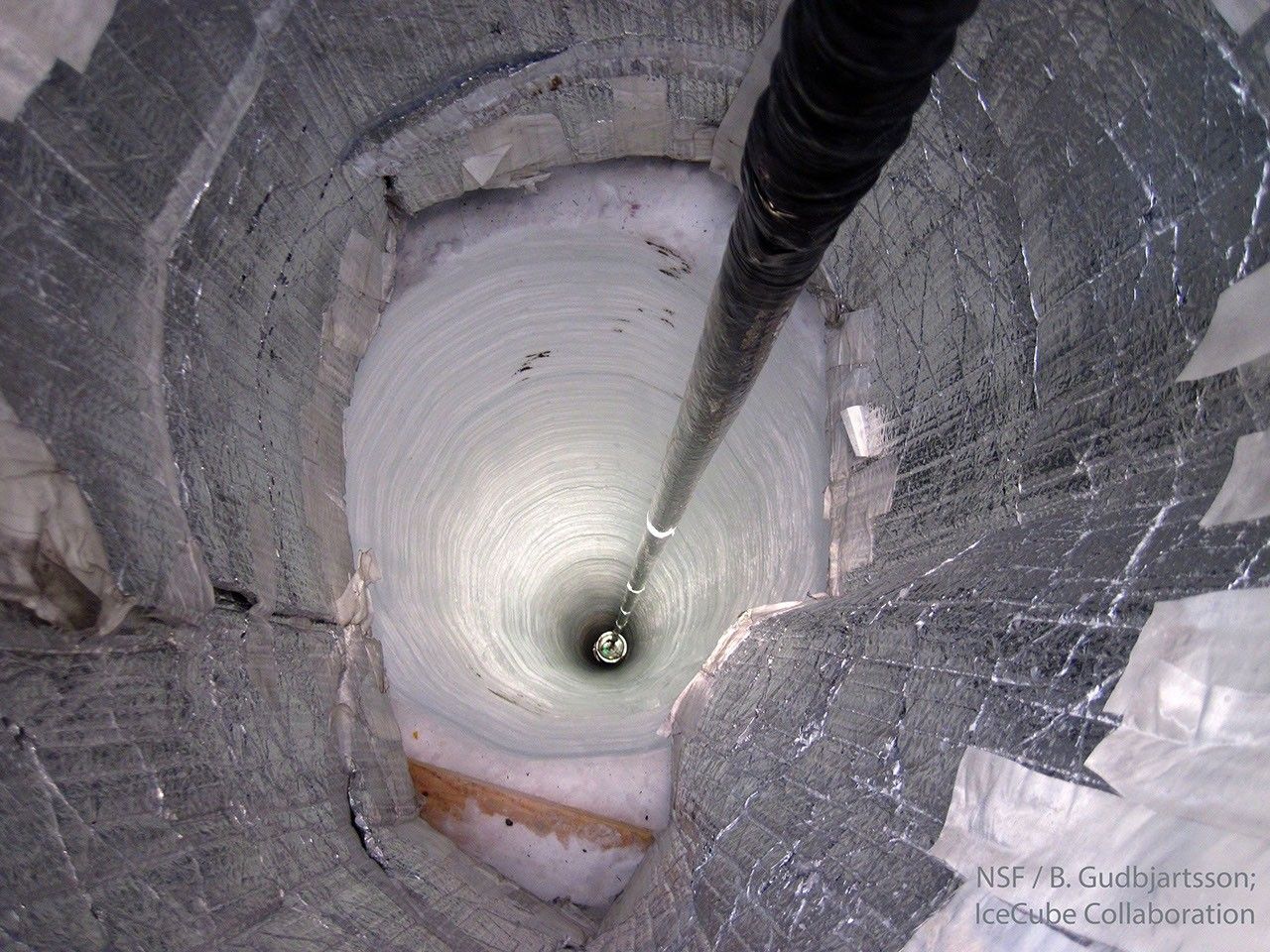
IceCube turns Antarctic ice into a giant neutrino telescope by freezing hundreds of light sensors deep below the South Pole. Its cosmic discoveries have earned the collaboration a Nobel Prize in Physics.
Scientists are quite literally drilling into Antarctica to study the universe. At the South Pole, researchers have transformed the ice into a working astronomical instrument by melting nearly 100 deep, narrow shafts and turning them into a vast detector array.
The project, known as the IceCube Neutrino Observatory, relies on an unusual construction method: in each hole, teams lower a long vertical cable fitted at intervals with basketball-sized light sensors. Once the string is in place, the water in the shaft freezes again, locking the detectors permanently into the exceptionally clear polar ice. Together, these instrumented columns form a three-dimensional observatory embedded in the “bottom of the world.”
IceCube is designed to catch one of nature’s most elusive messengers—neutrinos. These tiny particles are produced in high-energy cosmic environments and can travel immense distances through space, passing through stars, planets, and people with almost no interaction. That very property makes them valuable to astronomers, because neutrinos can carry information from powerful processes in the universe that light-based telescopes may not easily reveal.
The South Pole ice provides the key. When a high-energy neutrino does collide with an ice molecule, it can generate fast-moving secondary particles. Those particles, in turn, produce a faint flash of blue light in the surrounding ice. IceCube’s detectors are built to sense that blue glow, allowing scientists to register the event and infer the presence of the original neutrino.
Over time, the observatory has recorded many such neutrino detections, building a new way to observe energetic phenomena beyond Earth. In the image taken in 2010, one of the final detector strings is shown being lowered into the frigid darkness of a freshly melted hole—an installation step that helped complete what was, at the time, the largest neutrino detector ever constructed.
This week, the collaboration behind IceCube received a major honor. Organizers announced that a founding leader of the IceCube Collaboration will be awarded the Nobel Prize in Physics, recognizing the project’s unprecedented discoveries and its impact on modern astrophysics.
Why it matters
Neutrino observatories such as IceCube expand astronomy beyond what can be seen with light, offering a direct window into extreme cosmic events that may otherwise be hidden. The Nobel recognition underscores how foundational infrastructure—built deep in Antarctic ice—can reshape our understanding of the universe. Next to watch: what new sources of high-energy neutrinos IceCube and future detectors can pinpoint, and how those findings will connect to observations made with traditional telescopes.