After nearly a year in its deepest power-saving sleep, NASA’s New Horizons spacecraft has switched back to active operations—and mission managers say the far-flung probe…
After nearly a year in its deepest power-saving sleep, NASA’s New Horizons spacecraft has switched back to active operations—and mission managers say the far-flung probe is healthy and ready to begin sending home a new batch of science from the Kuiper Belt, the cold reservoir of ancient bodies beyond Pluto.
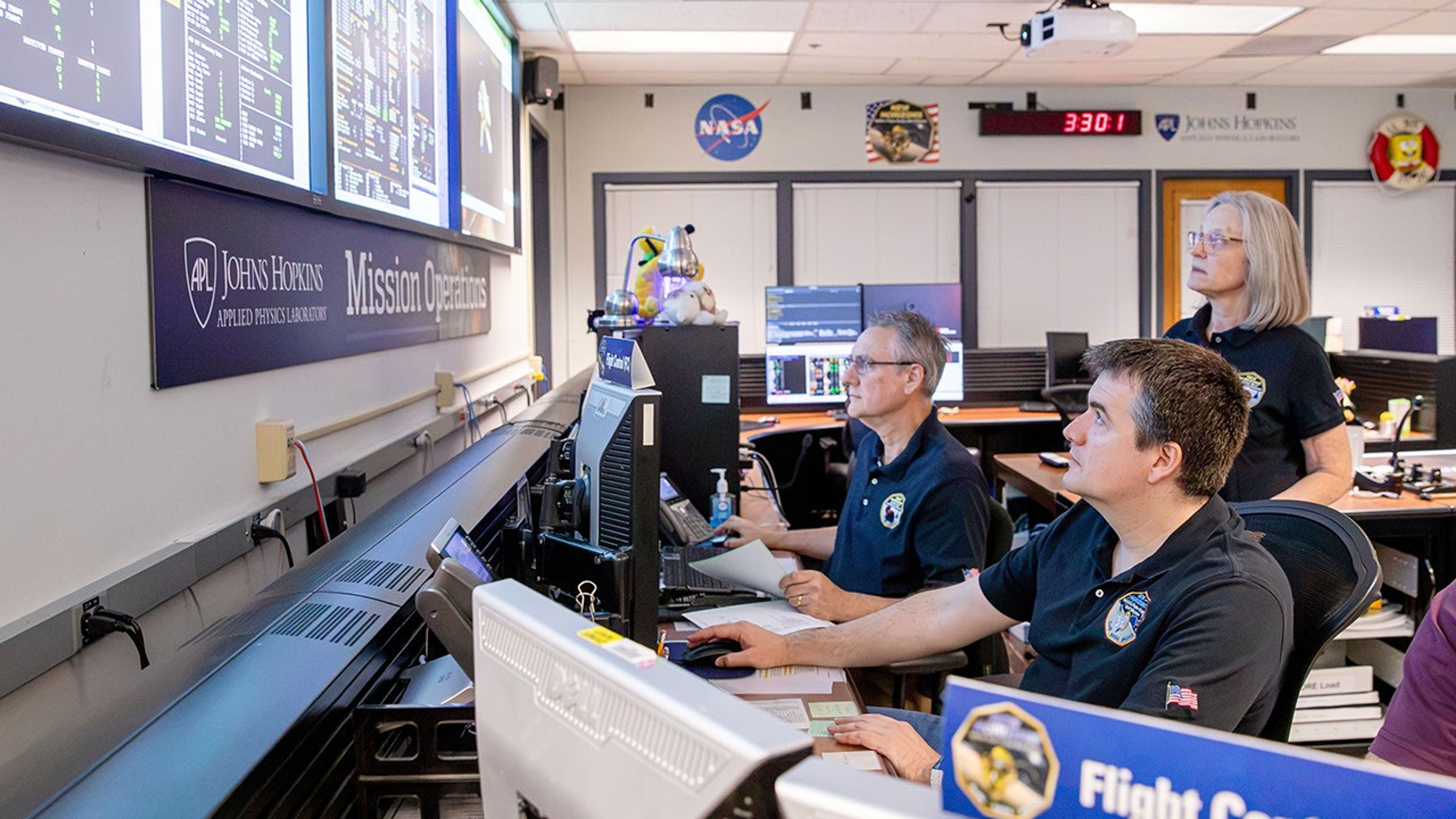
Controllers at the Johns Hopkins Applied Physics Laboratory (APL) in Laurel, Maryland, confirmed on June 23 that New Horizons had successfully exited hibernation, following a preloaded set of instructions that had been uploaded to the spacecraft’s main computer the previous July. The dormant stretch lasted 321 days, beginning Aug. 7, making it the longest hibernation period in the mission’s history.
The wake-up call came from extraordinarily far away. At the time of the confirmation, New Horizons was about 5.9 billion miles (9.5 billion kilometers) from Earth. Because of that distance, the radio message announcing its status took roughly 8 hours and 52 minutes to cross space before reaching Earth through NASA’s Deep Space Network, via the agency’s station near Madrid, Spain, and then on to the APL Mission Operations Center.
Hibernation is a standard strategy for New Horizons during long, quiet cruises. The mode reduces wear on the spacecraft and conserves resources by limiting routine interactions with Earth. During these intervals, teams on the ground do not actively command the probe or download stored observations. The spacecraft, however, does not stop working. Throughout the hibernation period it continued collecting and saving measurements around the clock from its heliospheric plasma instruments—Solar Wind at Pluto (SWAP) and the Pluto Energetic Particle Spectrometer Science Investigation (PEPSSI)—as well as from its space-dust monitor, the Venetia Burney Student Dust Counter.
Alice Bowman, New Horizons mission operations manager at APL, said the spacecraft still checked in weekly. Each report arrived as a status “beacon” transmitted through the Deep Space Network, offering a simple color-coded health summary. Every one of those weekly beacons, she noted, came back “green,” indicating the spacecraft remained in good condition throughout the entire hibernation run.
Now that New Horizons is awake, the mission team is beginning a stepwise return to full operations. Engineers will first downlink spacecraft health and safety information, then start transmitting the accumulated science data from the three instruments that continued observing during hibernation. In roughly three weeks, the probe’s Alice ultraviolet spectrograph is slated to begin a new campaign measuring how hydrogen gas is distributed in the outer heliosphere—the vast bubble carved out by the solar wind.
Meanwhile, SWAP, PEPSSI, and the dust counter will keep monitoring their respective environments as ground teams run a series of spacecraft and instrument checkouts. The project is also in the midst of updating its ground-system software to simplify long-term operations; testing has already begun and is expected to continue through the year.
Those preparations are increasingly important as the spacecraft heads farther from the Sun. New Horizons is operating with revised autonomy logic tailored for the deepening challenges of distance, including declining available power and the unavoidable growth in communications delay.
The wake-up marks another milestone in a mission that began with a record-setting fast launch in January 2006, sped past Jupiter in February 2007 for a gravity assist and close-up views, performed humanity’s first reconnaissance of Pluto in July 2015, and delivered the first flyby of a Kuiper Belt object—Arrokoth—in January 2019. Since then, New Horizons has continued surveying the outer heliosphere and studying dozens of additional Kuiper Belt targets from afar.