NASA will stage its 2026 Lunabotics Challenge from Tuesday, May 19, through Thursday, May 21, at the Astronauts Memorial Foundation’s Center for Space Education inside…
NASA will stage its 2026 Lunabotics Challenge from Tuesday, May 19, through Thursday, May 21, at the Astronauts Memorial Foundation’s Center for Space Education inside the Kennedy Space Center Visitor Complex in Florida. The event is scheduled to run daily from 8 a.m. to 6 p.m., and NASA will provide links for live viewing through the agency’s Lunabotics webpage.
Reporters are invited to attend in person on Wednesday, May 20. Media planning to cover the competition must RSVP no later than 4 p.m. EDT on Monday, May 18, by emailing the Kennedy Space Center newsroom at ksc-newsroom@mail.nasa.gov.
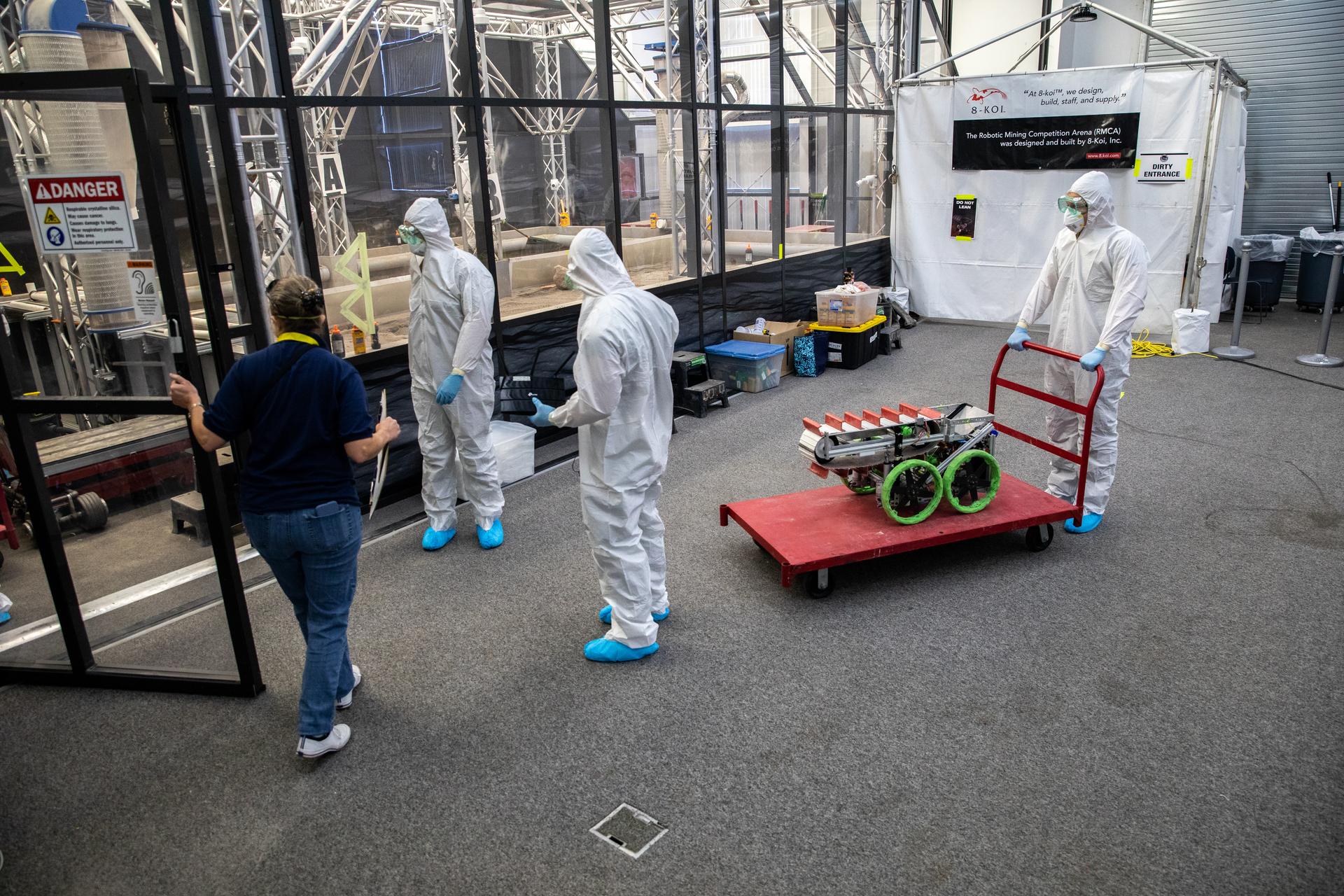
This year’s challenge will bring together 50 college teams from across the United States to design, construct, and operate prototype lunar robots. The student-built machines—self-driving rover concepts—will be judged on their ability to assemble a berm, a protective barrier made from soil and other materials that mimic lunar regolith. The aim is to demonstrate how robotic systems could help build infrastructure protections on the Moon in advance of sustained human activity.
On future Artemis missions, berms could play several roles in safeguarding equipment and surface assets. NASA notes that similar barriers could reduce the risk of damage from debris thrown during lunar landings and launches, provide shade for cryogenic propellant tank farms, and contribute to radiation protection for facilities such as a nuclear power plant, among other potential uses.
“The task of robotically building berm structures will be important for preparation and support of crewed lunar missions,” said Kurt Leucht, a NASA software developer and in-situ resource utilization researcher at Kennedy Space Center who also serves as a Lunabotics commentator. Leucht emphasized that the competition is intended to do more than test robotics performance: it also helps students develop practical engineering experience while contributing ideas and approaches relevant to Artemis-era exploration.
NASA created the Lunabotics Challenge in 2010 and now runs it as part of its Artemis Student Challenges portfolio. The agency describes the program as a way to strengthen and sustain student participation in STEM fields by offering hands-on opportunities for research and engineering design in science, technology, engineering, and mathematics.
Additional information about the Lunabotics Challenge is available at https://www.nasa.gov/learning-resources/lunabotics-challenge. For media inquiries, NASA identified Amanda Griffin at Kennedy Space Center, Florida (321-867-2468; amanda.griffin@nasa.gov).