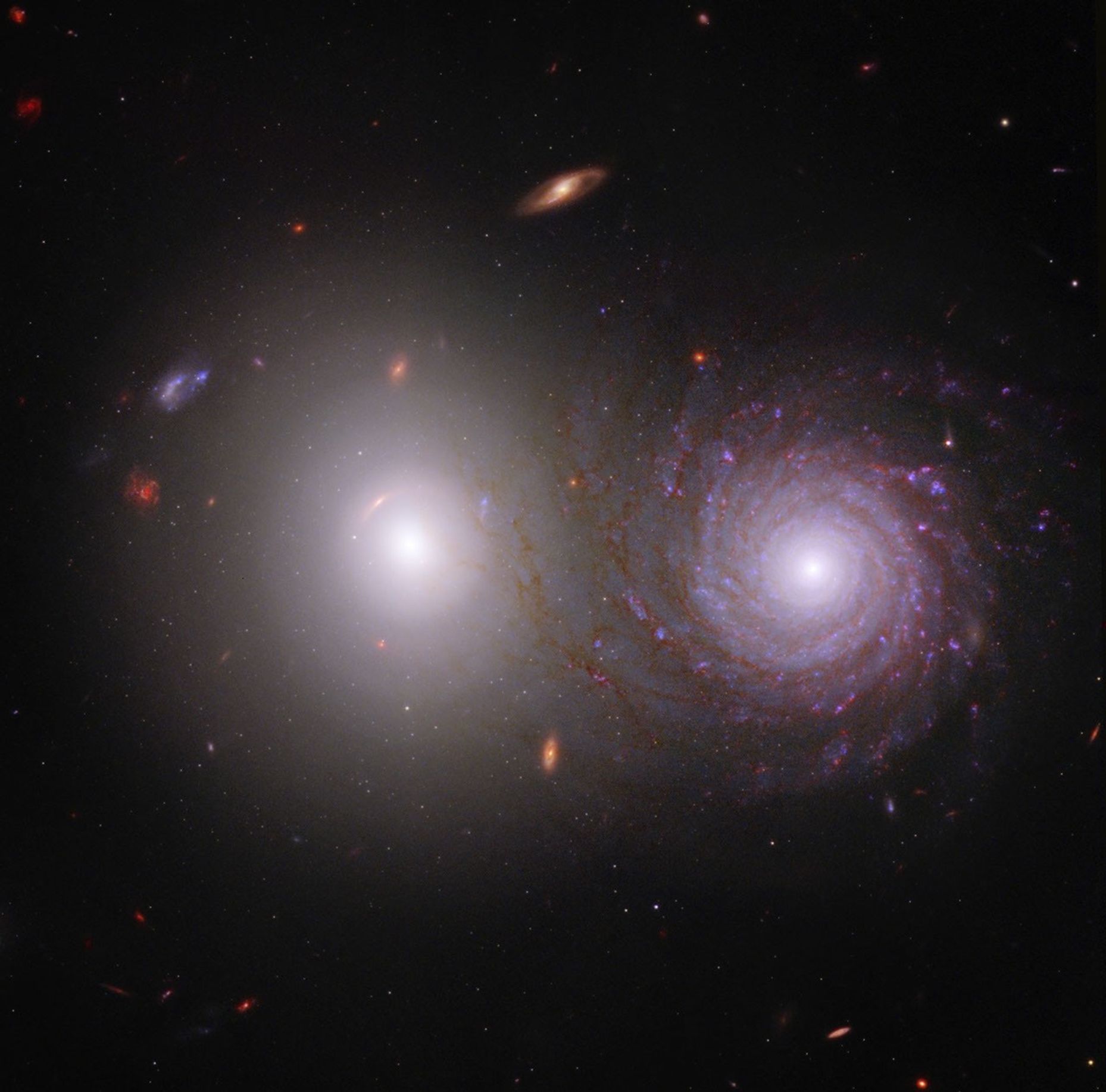
Galaxies—enormous systems of billions of stars mixed with gas and dust and bound together by gravity—fill the universe.
Galaxies—enormous systems of billions of stars mixed with gas and dust and bound together by gravity—fill the universe. Occasionally, however, chance geometry creates a particularly useful illusion: from Earth’s viewpoint, two galaxies align along the same line of sight and appear to partially overlap on the sky. These uncommon pairings are more than a visual curiosity. They provide astronomers with one of the best natural tools for investigating a component of galaxies that is notoriously hard to measure directly: interstellar dust.
NASA’s new citizen-science effort, called Overlap Zoo, is built around this idea. When a more distant galaxy sits behind a nearer one, the background object effectively serves as a bright backlight. Dust in the foreground galaxy then shows up as dark patches and lanes—silhouettes against the glowing backdrop. By analyzing how much of the background light is blocked or altered, researchers can trace where dust lies within the nearer galaxy and determine how strongly it absorbs, scatters, and reddens starlight passing through it.
Understanding those effects matters well beyond dust itself. Because dust changes the apparent brightness and color of astronomical objects, it can introduce errors into measurements across cosmology and galaxy evolution. More accurate descriptions of how dust dims light can help astronomers improve corrections applied to observations and, in turn, sharpen estimates of distances to faraway objects.
Before any of that science can happen, researchers need a large and reliable sample of overlapping galaxy pairs. That has become a challenge as modern surveys deliver an ever-growing flood of images. “As new and better observations of galaxies continue to multiply, it is becoming incredibly difficult for astronomers to classify every candidate galaxy pair,” said Trevor Butrum, a graduate student and lead for the Overlap Zoo project. He emphasized that public participation is essential for assembling “the biggest and cleanest catalog of overlapping galaxy pairs for further analysis.”
Overlap Zoo builds on earlier work from the Galaxy Zoo project, where volunteers flagged images that might contain overlapping systems. In the new project, participants examine those candidates more closely. Volunteers are guided through confirming whether a true overlap is present, identifying and classifying important features in each galaxy, and tracing their outlines. The platform is designed for people to learn as they contribute, allowing anyone to classify as many images as they wish.
The outcome, organizers say, will be the first large-scale catalog of overlapping galaxy pairs specifically suited for dust studies—an expanded dataset intended to support more precise astronomical analyses. Overlap Zoo is open to anyone with an internet-connected computer, and no specialized background is required. For NASA’s researchers, each verified pair adds another opportunity to use a cosmic alignment as a dust detector, turning a rare accident of perspective into a powerful scientific method.