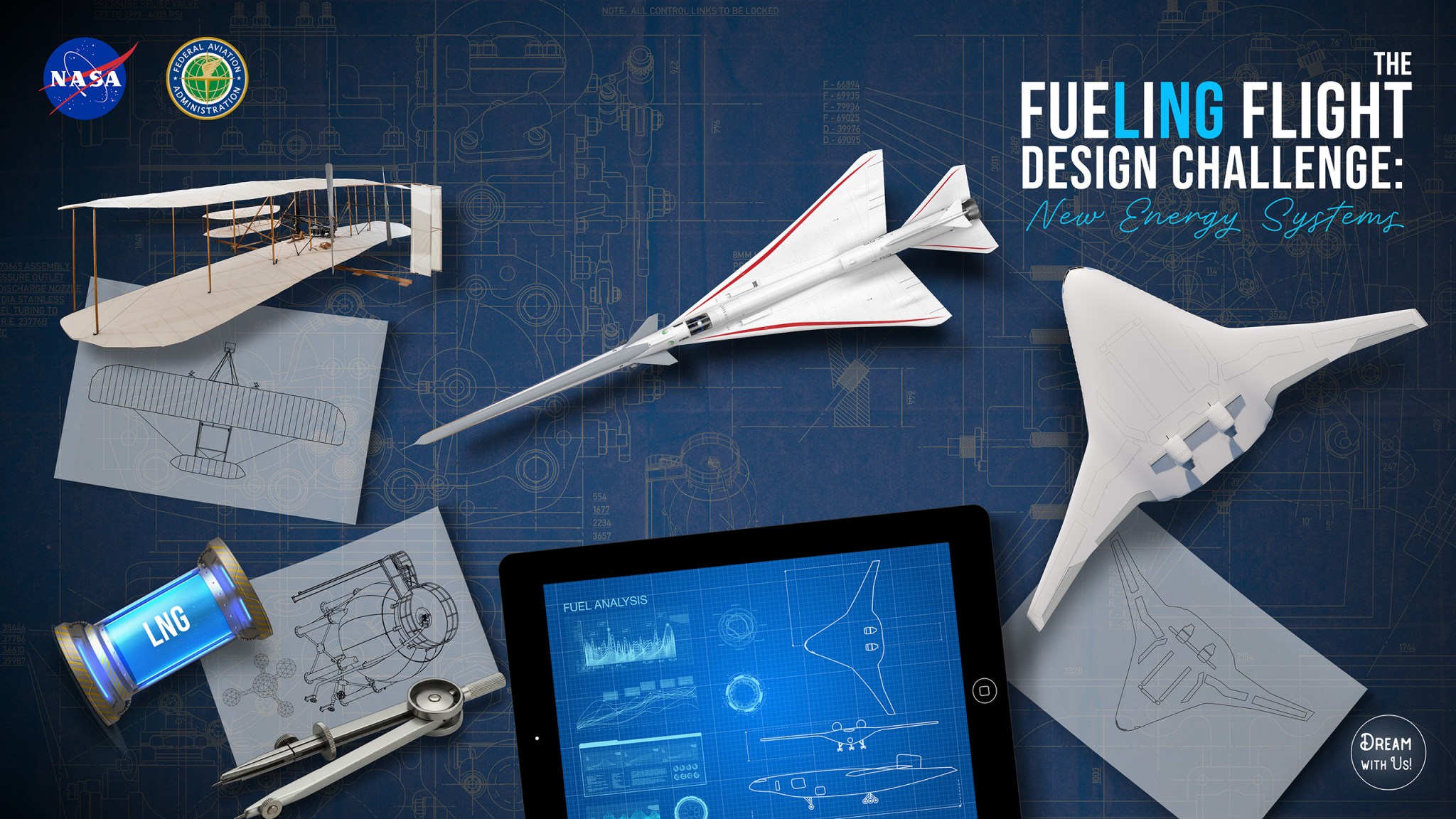
NASA is asking the next generation of engineers to imagine how aviation might work when airplanes no longer rely on a single, familiar fuel.
NASA is asking the next generation of engineers to imagine how aviation might work when airplanes no longer rely on a single, familiar fuel. For the 2026–2027 Dream with Us (DWU) student competition, the agency’s theme is “Fueling Flight Design Challenge: New Energy Systems,” a prompt built around a fast-changing reality: more aircraft are entering the United States’ National Airspace System, and the pressure is rising to improve safety, cut costs, reduce time in the air for passengers and cargo, and curb aviation’s environmental footprint through new propulsion and fuel choices.
Working alongside partners that include the Federal Aviation Administration, universities, and industry, NASA is using the challenge to explore what happens when an “emerging” aviation fuel is introduced at scale. This year’s competition is open to both middle school and high school students, with age-appropriate tasks for each group. Mixed-grade teams will be entered in the high school division. Eligible high school participants include students in grades 9–12 enrolled in public, private, parochial, or home schools across the United States, as well as children of U.S. military members stationed overseas. The 2026–2027 competition opens on September 25, 2026, with submissions for middle school entrants beginning the same day.
At the center of the project is liquefied natural gas (LNG). Student teams are expected to study what LNG is, how it could be used in aviation, and what advantages and tradeoffs come with adding a new fuel option. The exercise goes beyond chemistry and propulsion: because LNG must be stored differently than conventional jet fuel, adopting it could reshape aircraft layouts, airport operations, and the ground infrastructure that supports flight.
That broader systems thinking is a major focus of the challenge. For decades, most commercial aircraft have followed variations of the tube-and-wing configuration, in part because of the limits imposed by older materials and manufacturing techniques. NASA notes that advances in technology and materials are loosening those constraints, opening the door to alternative airframe concepts. At the same time, research into fuels and the growing demand for flights are pushing the industry toward multiple pathways—ranging from new fuel types to increasing electrification—rather than a single one-size-fits-all solution.
Airports, in turn, may have to evolve. Accommodating more than one kind of fuel could require new storage and delivery systems. New aircraft configurations might also drive changes in gate layouts and terminal “gateway” designs, and could even lead to dedicated areas for different types of aircraft. What those future airports look like, NASA suggests, will be determined by the researchers and designers now entering the field.
The economic stakes are substantial. Each year, more than 62 million metric tons of air cargo move around the world—representing over a third of global trade by value, or roughly $8.3 trillion annually. In an industry built on tight margins and massive scale, even small efficiency gains can translate into large financial impacts.
In the high school division, the scenario is framed as a real-world design assignment. A major air freight company, looking to replace part of its fleet, has announced interest in a new cargo aircraft that improves efficiency and runs on a different fuel. Student teams, acting as an aircraft manufacturer, are tasked with proposing a concept cargo aircraft designed specifically around LNG. NASA will provide engine performance data, but the teams must decide how to integrate LNG storage—and how that choice could enable new, potentially more aerodynamically efficient aircraft designs.