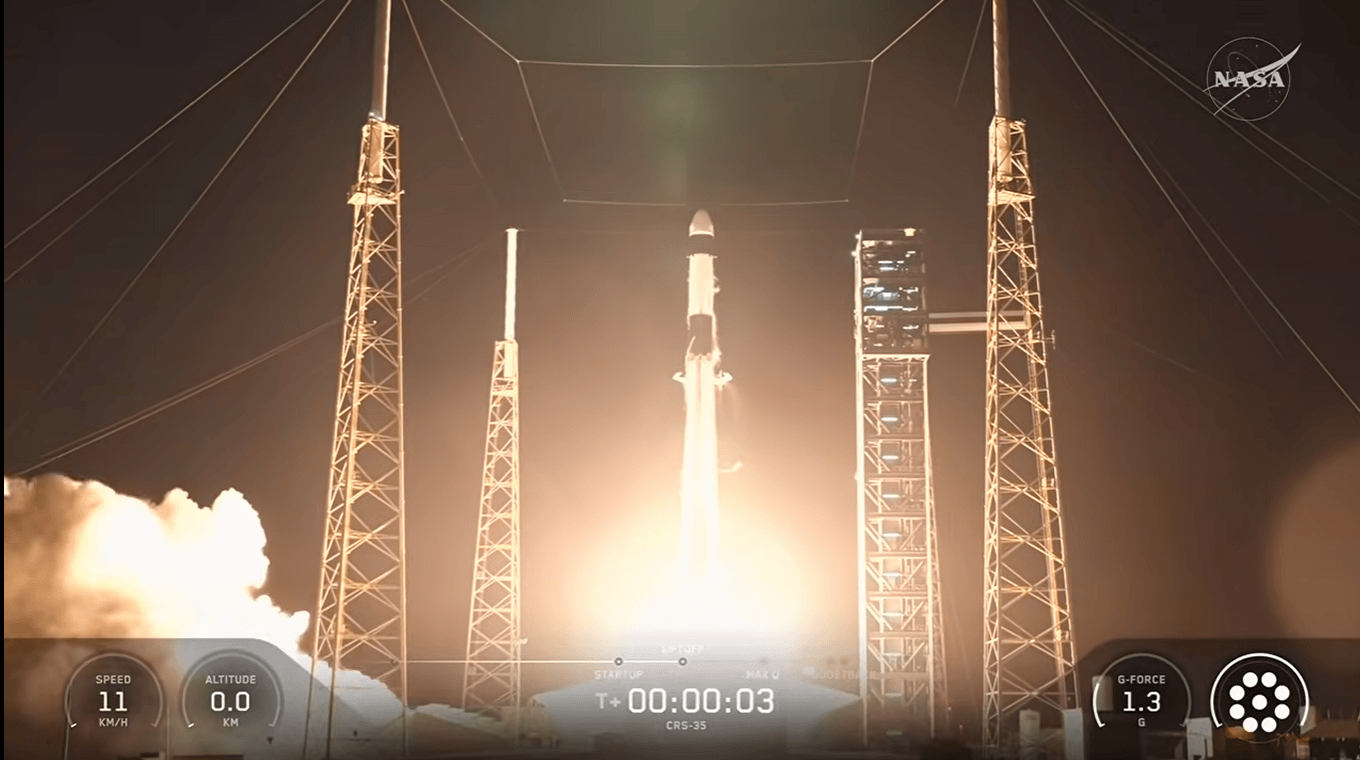
NASA and SpaceX launched a Dragon cargo mission to the ISS with over 6,300 pounds of supplies, including the final solar arrays and experiments in medicine and materials science.
NASA and SpaceX have launched the 35th commercial resupply flight to the International Space Station, sending a Dragon cargo spacecraft toward orbit with more than 6,300 pounds of equipment, supplies, and new research. The mission lifted off at 6:33 a.m. EDT Tuesday, riding a Falcon 9 rocket from Space Launch Complex 40 at Cape Canaveral Space Force Station in Florida.
After reaching orbit, Dragon began the multi-day trip to the station carrying a mix of routine logistics and high-priority hardware. Among the most consequential items aboard are the final two International Space Station Roll-Out Solar Arrays (iROSAs). These last panels are designed to finish the station’s ongoing power-system upgrades, increasing the electricity available for onboard experiments and daily operations and supporting the station’s eventual safe, controlled deorbit. NASA plans for astronauts to install the arrays during a series of spacewalks scheduled for later this fall.
Dragon is expected to dock autonomously at 11 a.m. Thursday, Oct. 15, linking up with the space-facing port of the Harmony module. NASA will provide live coverage of the rendezvous and docking beginning at 9:15 a.m. across its streaming platforms.
The cargo manifest also includes a slate of experiments that take advantage of microgravity conditions to probe biology, materials science, and medical technology. One set of delivered hardware supports research into manufacturing artificial retinas in space—work that could contribute to approaches aimed at restoring vision for patients on Earth. Another payload involves 3D models of heart tissue, intended to help researchers refine methods for large-scale drug testing that could be particularly valuable during future long-duration missions beyond low Earth orbit.
Materials science investigations are also on board, including samples and equipment to examine how a new type of glass forms in microgravity, where convection and sedimentation behave differently than they do on Earth. In addition, Dragon is carrying brain organoids—miniaturized, simplified tissue models—that scientists will use to explore biological pathways that may point toward treatment targets for neurodegenerative conditions, including Alzheimer’s disease, Parkinson’s disease, and multiple sclerosis.
NASA notes that these projects represent only a fraction of the hundreds of investigations conducted on the orbiting laboratory across biology and biotechnology, the physical sciences, and Earth and space science. The agency argues that research performed on the station not only produces benefits for people on Earth, but also helps mature the technologies and operational experience needed for missions deeper into the solar system.
The broader context includes NASA’s Artemis program, which aims to return astronauts to the Moon as a step toward future crewed missions to Mars.
Dragon is slated to remain at the station until mid-November. After that, the spacecraft will undock carrying time-sensitive research results and cargo back to Earth, with a planned splashdown off the coast of California.
Why it matters
Regular cargo flights keep the International Space Station functioning as a laboratory—delivering critical hardware like the last pair of roll-out solar arrays while returning research that can’t wait for long storage in orbit. The experiments aboard this mission touch on health, materials, and drug development, areas with potential impacts far beyond spaceflight. The completion of the station’s power upgrades is also a key milestone, enabling more research and supporting safe end-of-life operations in the years ahead.