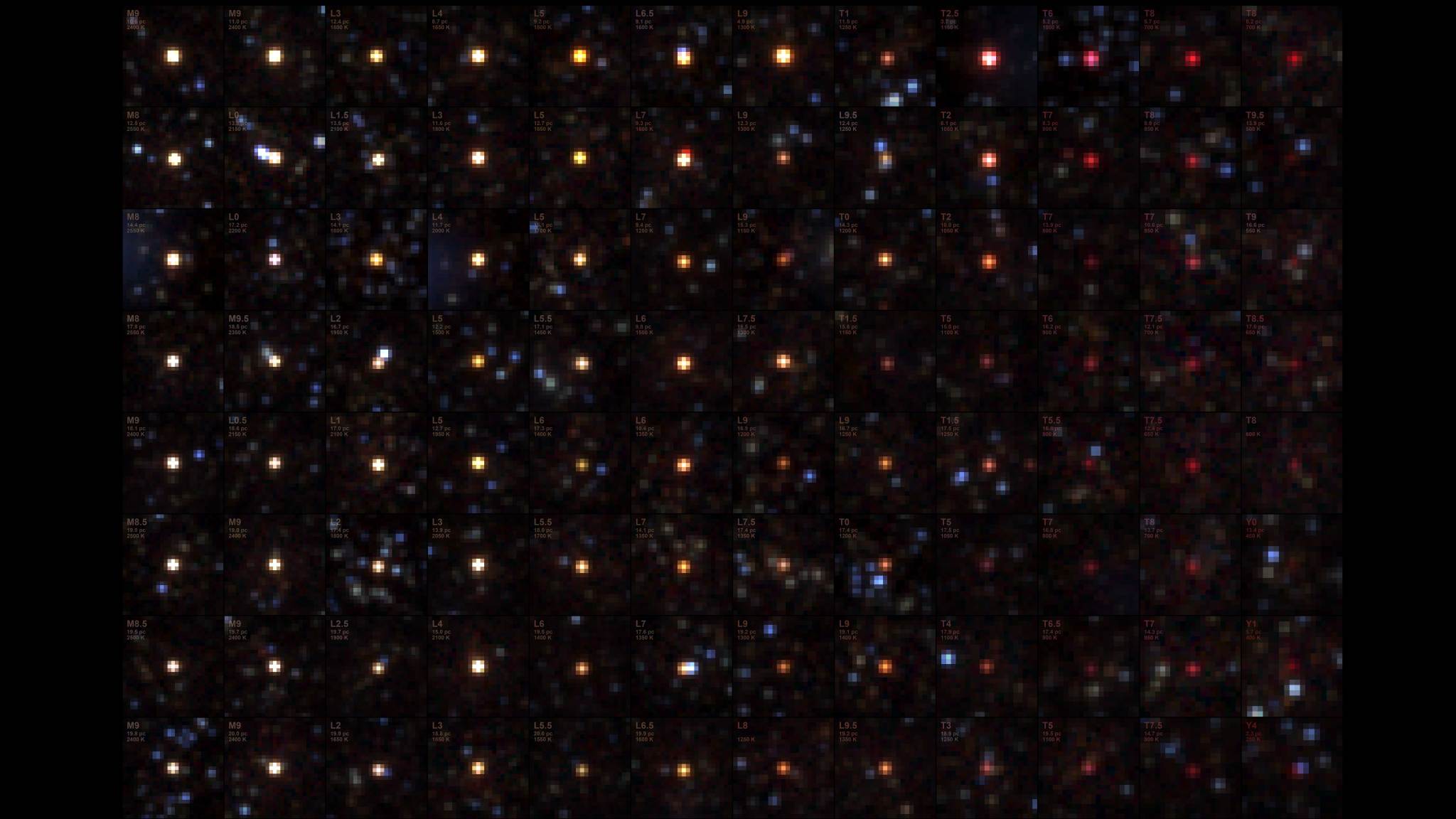
NASA’s SPHEREx telescope is detecting water, carbon dioxide, methane and other molecules in dozens of brown dwarf atmospheres, revealing unexpected chemical complexity.
NASA’s SPHEREx space telescope is offering a fresh look at brown dwarfs—enigmatic objects that sit between planets and stars—and early results suggest their atmospheres are far more chemically complex than astronomers have been able to confirm with large samples until now.
In a new study published in The Astrophysical Journal, researchers report that SPHEREx observations reveal molecular fingerprints in the skies of dozens of nearby brown dwarfs, including water vapor, carbon dioxide, carbon monoxide, and methane. Brown dwarfs were first identified in the 1990s and form the way stars do, collapsing from clouds of gas. But they never become massive enough to maintain hydrogen fusion in their cores, leaving them as faint, cooling spheres of warm gas—objects that resemble oversized versions of Jupiter and Saturn in some respects.
Unlike most planets, however, many brown dwarfs roam without a parent star. Heated by internal energy rather than stellar light, these free-floating worlds can drift through space for eons. Lead author Zafar Rustamkulov, a scientist at Caltech’s IPAC in Pasadena, described them as solitary objects that gradually dim over time, noting that scientists are still uncovering how intricate their atmospheres and evolution can be.
Until recently, detailed atmospheric studies of brown dwarfs from space have been limited to only a few dozen targets. That’s a challenge because much of what researchers think they know—about composition, weather, cloud layers, and how these properties change as brown dwarfs cool—has relied heavily on models.
SPHEREx (short for Spectro-Photometer for the History of the Universe, Epoch of Reionization, and Ices Explorer) is beginning to change that picture. Launched in March 2025 and managed by NASA’s Jet Propulsion Laboratory in Southern California, the infrared mission surveys the whole sky. For this study, the team examined 37 nearby brown dwarfs spanning the class’s full temperature range: roughly 4,000 degrees Fahrenheit down to about minus 10 degrees Fahrenheit (2,200 to minus 20 degrees Celsius).
A key advantage is how SPHEREx observes. The telescope measures brightness across 102 distinct wavelength bands, stretching from the deepest visible red into infrared heat radiation, producing spectra for each object. Those spectra allow scientists to identify molecules because each species absorbs light in characteristic patterns. Coauthor J. Davy Kirkpatrick of Caltech’s IPAC said the data show how these molecular signatures vary from object to object across the entire temperature span—and added that the team is working through much larger numbers. Thousands more brown dwarfs are already in the pipeline for analysis, raising the prospect of mapping how diverse these objects can be.
Observing from space is crucial. Rustamkulov noted that some of SPHEREx’s wavelengths are effectively inaccessible from the ground because water vapor in Earth’s atmosphere blocks them. From orbit, SPHEREx can capture light emerging from the deep, reddish cloud decks of brown dwarfs across the sky.
Brown dwarfs are not SPHEREx’s central mission. The spacecraft collects about 3,600 images each day to assemble all-sky maps aimed at charting the distribution of hundreds of millions of galaxies—data that will help researchers reconstruct conditions extremely early in cosmic history, within a minuscule fraction of a second after the Big Bang. As it scans, SPHEREx is also hunting for life-linked chemistry and surveying interstellar ices that could contribute ingredients for oceans on future worlds.
Other NASA observatories—including the James Webb Space Telescope and the now-retired Spitzer Space Telescope—have detected brown dwarfs for years. But SPHEREx is now measuring thousands of them in a particularly productive spectral window spanning deep red and infrared light, where atmospheric molecules imprint strong absorption features. Those patterns evolve as brown dwarfs age and cool, and SPHEREx has already caught some objects in a transitional phase when unusual clouds thin and methane-rich atmospheres emerge.
Why it matters
Brown dwarfs are natural laboratories for studying atmospheres, clouds, and chemistry under conditions that overlap with giant exoplanets but without the glare of a host star. By turning a small, model-driven field into a large statistical survey, SPHEREx could reshape how scientists classify these objects and test atmospheric theories. The next key development will be whether the mission’s expanding catalog reveals unexpected compositions or transitions that existing models cannot yet explain.