After an extended pause, NASA’s public updates on the Mars rover Perseverance are flowing again—and they arrive with a backlog of discoveries.
After an extended pause, NASA’s public updates on the Mars rover Perseverance are flowing again—and they arrive with a backlog of discoveries. Over the course of 2026, the rover has been methodically working through a rugged landscape known as “Lac de Charmes,” a maze of ridges and valleys located west of Jezero crater’s rim. Mission scientists have described the region as a kind of frontier: difficult terrain, complex geology, and some of the oldest rocks the rover has encountered since landing.
That age is the main attraction. The outcrops at Lac de Charmes appear to predate the river- and lake-laid sedimentary deposits inside Jezero crater, which formed later when water shaped the basin. Instead, these rocks likely originated when Mars was far younger and endured intense asteroid bombardment. By examining them up close, the team hopes to reconstruct conditions from Mars’s earliest eras—and to better understand how rocky worlds across the inner solar system developed during that chaotic time.
Rather than immediately drilling and caching samples, the mission’s strategy in Lac de Charmes has emphasized context first: map the geology, trace relationships between outcrops, and determine how the terrain formed before committing precious sampling opportunities. Perseverance’s route reflects that approach. Its drives have followed a looping, investigative path between promising exposures, allowing researchers to piece together a broader geologic story.
So far, the rover has ground into 13 selected rock surfaces to create “abrasion patches,” clearing away dust and weathered rinds to expose fresh interiors for detailed analysis. Those abraded targets have delivered a rich stream of measurements. Early interpretations indicate that many of the rocks are igneous—formed from molten material that cooled as lava or magma. Others appear to be impactites, produced or heavily altered by the extreme forces and heat of meteorite strikes. Some samples show signs that both processes may have played a role, hinting at a landscape repeatedly reshaped by volcanism and impacts.
The pace of exploration has also been improved by a new driving algorithm that repurposes computing hardware once dedicated to communicating with NASA’s Ingenuity helicopter. With that upgrade, Perseverance can execute longer traverses with better accuracy, helping the rover cover more ground while continuing to stop for close inspection when the terrain demands it.
Although the Lac de Charmes campaign is now approaching its conclusion, the rover’s latest detour has opened a fresh chapter. The science team redirected Perseverance toward a site nicknamed “Idubi” after imagery revealed hundreds of light-toned boulders scattered across the area. On arrival, the location quickly proved unusually diverse, concentrating rocks with contrasting textures and compositions in a relatively small zone.
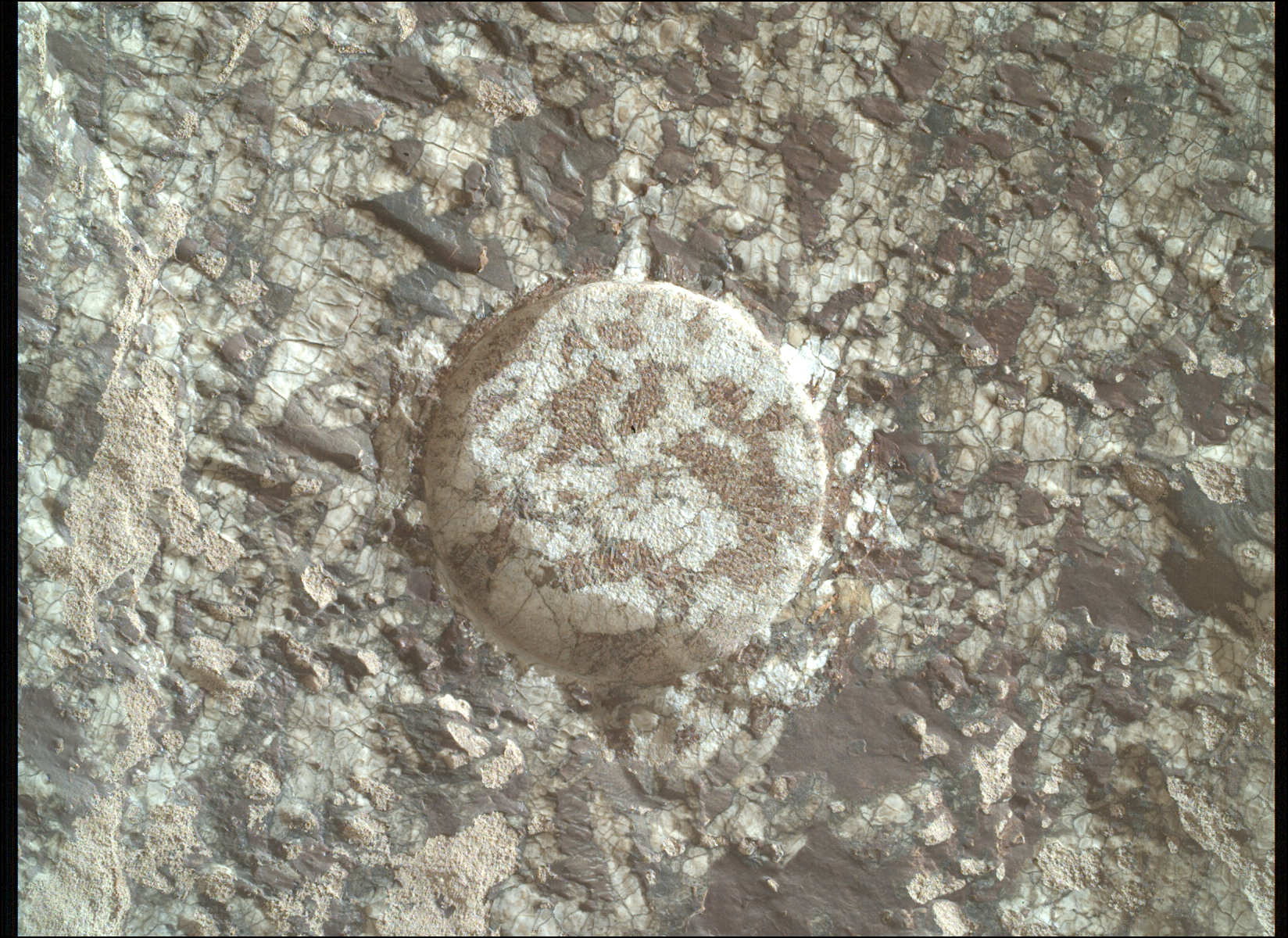
One light-colored boulder in particular drew immediate attention. After the rover abraded its surface—an abrasion patch named “Badger Peak”—the freshly exposed rock revealed a striking pattern of light and dark material unlike anything Perseverance has previously documented. Engineers attempted to collect a sample from the boulder, but the drilling effort did not succeed because the rock was too hard. The team is now scouting for another boulder with similar characteristics that can be sampled successfully.
Nearby, Perseverance has also paused at an outcrop called “Gardenia,” which may be a breccia—a rock assembled from fragments of older rocks, potentially recording multiple geologic events in a single specimen. The rover is expected to abrade this target as well, a step that should give scientists a clearer view of its composition and origin.
Months into its work at Lac de Charmes, Perseverance continues to deliver surprises. And as it prepares to press onward beyond this ancient terrain, the mission team expects the stream of new geologic clues—and new mysteries—to continue.