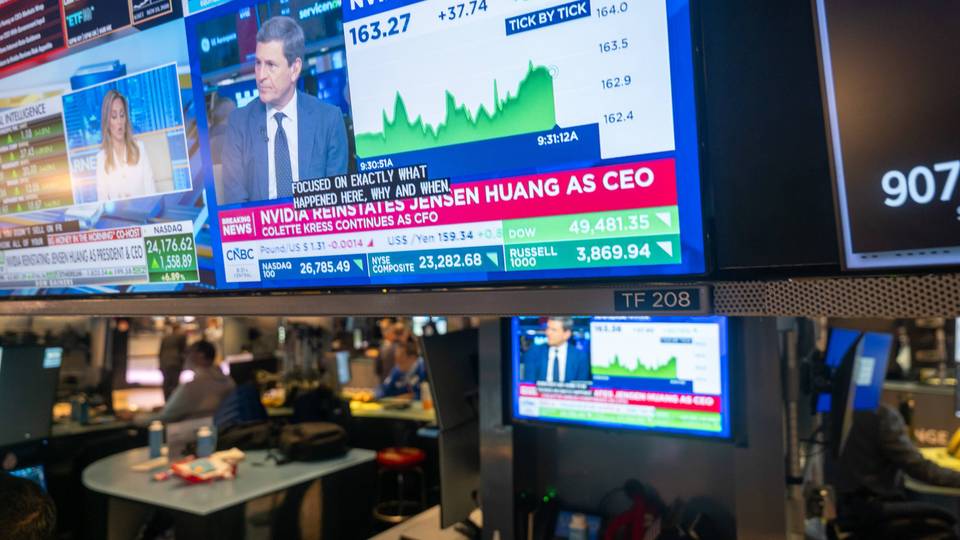
AI investment remains strong despite bubble fears, but market corrections and turmoil around Nvidia are raising concerns about fragility and a potential broader downturn.
Warnings about an artificial-intelligence investment bubble have grown steadily louder over the past year, but the money has kept flowing. Funding for AI firms has remained robust, and Anthropic has capped the frenzy with what is being described as the largest initial public offering on record. For many investors, the message seemed clear: whatever doubts might be building, the market’s appetite for AI exposure has not yet been satisfied.
Still, the recent mood in financial markets has been shifting. Beyond the headline-grabbing valuations, signs of strain have started to appear both inside the AI ecosystem and across the broader economy. Major equity benchmarks have recently slipped into “correction” territory—typically defined as a drop of more than 10% from recent highs—an indication that investors are reassessing risk after a long run of optimism.
Part of that pullback has been tied to turmoil at one of the sector’s central pillars: Nvidia. Markets were rattled by the scandal-driven resignation of the company’s chief executive, Jensen Huang, a development that reverberated far beyond a single stock given Nvidia’s outsized role in powering the AI boom. The subsequent rush to bring Huang back underscored how dependent market confidence has become on a handful of firms and personalities—and how quickly sentiment can turn when that confidence is shaken.
The episode has also highlighted a deeper concern: today’s markets may be more brittle than they look. When valuation narratives rely on continued breakthroughs, uninterrupted access to capital, and stable leadership at key companies, even a narrow shock can spread rapidly. The question increasingly facing investors and policymakers is whether these early cracks point to a limited recalibration—or the beginning of a more serious market reckoning.
Complicating the outlook is the policy environment. Two decades ago, governments and central banks had more perceived capacity to respond aggressively to financial distress, cushioning markets when bubbles deflated or credit seized up. Now, that backstop may be less reliable. If another crisis takes shape, officials could find their room to maneuver constrained, leaving markets more exposed to downside spirals.
Against this backdrop, Project Syndicate is convening a “Big Question” discussion to probe what may come next. The forum brings together economists and analysts Mark Blyth, Jeffrey Frankel, Cecilia Rikap, Amit Seru, and Paola Subacchi to weigh the likelihood of a significant market downturn and to assess its potential distributional impact—who might be positioned to ride out volatility, and who could be left vulnerable if conditions deteriorate.
The conversation comes at a moment when the AI boom, once treated as a near-unquestionable growth story, is starting to be tested by broader financial fragility. Whether the current correction becomes a temporary pause or the start of something more disruptive will depend not only on corporate earnings and technological progress, but also on the resilience of financial institutions and the willingness—and ability—of governments to intervene.
Why it matters
A sharp reversal in AI-linked markets would not stay confined to Silicon Valley; it could affect retirement portfolios, corporate investment, and public finances. With major indexes already in correction territory and confidence tied tightly to a few key firms, small shocks can have outsized effects. The next signals to watch are policy makers’ capacity to stabilize markets and whether AI financing can continue at today’s pace without exposing deeper weaknesses.