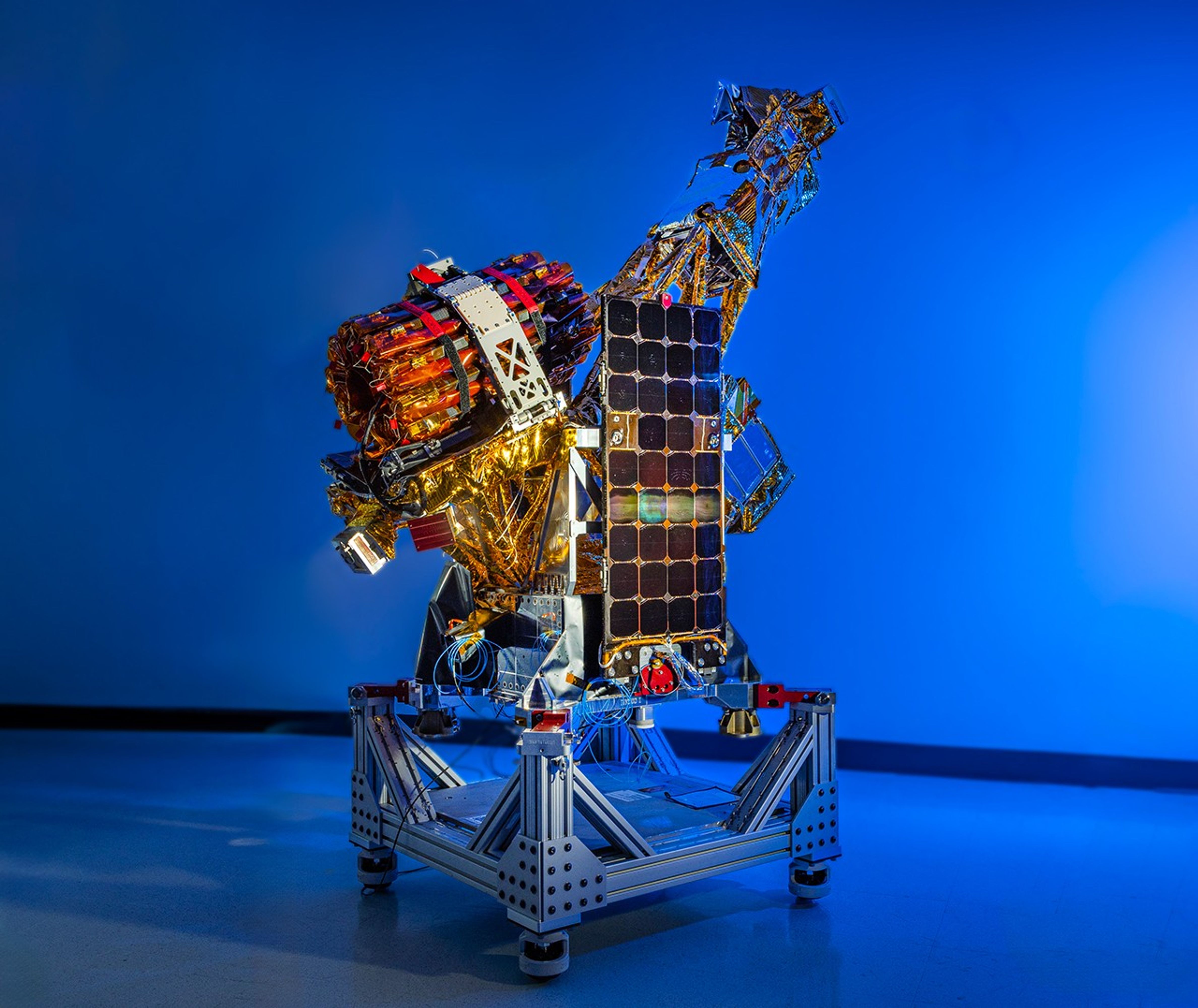
Inside Blue Canyon Technologies’ facilities in Lafayette, Colorado, one of three spacecraft for NASA’s INCUS mission has cleared a major milestone: completion of…
Inside Blue Canyon Technologies’ facilities in Lafayette, Colorado, one of three spacecraft for NASA’s INCUS mission has cleared a major milestone: completion of prelaunch testing ahead of a planned late-May 2026 readiness date. The satellite is part of a trio that, working together, will deliver the first space-based survey focused specifically on how tropical convective storms build and change over time.
INCUS—short for Investigation of Convective Updrafts—relies on three nearly identical satellites operating in low Earth orbit as a coordinated formation. Their timing is central to the mission design. The first and second spacecraft will pass over the same target area just 30 seconds apart, while the third will follow 90 seconds after the second. That staggered sequence is intended to capture rapid storm evolution that is difficult to resolve with single-satellite overpasses.
Each satellite is equipped with a radar instrument built to measure the vertical movement of air and water in developing storms. Scientists refer to that combined vertical transport as convective mass flux, a key quantity for understanding how thunderstorms grow, intensify, and organize—especially in the tropics, where convection plays an outsized role in shaping global weather and climate patterns. In addition to the radars, the middle satellite in the formation will also carry a microwave radiometer, adding complementary observations to help characterize storm structure and the surrounding atmosphere.
NASA currently plans to launch INCUS in 2027 from the agency’s Wallops Flight Facility in Virginia. The mission is funded through the Earth Venture Mission-3 acquisition within NASA’s Earth System Science Pathfinder Program, which supports targeted Earth science investigations. INCUS is led by principal investigator Sue van den Heever of Colorado State University in Fort Collins.
The effort also fits into NASA’s broader Earth observation strategy. INCUS is among a set of missions designed to meet the agency’s clouds, convection, and precipitation measurement needs as part of the Earth System Observatory—an interconnected suite of missions intended to examine Earth’s changing natural systems and the ways those systems influence one another.
In addition, INCUS is incorporated into FALCON, short for Fleet for the Atmosphere Linking Commercial Observations with NASA. Under the FALCON framework, atmospheric observing satellites draw on a mix of contributions, combining hardware and expertise from NASA centers, universities, and commercial partners. Together, those partnerships are intended to expand and accelerate the collection of key atmospheric data, with INCUS adding a new capability: closely timed, multi-satellite views of the inner dynamics of tropical storms from space.