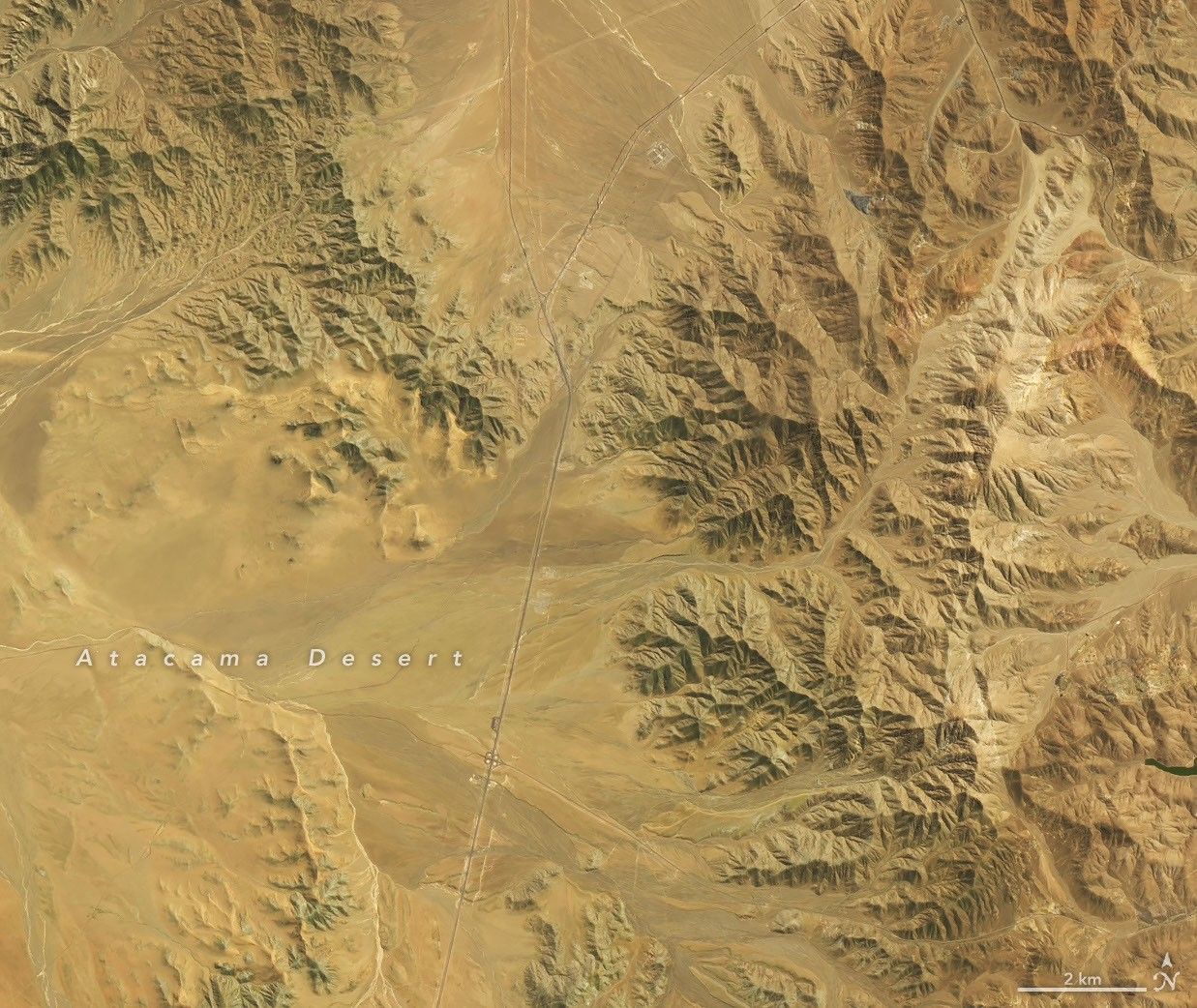
Unusually heavy winter rains linked to El Niño triggered a vast “flowering desert” in Chile’s Atacama, with satellites capturing colorful blooms that may be the largest yet recorded.
Parts of northern Chile’s Atacama Desert—better known for bare rock and salt flats than vegetation—erupted into broad bands of red-purple, green, and white during the austral spring of 2026. The burst of color followed an unusually wet winter that delivered the moisture needed to rouse seeds that can lie dormant in the soil for years, setting off what researchers say may be the largest desierto florido (“flowering desert”) observed in the era of satellite monitoring.
The timing aligns with a strengthening El Niño in the tropical Pacific. In typical years, a persistent subtropical high-pressure system helps keep the Atacama among the driest places on Earth. During El Niño, that high tends to weaken, while a separate blocking high often develops in the South Pacific near the southern tip of South America. Together, these shifts can nudge the Southern Hemisphere storm track northward, steering more storm systems toward latitudes that usually stay parched.
Chile’s national weather service, the Dirección Meteorológica de Chile, reported that conditions began changing in mid-July, when a succession of storm fronts—fed by an atmospheric river—brought one of the heaviest July rain episodes in decades across a long swath of the country, from the Atacama region south to Los Lagos. Winter weather continued into August, when back-to-back storms even dropped rare snow on parts of the Atacama, underscoring how exceptional the season had become.
As spring arrived, satellites captured the desert’s transformation in detail. Image pairs taken weeks apart show the landscape progressing through different stages of flowering: scenes from September 14 were collected by the Operational Land Imager (OLI) aboard Landsat 8, while October 24 imagery came from OLI on Landsat 9.
One set of images highlights terrain roughly 30 kilometers (20 miles) southwest of Copiapó, near the eastern portion of Desierto Florido National Park. By late October, expansive red-purple fields dominate the view—blooms of pata de guanaco, most likely Cistanthe longiscapa or another Cistanthe species, according to remote-sensing scientist Roberto Chávez of the Pontificia Universidad Católica de Valparaíso. Chávez and colleagues were on site the same day as the satellite overpass, documenting the flowering with drones and digital cameras while coordinating those observations with satellite data.
Their broader aim is to translate these combined measurements into maps showing how biodiversity within the flowering desert shifts across the landscape and changes over time—information that could support land-use decisions and conservation management.
A second satellite comparison focuses on an area about 50 kilometers (30 miles) southwest of Copiapó, located within a priority zone recognized for its biological value, including its flowering displays. In October, Cistanthe again appears abundant. But the September imagery reveals another signature of the phenomenon: green hillsides topped with white, attributed to suspiros (Nolana), likely Nolana baccata, according to plant geographer Andres Moreira-Muñoz, also at the Pontificia Universidad Católica de Valparaíso. Researchers photographed Nolana-covered slopes there on September 24, 2026.
Long-running satellite records have become central to understanding when and where the Atacama blooms. A 2014 study used Landsat data to map flowering and fog-dependent plant communities around the Copiapó dune field. Another analysis in 2019 drew on NASA’s long-term vegetation record to identify 13 bloom events between 1981 and 2015. Against that backdrop, the 2026 flowering stands out. Moreira-Muñoz said the current episode appears to be the most notable yet in its reach, intensity, and persistence—at least within the period tracked by modern remote sensing.
Why it matters
The Atacama’s rare blooms reshape habitats and draw attention to fragile ecosystems that can be affected by tourism, development, and climate variability. If El Niño-driven shifts continue to amplify precipitation extremes, land managers may face new pressures to protect biodiversity hotspots that appear only episodically. The next key question is how long the 2026 bloom persists—and whether follow-on wet years alter the desert’s plant communities in lasting ways.