APODScienceAPODAPOD: 2026 October 13 –…Today’s APODArchiveSubmissionsIndexSearchCalendarRSSEducationAboutDiscuss APOD Astronomy Picture of the Day Discover the cosmos! Each day a different image or photograph of our fascinating universe is featured, along with a brief explanation written by a professional astronomer. OriginalAnnotated Desert Stairway to Heaven Explanation: This stairway in Chile brings you only a little bit closer […]
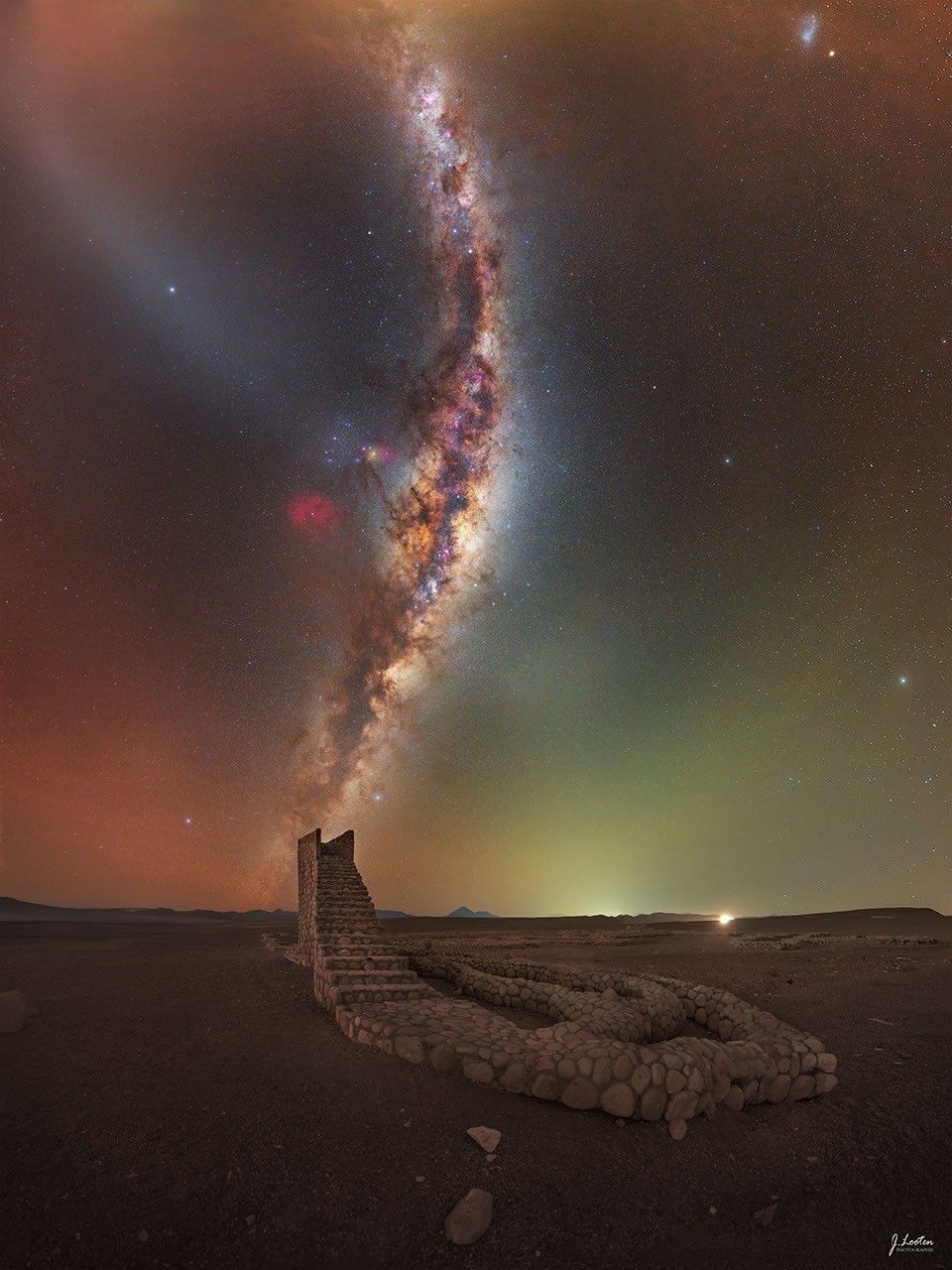
A staircase in Chile’s Atacama Desert may promise only a modest climb, but the view overhead is the real spectacle. In a wide-angle nightscape assembled from multiple images, a foreground artwork known as the Desert Staircase appears to lead toward a sky dense with astronomical landmarks—inviting the familiar “stairway to heaven” metaphor while underscoring how far the cosmos remains beyond reach.
The scene is dominated by a dramatic, dark ribbon cutting through the star field: the dust lanes of the Milky Way. Rising steeply behind the desert, the galaxy’s central band appears almost vertical, an effect created by the timing and framing of the shot as well as the latitude of northern Chile, where the Milky Way can present striking orientations during certain seasons and hours of the night.
To the upper left, a faint, pale glow marks the zodiacal light—sunlight scattered by dust particles spread through the inner Solar System. Within that same zone of sky, the bright star Spica is visible, serving as a pinpoint reference amid the softer, diffuse band of reflected light.
Just above the horizon, the photograph records subtle atmospheric luminescence: airglow rendered in green and red tones. Unlike auroras, which are driven by bursts of solar activity, airglow is a persistent, planet-wide phenomenon produced when atoms and molecules in the upper atmosphere release light after being energized by sunlight during the day.
At the top right of the image sits another destination entirely: the Small Magellanic Cloud, a dwarf galaxy that orbits the Milky Way and is visible from the Southern Hemisphere. Its hazy, detached patch contrasts with the Milky Way’s dense star fields, reminding viewers that the night sky is not only a map of our own galaxy but also a window onto neighboring systems.
The photographer also built terrestrial geography into the composition. Along the horizon—discernible on close inspection—lie, from left to right, sections of the Andes Mountains, the prominent cone of Licancabur volcano, and the distant glow from the town lights of San Pedro de Atacama. These ground-level features anchor the sky’s scale, emphasizing the desert’s renowned darkness and the region’s status as one of Earth’s premier locations for astronomy.
The composite image was captured in July 2025 and carefully timed so the Desert Staircase aligns with the Milky Way’s near-vertical sweep, turning a desert sculpture into a visual gateway to the galaxy beyond.
Why it matters
Images like this illustrate how the Atacama’s clear, dry air enables both professional and amateur astronomy—conditions increasingly threatened worldwide by light pollution and atmospheric change. For skywatchers, the scene highlights several phenomena at once, from zodiacal light to airglow, that are easy to miss in brighter skies. As observatories expand in northern Chile, preserving dark-sky environments around places such as San Pedro de Atacama will be crucial to keeping these views—and the science they support—within reach.