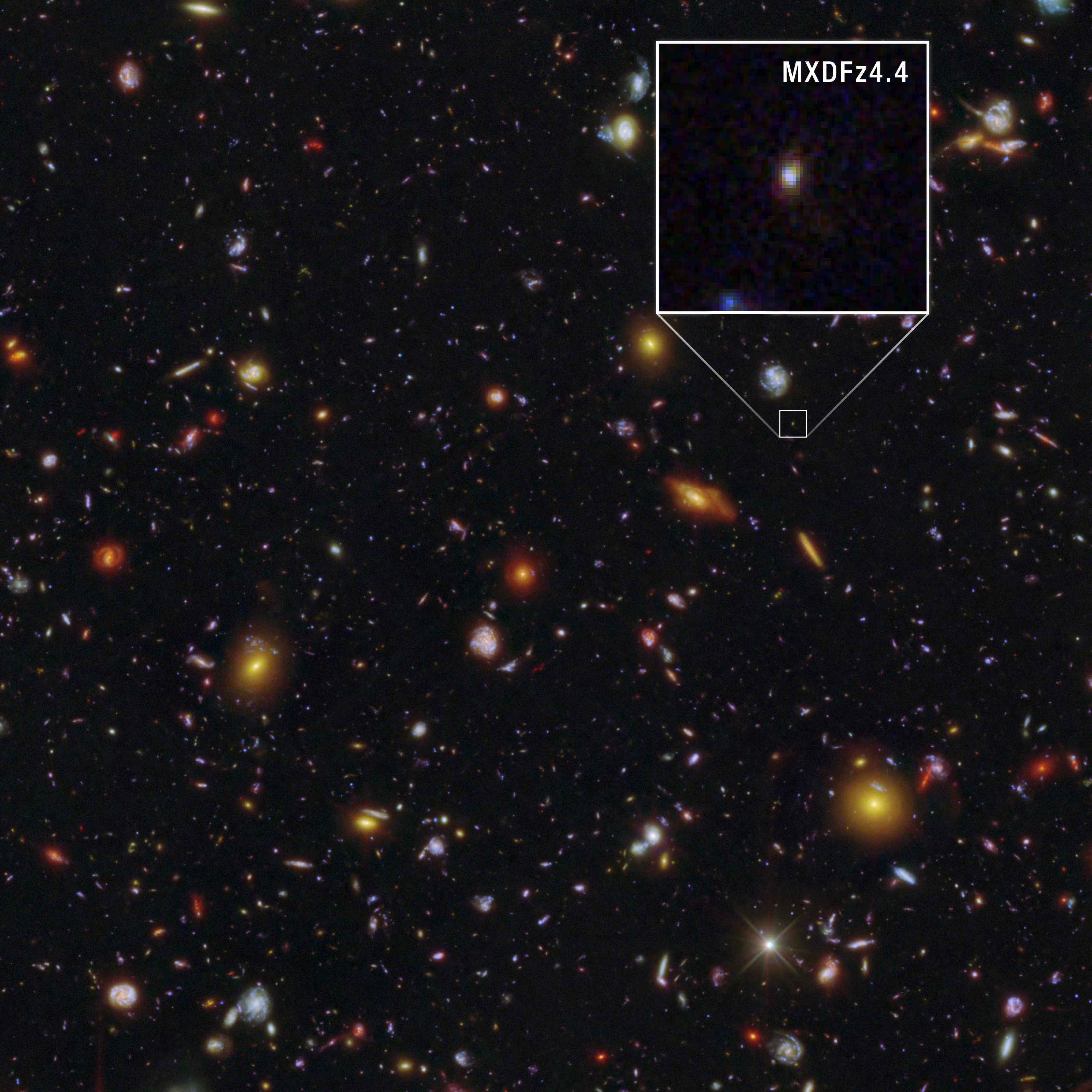
Astronomers studying the early universe with NASA’s Hubble Space Telescope have detected something long considered out of reach: ionizing ultraviolet radiation escaping…
Astronomers studying the early universe with NASA’s Hubble Space Telescope have detected something long considered out of reach: ionizing ultraviolet radiation escaping from a galaxy seen as it existed just 1.4 billion years after the Big Bang. The observation offers direct evidence that compact, intensely star-forming galaxies could have helped dismantle the primordial “fog” of neutral hydrogen that once absorbed high-energy light, gradually making the universe transparent. The results are reported in a study published June 23 in The Astrophysical Journal.
The galaxy, known as MXDFz4.4, is observed near the close of the Era of Reionization—a sweeping transition in cosmic history. In the universe’s first roughly billion years, the space between galaxies contained abundant neutral hydrogen gas that blocked energetic ultraviolet photons. Over time that gas became ionized, allowing ultraviolet light to travel freely. Researchers suspect the shift unfolded over hundreds of millions of years rather than happening abruptly, but direct observations that connect galaxies to ionizing radiation during this period have been scarce. MXDFz4.4 provides a rare data point.
“Seeing a galaxy like this was thought to be impossible,” said lead author Ilias Goovaerts, a postdoctoral fellow at the Space Telescope Science Institute (STScI) in Baltimore. The prevailing expectation was that neutral hydrogen in the early cosmos would be too dense to permit any escaping ionizing radiation to be detected. Yet Hubble not only identified the signal, it also helped characterize the galaxy in detail.
The physics begins with young, massive stars, which produce intense ultraviolet light capable of stripping electrons from hydrogen atoms. After traveling more than 12 billion years to reach Earth, that radiation has been stretched by the expansion of the universe—redshifted into wavelengths Hubble can observe. With its combination of wavelength coverage, sensitivity, and crisp space-based resolution, Hubble is uniquely able to capture this kind of radiation from such early epochs.
While astronomers have cataloged many galaxies from the same era, none had previously yielded a clear detection of escaping ionizing photons. “That makes MXDFz4.4 one of a kind,” said co-author Marc Rafelski, Hubble deputy mission head at STScI.
To tease out the source of the emission, the team relied on Hubble’s extremely long exposures assembled from multiple archival surveys. The data indicate that the galaxy’s ultraviolet output is driven by clusters of very young stars formed in bursts within the last few million years of the galaxy’s life. Those stars are packed into a remarkably small region: MXDFz4.4 spans an area about 100 times smaller than the Milky Way’s, yet it is producing new stars about 10 times faster. Concentrating many hot, massive stars in a tight volume, Goovaerts noted, is an efficient way to punch channels through surrounding gas.
The researchers estimate that roughly 50% to 100% of the ionizing radiation from these young stars escapes the galaxy’s immediate environment. Short stellar lifetimes may enhance that leakage: massive stars survive only a few million years before many explode as supernovae, injecting vast energy into their surroundings and carving out cavities that let even more light stream outward.
The picture is strengthened by complementary observations. Near-infrared measurements from NASA’s James Webb Space Telescope helped determine the galaxy’s mass, separate the contribution of older, cooler stars, and reconstruct its star-formation history—showing that the recent activity came in bursts and that the older population cannot account for the ionization. “Without Webb to clarify what we saw in Hubble’s images, we couldn’t make these conclusions,” Rafelski said. Meanwhile, visible-light spectroscopy from the European Southern Observatory’s Very Large Telescope, using the MUSE eXtremely Deep Field data set that gives MXDFz4.4 its name, pinned down the galaxy’s age at 1.4 billion years after the Big Bang.