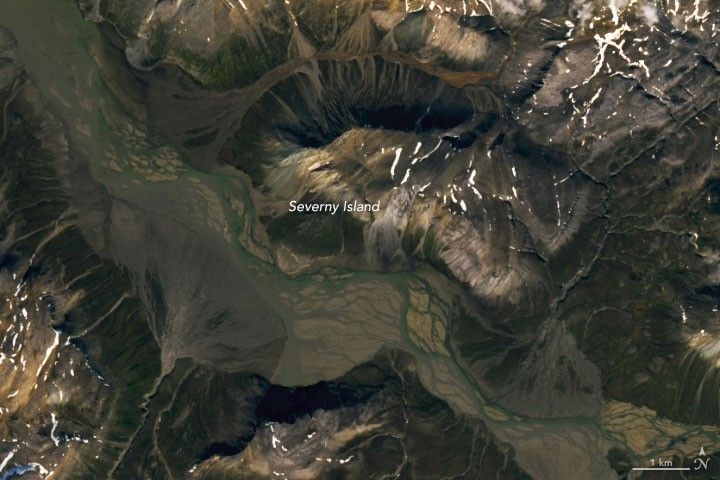
Sediment carved from ice-covered mountains is fanning out across a wide river valley on Russia’s Severny Island, creating striking cone-shaped deposits visible from space.
Sediment carved from ice-covered mountains is fanning out across a wide river valley on Russia’s Severny Island, creating striking cone-shaped deposits visible from space. A recent Landsat 9 scene captures several of these features—known as alluvial fans—arranged like opposing wedges along a braided river system at the island’s southern end.
Severny Island (Ostrov Severnyy) lies deep in the Russian Arctic as part of the Novaya Zemlya archipelago. It is mountainous, uninhabited, and dominated by glacial ice. In the north, some glaciers extend to the coastline and meet the sea. Farther south, many glaciers terminate on land, where their meltwater forms streams that race downslope and deliver sediment into valley networks.
Alluvial fans develop where steep, confined channels emerging from rugged slopes spill onto flatter terrain. The shift in gradient slows the flow, reducing the river’s ability to carry its load. As a result, sediment drops out, building a wedge that broadens outward from the mountain front. Over time, the river subdivides into multiple smaller channels and repeatedly shifts position, distributing material across the deposit and gradually constructing a fan-like shape.
In the Landsat view, multiple fans appear in contrasting orientations along the same valley system, a pattern that becomes even more apparent in a wider perspective of the region. Several valleys trending northwest to southeast show the same “dueling” arrangement—fans building out from opposite sides toward the central drainage.
The ingredients for these landforms are abundant on Severny. Seasonal snowmelt and glacial runoff likely provide a steady supply of water and sediment during the warmer months. Hydrologists note that melt-season flows can transport larger volumes of debris out of the mountains, increasing the rate at which fans grow. Glaciers themselves are also major sediment factories: as ice moves downhill, it grinds rock into loose material that can be flushed away when meltwater increases.
That linkage between meltwater, sediment, and fan construction is especially relevant for southern Severny Island, where many glaciers are small and terminate on land. Such glaciers are often more sensitive to atmospheric warming because their lower-elevation ice is more exposed to melt. Although the archipelago’s glaciers remain relatively understudied due to the region’s remoteness, satellite monitoring has begun to fill in the gaps.
Recent studies that combined satellite data with digital elevation models found that land-terminating glaciers across Novaya Zemlya thinned during the 2000s and 2010s, with the strongest losses occurring at lower elevations. The same processes reshaping the glaciers may also be helping to feed the island’s sediment-laden streams—keeping Severny’s Arctic rivers stocked with the raw material needed to build and rebuild the fans spreading across its valleys.
The imagery was produced using Landsat data from the U.S. Geological Survey and published by NASA’s Earth Observatory.