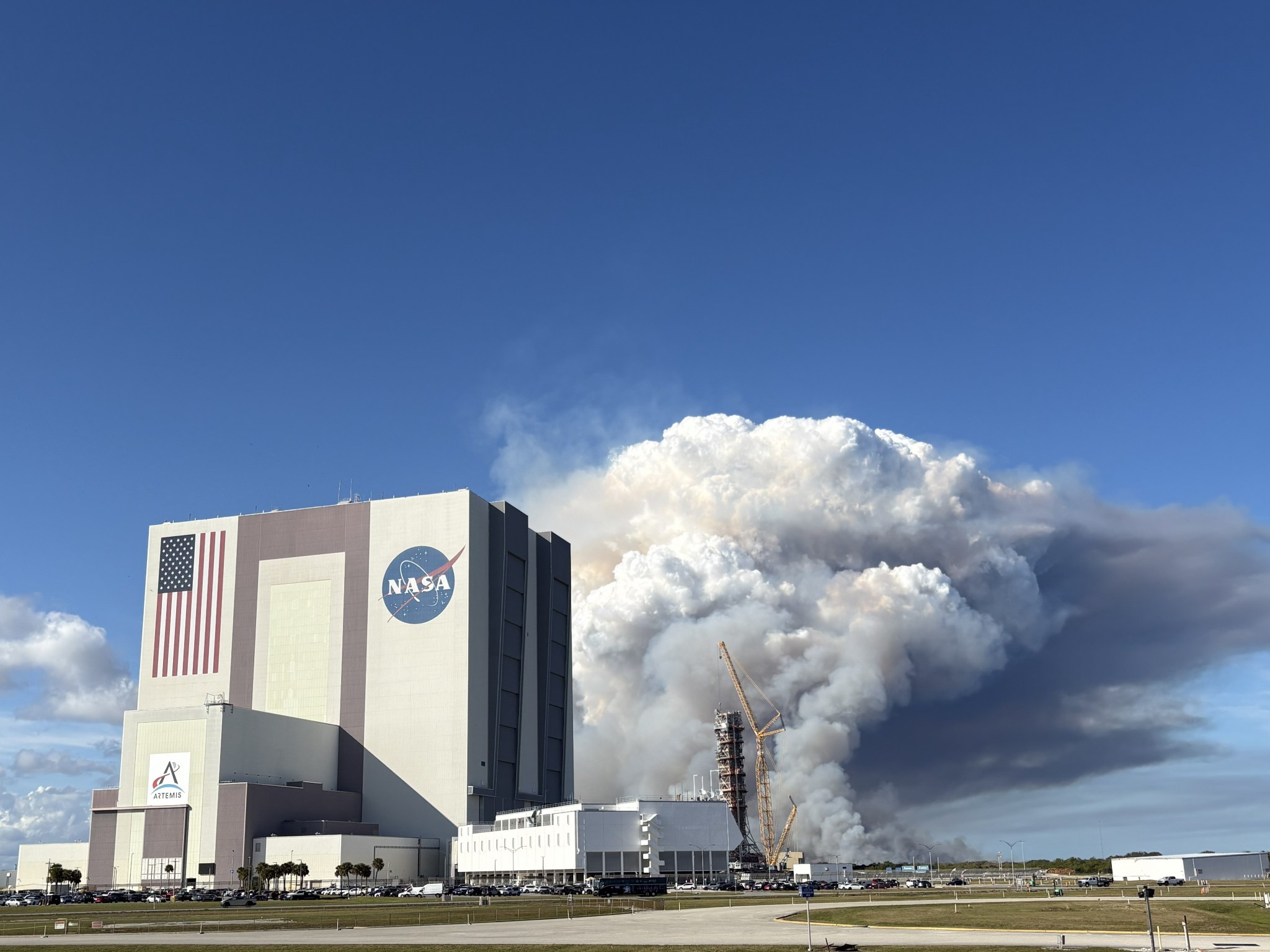
Spectators who flock to NASA’s Kennedy Space Center for a rocket launch are used to seeing flames and smoke rising from the pad.
Spectators who flock to NASA’s Kennedy Space Center for a rocket launch are used to seeing flames and smoke rising from the pad. But on the second weekend of January 2026, the haze over Florida’s busiest spaceport came from a very different source: a carefully planned set of prescribed fires lit on purpose—while a launch countdown was underway.
In a first for Kennedy, NASA worked with the U.S. Fish and Wildlife Service and commercial space partners to carry out roughly 2,600 acres of controlled burns across scrub habitat on and around the center. Personnel from NASA Kennedy’s Spaceport Integration Directorate coordinated the effort, while Fish and Wildlife crews executed two separate burns designed to reduce wildfire fuel and sustain the fire-dependent ecosystem of the Merritt Island National Wildlife Refuge, which surrounds the spaceport.
The larger operation covered about 1,400 acres in the northeast portion of the center at a site known as Happy Creek. That area is an important stronghold for the federally protected Florida scrub-jay and other species that depend on periodic fire to maintain the open, scrubby landscape they need to survive.
A second burn targeted about 1,200 acres east of Kennedy Parkway and south of the industrial zone, near the spaceport’s seven-story headquarters. The unit also sits close to high-profile facilities that support both NASA’s legacy programs and future missions, including the Neil A. Armstrong Operations and Checkout Building and the Space Systems Processing Facility.
Until now, using fire as a land-management tool inside Kennedy’s secure perimeter—or within the refuge—typically meant halting launch-related activities. That approach is becoming increasingly difficult to sustain. The spaceport recorded more than 100 successful liftoffs for the first time in 2025, and officials expect the pace of launches to keep increasing, raising the stakes for managing vegetation and reducing the risk of uncontrolled fires.
“As more launches occur at Kennedy, the need for proper land management at the refuge has never been greater,” said Greg Gaddis, the center’s senior operations manager for the spaceport. He warned that without new ways to cut down fuel on the ground while accommodating government and commercial launch schedules, a stray lightning strike or other ignition source could trigger a fire with severe consequences for U.S. space operations and the private sector.
Launch traffic is now one of several variables the prescribed burn manager—known as the burn boss—must weigh when selecting burn windows. Weather is another: during Florida’s dry season, steady Atlantic breezes can rapidly intensify a fire or shift smoke into sensitive areas, threatening refuge wildlife as well as launch and processing infrastructure.
Kennedy officials emphasized that safety drove every step. The center’s Space Operations Office worked directly with Fish and Wildlife and mission partners, reviewing wind forecasts and putting measures in place to protect employees in areas expected to be impacted by smoke. NASA issued smoke advisories, temporarily moved some staff, and enabled remote work for others. Smoke also led to intermittent closures of major roads and entrances over the weekend.
Shawn Sullivan, assistant fire management officer for Fish and Wildlife’s Region 4 and the burn boss for the operation, described the effort as a real-time lesson in coordination. “To do is to learn, and we all learn each day,” he said, praising the collaboration among specialized teams.
Land managers say the refuge is healthiest when burns occur every two to three years, a cycle that supports resilient habitats—particularly for species like the Florida scrub-jay that evolved alongside regular fires. Choosing the right time and location, officials noted, remains one of the most complex responsibilities in managing a wildlife refuge embedded within an increasingly active spaceport.