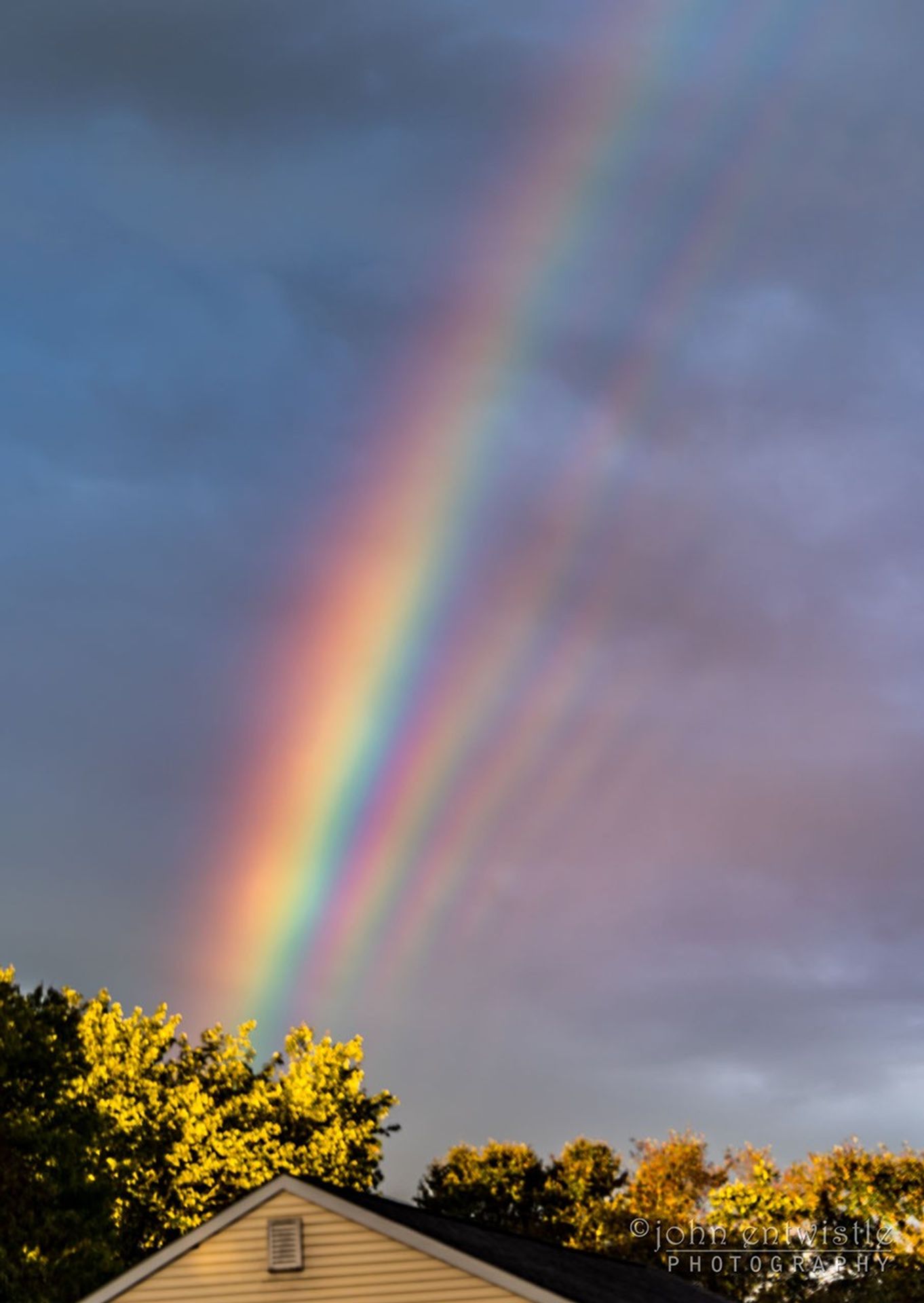
A rare cluster of supernumerary rainbows appeared over New Jersey after Hurricane Florence, showing multiple faint arcs. The extra bands arise from wave interference in uniform raindrops.
In 2018, as the remnants of Hurricane Florence moved beyond the Jersey Shore in New Jersey, the weather briefly set the stage for an optical display far more elaborate than an ordinary rainbow. With the Sun breaking through in one part of the sky, the opposite horizon lit up with what looked like a layered ring of color—a cluster of closely spaced arcs appearing and disappearing over roughly 30 minutes.
The photographer, watching alongside his daughter, recorded the shifting spectacle as bands of color strengthened, softened, and returned again. In a single image, at least five distinct extra arcs can be seen: these are known as supernumerary rainbows, a relatively rare form of rainbow that adds faint, repeated fringes inside the primary bow.
Unlike the common rainbow produced mainly by refraction and internal reflection in a wide range of raindrop sizes, supernumerary bows require more precise conditions. They form when the falling droplets are nearly uniform in size—typically smaller than a millimeter across. When that uniformity is present, sunlight entering the droplets doesn’t just bounce around and exit to form the familiar spectrum. It also behaves as a wave, and wave effects become visible.
Specifically, light emerging from slightly different paths within the droplets can overlap and combine. Where the waves reinforce each other, the colors brighten; where they cancel, they dim. The result is a set of delicate, additional bands—an interference pattern comparable to the rippling patterns created when disturbances on a pond intersect. These extra stripes can be vivid when conditions are just right, but they can also fade quickly as droplet sizes change with shifting wind, evolving rainfall, or the end of a storm.
Supernumerary rainbows carry historical scientific weight, too. When observers in the early 19th century documented these extra arcs, the phenomenon posed a problem for purely ray-based explanations of optics. The fringes could not be accounted for without treating light as a wave. Their existence became one of the clues—well before modern quantum and electromagnetic theory—that the nature of light involved wave behavior, not just straight-line rays.
The New Jersey scene after Florence offered a natural demonstration of that physics: the atmosphere briefly became a laboratory, producing multiple interference fringes in plain view.
Why it matters
Supernumerary rainbows are more than a photogenic curiosity—they are direct, observable evidence of wave interference in everyday life. For photographers, weather watchers, and educators, they highlight how subtle changes in droplet size and storm conditions can dramatically alter what appears in the sky. As extreme weather events and shifting precipitation patterns continue to affect coastal regions, similar short-lived optical displays may become more widely documented, offering both striking images and teachable moments in atmospheric science.