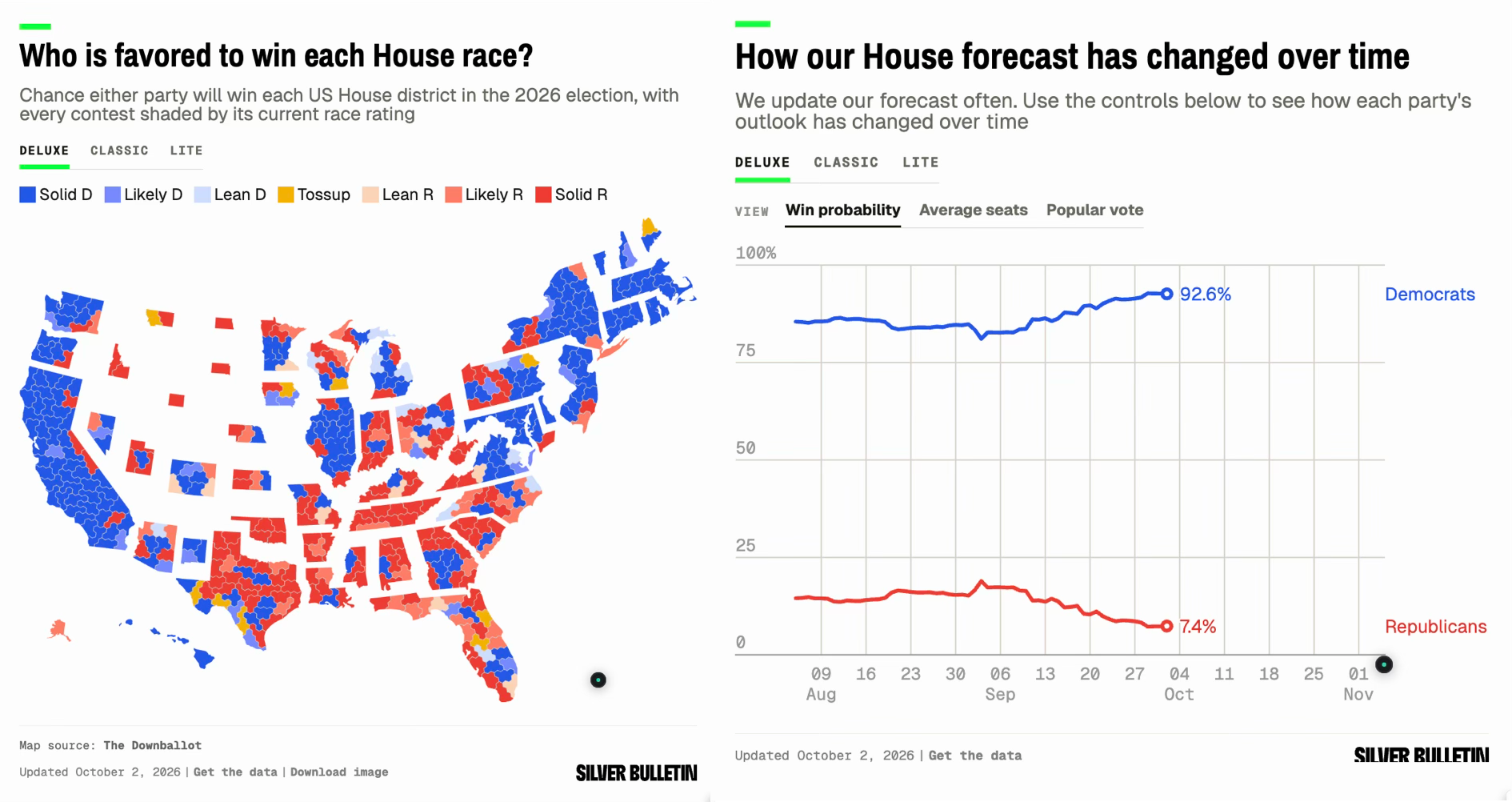
Nate Silver’s latest numbers suggest Republicans may not need to win the national popular vote for the House by much to secure a majority.
Nate Silver’s latest numbers suggest Republicans may not need to win the national popular vote for the House by much to secure a majority. In his view, a GOP advantage of roughly 2.5 percentage points in the overall House vote would be sufficient, on average, to translate into control of the chamber—an estimate that underscores how small shifts in turnout and district-level performance can decide which party reaches the critical 218-seat threshold.
Silver’s analysis—published through his subscription newsletter, the Silver Bulletin—does not present House control as the product of a single headline race. Instead, it highlights a handful of districts that appear poised to function as the tipping points: the contests most likely to deliver the seat that puts one party over the top.
Five races stand out in the model as the most probable candidates for that decisive “seat #218.” They are Pennsylvania’s 10th District, where Janelle Stelson is running against incumbent Scott Perry; Arizona’s 6th District, featuring JoAnna Mendoza against incumbent Juan Ciscomani; Pennsylvania’s 7th District, where Bob Brooks is challenging incumbent Ryan Mackenzie; New York’s 17th District, with Cait Conley taking on incumbent Mike Lawler; and Wisconsin’s 3rd District, where Rebecca Cooke faces incumbent Derrick Van Orden. Taken together, these districts span multiple regions and political environments, but share a common feature: they sit close enough to the national partisan balance that modest changes in the broader electorate could flip them.
What distinguishes Silver’s approach, supporters argue, is less the list of competitive seats than the discipline behind the probabilities. His stated priority is calibration—ensuring that events assigned a 75% likelihood occur about three-quarters of the time. That focus pushes against the tendency, common in campaign coverage and partisan commentary, to mistake hope or momentum for measurable advantage.
The same emphasis also shapes how Silver treats the “horserace” narrative. Rather than framing elections as a sequence of day-to-day lead changes—Candidate A up, then Candidate B, then back again—his perspective is that most outcomes are driven by fundamentals and structural factors that are often set well before Election Day. Polls and late-breaking developments can matter, but they tend to operate within constraints created by earlier events and underlying conditions.
In that telling, the real story is not the constant oscillation of short-term indicators, but the slow accumulation of forces—district partisanship, incumbency, national political climate—that eventually reveals itself in the final vote count. Many of the decisive factors, Silver’s framework implies, are already in place; the challenge is that observers cannot yet know which of them will prove most determinative until the election is over.
For readers trying to understand House control, the takeaway is straightforward: if the GOP does end up with around a 2.5-point popular-vote edge, Silver’s estimates suggest the party would be well-positioned to capture the seats needed for a majority—and the races most likely to deliver that majority could be decided in a small set of closely watched districts.