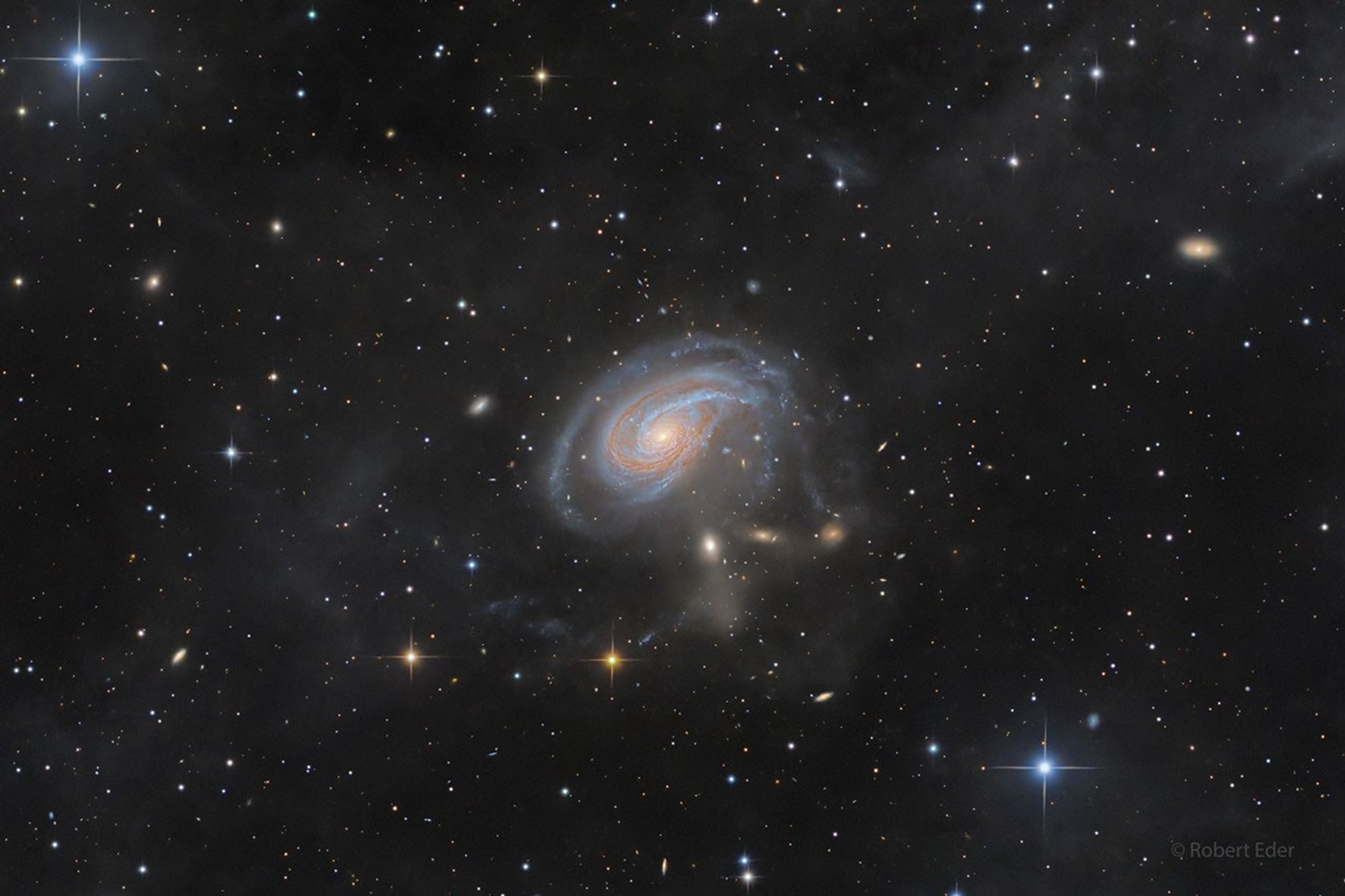
A striking new astronomical image is turning attention to Arp 78, an unusually distorted spiral galaxy located in the direction of the constellation Aries.
A striking new astronomical image is turning attention to Arp 78, an unusually distorted spiral galaxy located in the direction of the constellation Aries. Though it appears among the familiar stars of our own sky, the galaxy lies far beyond the Milky Way—about 100 million light-years away—placing it firmly in the realm of distant “island universes” that populate intergalactic space.
Arp 78 is better known to many observers as NGC 772, and it is notable not only for its odd appearance but also for its sheer scale. Astronomers estimate the galaxy spans roughly 200,000 light-years, making it about twice the diameter of the Milky Way. The new detailed view highlights the feature that has earned it a place in catalogs of peculiar galaxies: an outsized spiral arm that sweeps dramatically around the galaxy’s outskirts.
That oversized arm is not just visually impressive—it carries clues about the forces shaping the system. The image traces dark, curving dust lanes along the arm, while bright knots of young, blue star clusters line its length, signaling active star formation. Astronomers attribute the arm’s exaggerated development to gravitational tides acting across the galaxy, a sign that Arp 78’s structure has likely been pulled and stretched by external influences rather than evolving in isolation.
The leading suspect is its nearby companion, NGC 770, visible directly below the larger spiral in the portrait. Compared with NGC 772, NGC 770 is smaller and more compact, and it presents a smooth, fuzzy profile typical of an elliptical galaxy. Researchers think repeated gravitational encounters between the pair are the most likely cause of the tidal distortions that have amplified NGC 772’s outer arm.
The deep exposure also reveals faint stellar streams around the galaxies—subtle arcs and wisps of light that can be left behind when galaxies interact. These low-surface-brightness features offer additional evidence that the system has experienced past gravitational disruption, as stars can be drawn out into extended structures during close passes or minor mergers.
In the foreground, spiky-looking stars belonging to the Milky Way punctuate the scene, their diffraction spikes providing a sharp contrast to the soft glow of the distant galaxies. The juxtaposition underscores the depth of the image: nearby stars from our own galaxy appear superimposed on a far more remote cosmic encounter.
The Astronomy Picture of the Day project, which features a different space image each day accompanied by an astronomer’s explanation, noted that its email address for image submissions has changed and directed contributors to its updated submissions page.