Researchers say India’s overtime pay and week-by-week hour limits are stricter than Germany’s, making factories slower and costlier when scaling output.
India’s economic rulebook often resembles that of wealthy nations, but without the same administrative capacity to enforce or adapt it. Economists Shruti Rajagopalan and her co-author have described this pattern as “premature imitation”: adopting sophisticated regulations suited to high-income states, even when institutions on the ground are weaker, producing unintended distortions.
A new example, highlighted by researchers Anand, Chandra, and Pradeep at Prosperity Insights, suggests the imitation sometimes goes further—past the developed-world benchmark. Their comparison of work-hour rules finds India, not Germany, as the more restrictive jurisdiction for manufacturers trying to scale output quickly.
On paper, the two countries look similar at first. Both set a standard workday of eight hours. The divergence comes when demand spikes and firms need flexibility. In India, overtime must be paid at double the normal wage. By contrast, many advanced economies mandate time-and-a-half, and some impose no statutory overtime premium at all. Germany is unusual in another way: it does not set an overtime rate in national law, leaving pay levels to collective bargaining or agreements between employers and workers.
India is also more rigid about how much overtime employees can work. The country caps overtime at 144 hours per quarter. Germany does not regulate “overtime hours” directly; instead it limits total working time to a maximum of 10 hours per day and, on average, 48 hours per week. That averaging provision is central. German employers can shift hours across weeks within a six-month window: a stretch of long weeks can be made legal if compensated by shorter weeks later in the period. India’s rules are week-by-week, meaning firms cannot easily rearrange regular hours to handle peaks without triggering overtime obligations.
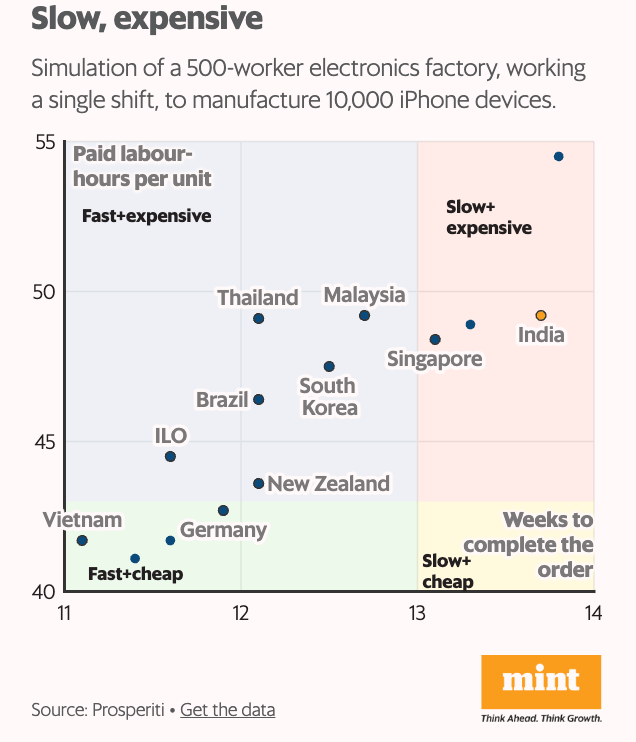
The consequences show up in a simple manufacturing thought experiment used by the researchers. They imagine identical 500-worker electronics factories—same wages, productivity, and technology—operating under the labor-hour rules of 16 different countries. Each factory receives a rush order ahead of a September iPhone launch: produce 10,000 devices within three months. With only working-time regulations varying, the analysis isolates how labor-law flexibility affects speed and cost.
Under India’s regime, the factory cannot keep pace with the fastest jurisdictions. It would take 13.7 weeks to finish the order—about 23% slower than the quickest factory in the comparison. The primary constraint is the inability to redistribute regular hours across weeks; the only legal lever to accelerate production is overtime, which is limited and expensive.
Costs rise as well. To meet the order, the Indian factory pays for 49.3 labor-hours per unit—at least 18% higher than the “cost frontier” factories. The arithmetic reflects the overtime premium: of 800 production hours per worker, 144 hours are compensated at twice the regular wage. That pushes paid labor time to 985 hours for 800 hours of output.
The result is a troubling combination for policymakers trying to court global manufacturers: slower delivery and higher regulatory-driven labor costs. In the researchers’ equal-wage comparison, producing iPhones in Germany comes out faster and cheaper than in India—an outcome meant to highlight regulatory inflexibility, not real-world wage differences.
As with many stringent rules, enforcement and compliance vary. Smaller Indian firms and workers often find informal workarounds and private agreements. But the multinational manufacturers India most wants to attract—large exporters operating in the spotlight—are far more likely to follow the law as written, making the rigidity economically consequential.
Why it matters
India’s push to become a major manufacturing hub depends not only on wages and infrastructure, but also on whether factories can legally scale up during peak demand. Rigid overtime caps and costly premiums can deter large, compliant global firms even when informal flexibility exists for smaller players. The key question going forward is whether India reforms working-time rules to preserve worker protections while allowing the scheduling flexibility that export manufacturing typically requires.