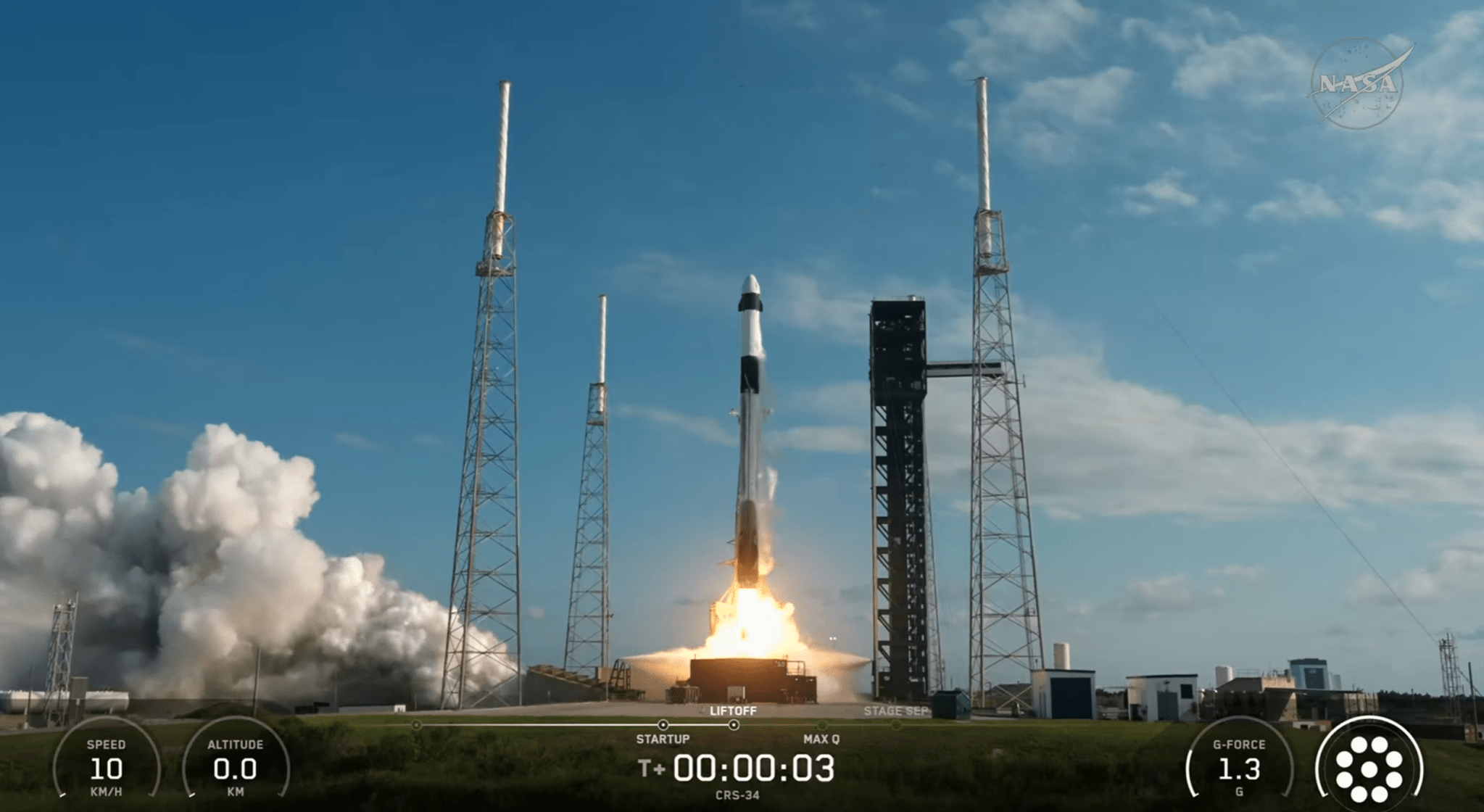
SpaceX has launched its 34th commercial cargo flight to the International Space Station for NASA, carrying a fresh slate of research along with supplies for the orbiting laboratory’s Expedition 74 crew.
SpaceX has launched its 34th commercial cargo flight to the International Space Station for NASA, carrying a fresh slate of research along with supplies for the orbiting laboratory’s Expedition 74 crew.
The mission lifted off at 6:05 p.m. EDT Friday, when a Falcon 9 rocket rose from Space Launch Complex 40 at Cape Canaveral Space Force Station in Florida. Riding atop the booster was SpaceX’s Dragon cargo spacecraft, packed with nearly 6,500 pounds of equipment, materials, and provisions bound for the station.
Dragon is expected to complete an automated rendezvous and dock at about 7 a.m. Sunday, May 17. The spacecraft will link up with the forward-facing port of the station’s Harmony module, a key connection point for visiting vehicles. NASA plans to provide live coverage of the final approach and docking starting at 5:30 a.m. on NASA+, Amazon Prime, and the agency’s YouTube channel, with additional viewing options available through NASA’s online and social media platforms.
Beyond everyday necessities for the crew, the cargo manifest includes multiple new investigations aimed at sharpening scientists’ understanding of how living systems and the space environment behave in microgravity. One study will assess how accurately Earth-based simulators reproduce weightless conditions—an important question for researchers who must often rely on ground facilities to prepare experiments for space. Another payload involves a bone scaffold derived from wood, a novel approach that could inform future therapies for bone-weakening disorders such as osteoporosis. A third experiment brings specialized hardware intended to help scientists examine how red blood cells and the spleen respond to spaceflight, shedding light on physiological shifts that can occur during long stays in orbit.
The Dragon vehicle is also transporting instruments focused on broader questions in space and planetary science and on the space environment surrounding Earth. Among them is a new sensor suite designed to observe charged particles near our planet—phenomena that can interfere with satellites and even affect power grids on the ground. Another investigation seeks to deepen fundamental understanding of how planets take shape, while a separate instrument is built to capture exceptionally precise measurements of sunlight reflected by Earth and by the Moon.
NASA emphasized that these projects represent only a small portion of the research portfolio conducted aboard the station, spanning biology and biotechnology, the physical sciences, and Earth and space science. The ISS has hosted a continuous human presence for more than a quarter century, providing a unique platform for experiments that cannot be replicated on the ground.
That steady stream of research also supports NASA’s broader exploration goals. Work on the station helps the agency address the medical and technical challenges of human spaceflight, encourages commercial activity in low Earth orbit, and contributes to preparations for longer missions—first to the Moon under the Artemis program and, eventually, to Mars.
Dragon is slated to remain docked until mid-June. At that point it will depart the station carrying time-sensitive research samples and return cargo, culminating in a splashdown in the Pacific Ocean off the coast of California.