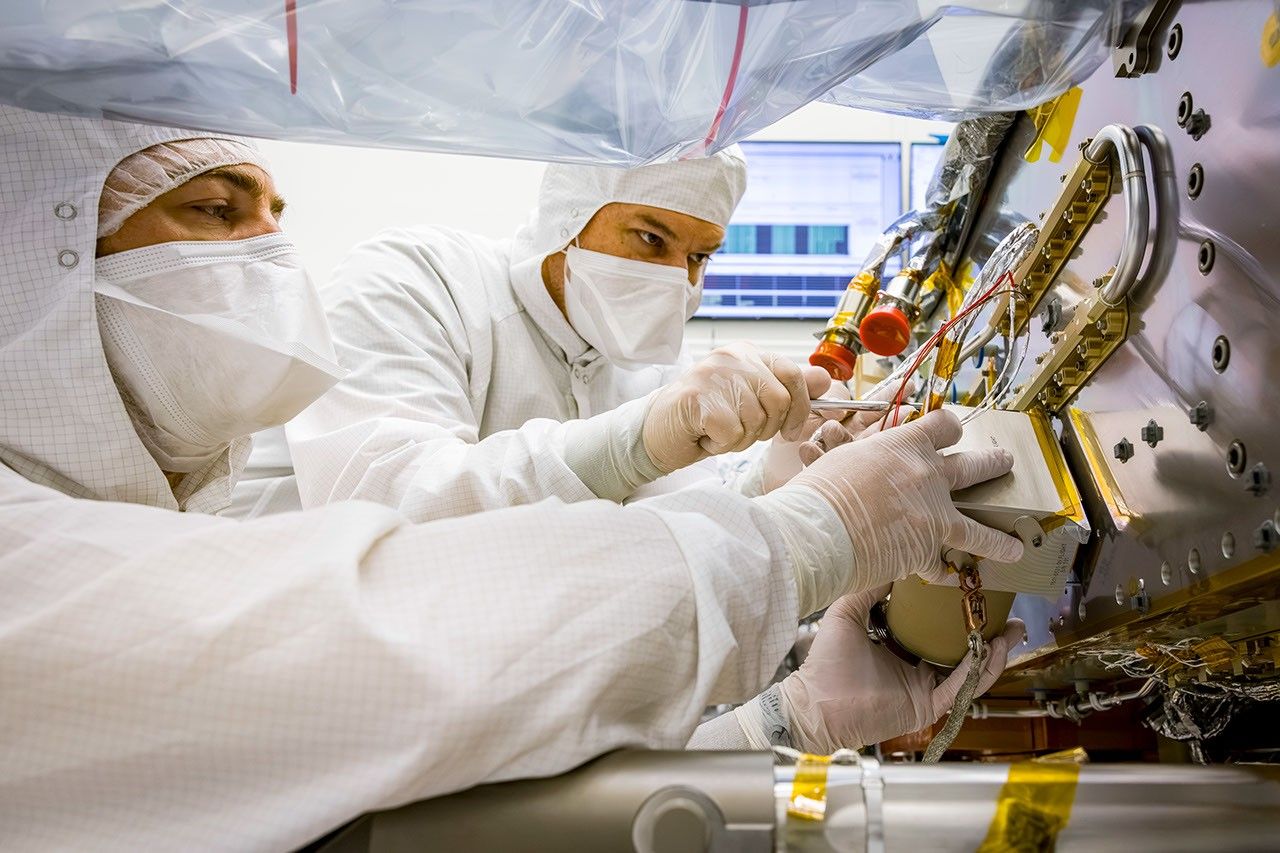
NASA’s Dragonfly mission has received its first major science instrument suite at Johns Hopkins APL: DragonCam, seven cameras to capture Titan’s surface in flight and on the ground.
Science hardware for NASA’s Dragonfly mission is beginning to arrive at the Johns Hopkins Applied Physics Laboratory (APL) in Laurel, Maryland, where engineers are assembling the rotorcraft that will one day hop across Saturn’s moon Titan. The first major instrument suite to be delivered is DragonCam—a set of seven science cameras intended to document Titan’s surface both during flight and while the vehicle is parked on the ground.
By mid-November, all seven cameras—designed and built by Malin Space Science Systems—had been mounted inside insulated housings, put through initial testing, and integrated onto the Dragonfly spacecraft. The protective packaging is essential for survival on Titan, where ambient temperatures plunge to about minus 290 degrees Fahrenheit. Each camera will view the outside world through its own window in a foam enclosure, which also helps shield Dragonfly’s interior from the moon’s cryogenic conditions.
DragonCam is paired with a tunable LED illumination system built at APL. Spanning wavelengths from infrared through ultraviolet, the light array will help scientists assess the colors of materials at sampling sites and infer aspects of their composition. The lighting could be especially valuable during Titan’s prolonged darkness: the moon’s night lasts nearly eight Earth days, and ultraviolet illumination may allow Dragonfly to spot organic compounds that fluoresce.
The camera suite is designed to deliver both close-up detail and broader context. “One of the most exciting things about Dragonfly is that we'll be able to see Titan from perspectives we've never had before,” said mission principal investigator Elizabeth Turtle of APL. She emphasized that imaging from the ground and in the air will enable everything from sweeping panoramas to close looks at terrain, helping researchers understand the processes that shaped Titan’s unusual landscape.
Alongside the science imagers, Dragonfly also carries two navigation cameras—likewise produced by Malin Space Science Systems—that were installed earlier this summer. Michael Ravine, DragonCam development manager and a Dragonfly co-investigator at Malin, called the delivery a key step toward envisioning how the system will perform on Titan, describing the cameras as the mission’s “eyes” on a new world.
Two forward-facing cameras form the heart of DragonCam’s terrain-imaging capability: a wide-angle camera (WAC) with a 90-degree field of view, and a medium-angle camera (MAC) that overlaps with the wide view while capturing a portion of it at higher resolution. Used together, they provide a stereoscopic look ahead of the rotorcraft. Two additional wide-angle cameras mounted on the sides expand that coverage to panoramic vistas.
For operations on the ground, two downward-looking WACs will image the surface beneath Dragonfly, supporting decisions about whether a landing site is safe for deploying the mission’s sampling drill—DrACO, short for Drill for Acquisition of Complex Organics—as well as its seismometer. A separate microscopic imager will examine the drill target area at high resolution, resolving features in sand grains on the scale of millimeters around the sampling spot.
“DragonCam will give us critical context for the samples collected by DrACO,” said Carolyn Ernst, DragonCam’s instrument scientist at APL. With Dragonfly set to collect material from multiple locations, she said the imagery will help scientists connect laboratory-style measurements to Titan’s wider geology.
More Dragonfly instrument hardware is expected to arrive for integration and testing in the coming months, including components of DraGNS (a gamma-ray and neutron spectrometer), DraGMet (geophysics and meteorology sensors), DraMS (a mass spectrometer), and the DrACO sampling system.
Why it matters
Dragonfly’s camera suite is central to turning Titan from a distant, hazy orb into a mapped, interpretable landscape—guiding both science decisions and safe surface operations. By combining panoramic, stereo, and microscopic views with multispectral illumination, the mission aims to link what it drills and measures to the broader story of Titan’s geology and organic chemistry. The next milestone to watch is the delivery and integration of Dragonfly’s remaining instrument packages as the rotorcraft moves toward full-system testing.