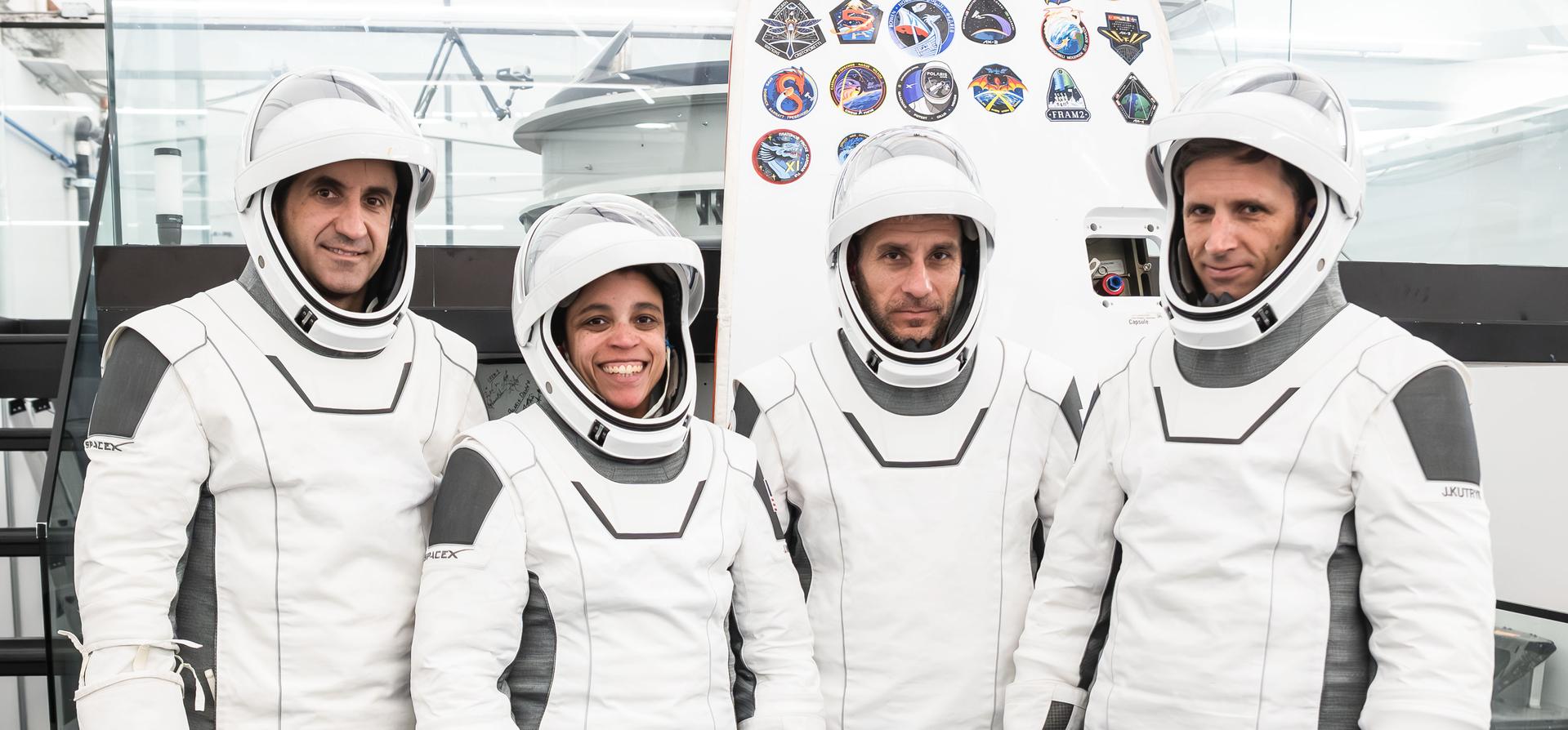
Four astronauts are preparing to head to the International Space Station on NASA’s SpaceX Crew‑13 mission, a long-duration flight focused on scientific research,…
Four astronauts are preparing to head to the International Space Station on NASA’s SpaceX Crew‑13 mission, a long-duration flight focused on scientific research, technology demonstrations, and routine upkeep of the orbiting laboratory.
The crew includes NASA astronaut Jessica Watkins as commander and NASA astronaut Luke Delaney as pilot. They will be joined by Canadian Space Agency astronaut Joshua Kutryk and Roscosmos cosmonaut Sergey Teteryatnikov, both serving as mission specialists. NASA and SpaceX are targeting liftoff no earlier than 11:10 a.m. EDT on Thursday, Oct. 1, from Space Launch Complex 40 at Cape Canaveral Space Force Station in Florida. Once in orbit, the team will integrate with the station’s Expedition 75 crew.
Over the course of the mission, the astronauts will carry out experiments designed to expand the capabilities needed for future exploration—particularly toward the Moon and Mars—while also generating insights that can benefit health and technology on Earth. According to Dana Weigel, who manages NASA’s Low Earth Orbit Program at the agency’s Johnson Space Center in Houston, Crew‑13’s research slate includes work that could support improved treatments for heart disease and Parkinson’s disease. The crew will study tissues derived from human stem cells, an approach intended to strengthen disease modeling, refine pharmaceutical testing, and inform medical development. Additional investigations will examine strategies for crop production—an area considered critical for sustaining crews on longer missions—along with studies aimed at clarifying blood-flow irregularities observed in microgravity. The astronauts are also scheduled to evaluate new diagnostic medical tools for tracking crew health in space.
Crew‑13 marks the 13th SpaceX-led crew rotation flight to the space station under NASA’s Commercial Crew Program. On the ground, teams are moving through Dragon’s preflight processing milestones while preparing a Falcon 9 booster that is slated to fly for the third time. In orbit, NASA’s SpaceX Crew‑12 is getting ready to depart after a short handover period following Crew‑13’s arrival.
NASA and SpaceX plan to complete standard checkouts of the rocket and spacecraft systems and finalize certifications before mating the Dragon capsule to the Falcon 9 inside SpaceX’s hangar at the launch site. After integration, the stack is expected to roll to the pad and be raised for key rehearsals and tests, including a dry dress rehearsal with the crew and a static fire of the rocket’s first-stage engines ahead of launch.
The four astronauts will fly aboard a SpaceX Dragon spacecraft named Grace, which previously supported Axiom Mission 4, a private astronaut mission that flew in summer 2025.
For Watkins, Crew‑13 will be her second trip to the station. Selected as a NASA astronaut in 2017, she grew up in Lafayette, Colorado, earned an undergraduate degree in geological and environmental sciences from Stanford University, and completed a doctorate in geology at the University of California, Los Angeles. Before joining the astronaut corps, she studied the Martian surface as part of the Curiosity rover science team at NASA’s Jet Propulsion Laboratory in Southern California. Watkins first reached the space station on Crew‑4 in 2022, logging 170 days in space during Expeditions 67 and 68. With Crew‑13, she is set to become the first NASA astronaut to launch twice aboard a SpaceX Dragon.
Delaney, selected as a NASA astronaut in 2021, is making his first spaceflight. A Florida native, he earned a mechanical engineering degree from the University of North Florida and a master’s in aerospace engineering from the Naval Postgraduate School. A distinguished naval aviator, Delaney flew missions supporting Operation Enduring Freedom and took part in exercises across the Asia‑Pacific region. He later worked as a test pilot evaluating developing aircraft systems, instructed other test pilots, and served as a research pilot at NASA’s Langley Research Center in Hampton, Virginia, supporting airborne science campaigns.
Kutryk is also flying to space for the first time. Chosen as a CSA astronaut in 2017, he previously served as a CF‑18 fighter pilot, flying missions tied to Canada’s commitments with NATO, the United Nations, and the North American Aerospace Defense Command.