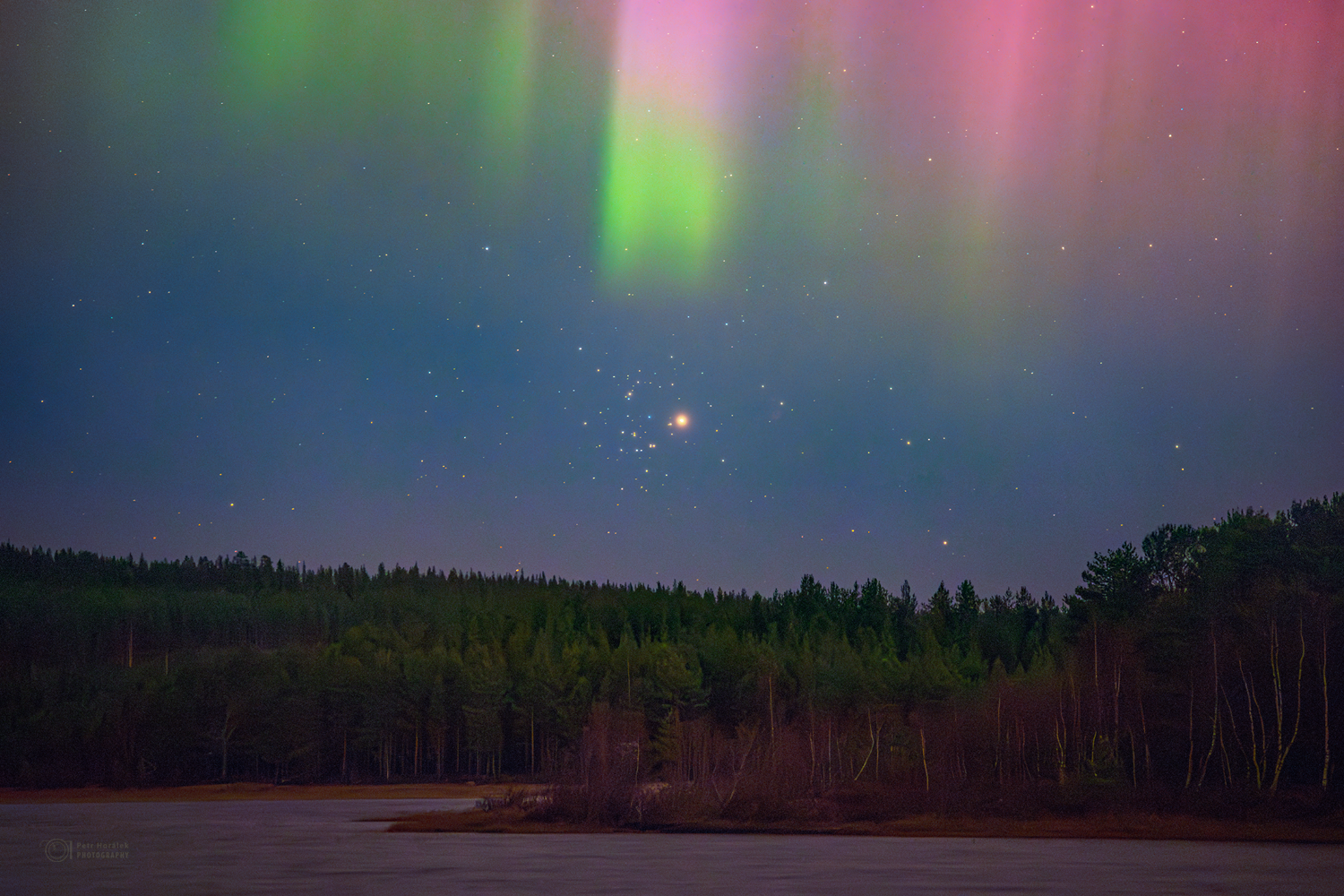
Over northern Sweden, Mars appeared unusually close to the Beehive Cluster as a bright auroral curtain shimmered overhead, captured in a rare night-sky alignment.
A rare alignment of celestial and atmospheric events unfolded over northern Sweden, where Mars appeared to slip into the same patch of sky as the Beehive Cluster while shimmering aurora lit the night.
The scene was recorded near Lansjärv, Sweden, with a line of trees along the horizon and a bright auroral band hanging like a curtain overhead. Beneath that glowing arc sat the Beehive Cluster—also known as M44 or Praesepe—while Mars shone nearby, temporarily positioned unusually close to the cluster’s center from our viewpoint on Earth.
The aurora was triggered by solar activity days earlier. A solar eruption sent a surge of charged material toward Earth, arriving on October 10, 2026. When that disturbance struck, it strongly agitated Earth’s magnetic environment. Energetic particles were funneled into the upper atmosphere, where they collided with atmospheric molecules and transferred energy. As those molecules relaxed back to lower energy states, they emitted light, producing the colorful auroral display captured in the image.
In northern Scandinavia, auroras are more than photogenic space weather. In North Sámi, auroras are called guovssahasat, and Sámi tradition treats the phenomenon with respect. The photograph therefore documents not only a geophysical consequence of solar storms, but also a familiar presence in Arctic skies that carries cultural significance for Indigenous communities across Sweden and neighboring regions.
While Mars is a solitary planet and the aurora is an Earth-bound glow, the Beehive Cluster is a genuine deep-sky gathering: a rich concentration of relatively young stars. Despite its name, it is not connected to insects—though real bees have traveled to space. Astronomers value clusters like M44 because their stars formed at roughly the same time, allowing researchers to compare how stellar properties evolve under similar ages and compositions.
One important measurement comes from how fast these stars spin. The rotation periods of Beehive stars have helped scientists track how stellar rotation slows with time. As stars age, they lose mass through stellar winds, and that outflow carries away angular momentum, gradually reducing their spin rates. Observations of the Beehive Cluster have therefore contributed to broader efforts to understand how stars change as they mature.
Here, all those threads—planetary motion, a cluster of young suns, and the aftereffects of a solar eruption—converged for a fleeting moment above the forests of Sweden.
Why it matters
Auroras are a visible reminder that solar eruptions can disturb Earth’s magnetic field, with implications that extend beyond beautiful skies to space-weather risks for technology. The same image also highlights how star clusters like M44 serve as natural laboratories for studying how stars spin down over time. With the Sun becoming more active at times, monitoring solar eruptions and their terrestrial effects remains essential—while skywatchers can look for more chance alignments that put familiar planets against rich stellar backdrops.