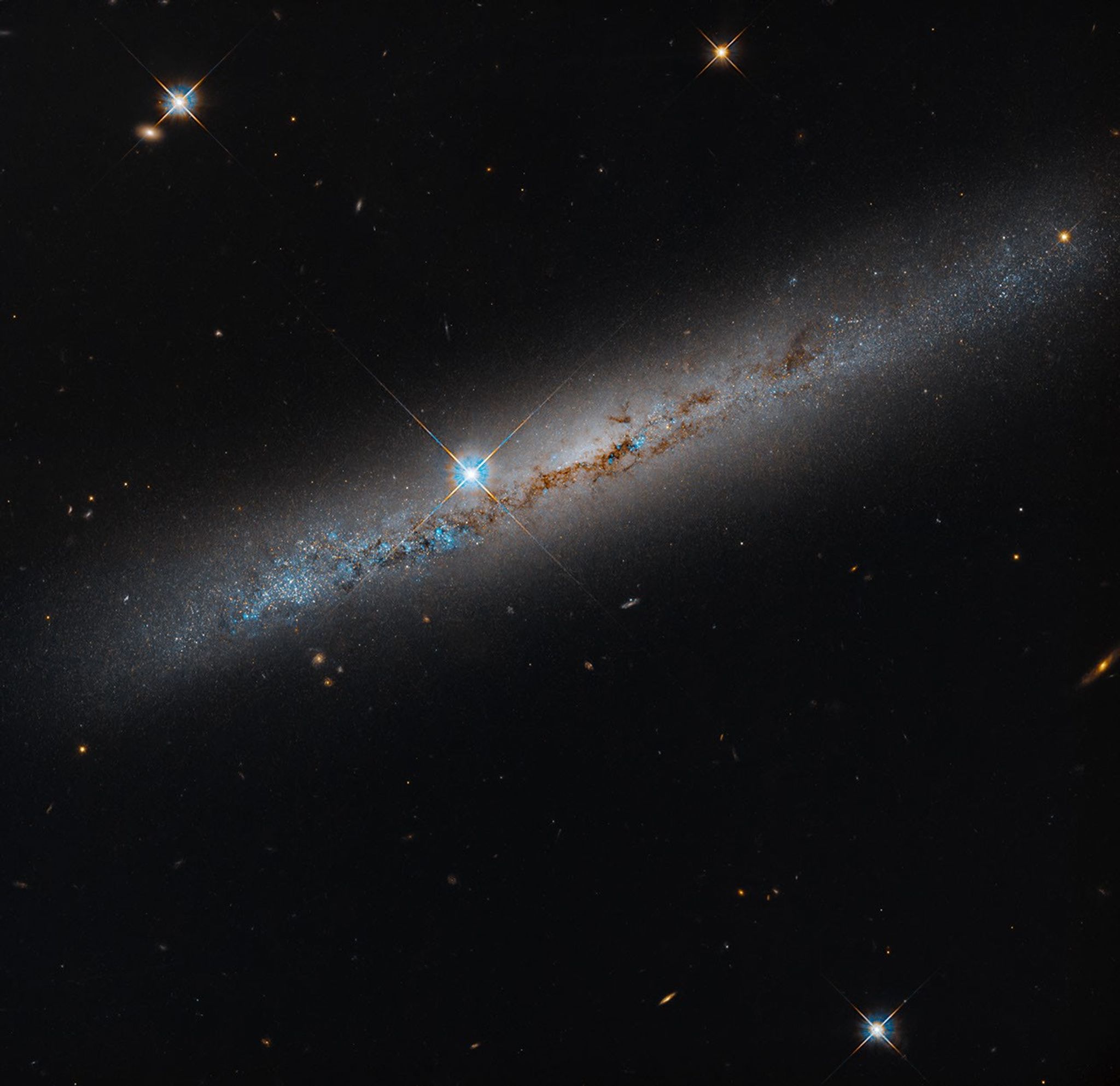
Hubble’s edge-on view of NGC 1827 reveals bright young stars and dark dust lanes in its thin disk, as part of a survey of satellite galaxies around Milky Way-like hosts.
Hubble has captured a striking edge-on view of NGC 1827, an intermediate spiral galaxy about 37 million light-years from Earth in the constellation Columba (the Dove). Seen from the side, the galaxy’s flattened disk and central bulge stand out sharply, offering astronomers a clear look at how gas, dust, and young stars are arranged along its plane.
The image was taken with Hubble’s Advanced Camera for Surveys as part of a larger observing campaign focused on small companion galaxies. In this program, researchers are surveying 260 satellite galaxies that orbit 22 host galaxies broadly similar to the Milky Way, all located within roughly 32 million light-years of Earth. Hubble has already completed observations of 111 of these satellites. Finishing the remaining targets is expected to require 149 additional Hubble orbits—about one orbit of observing time per galaxy.
NGC 1827’s disk shows scattered patches of vivid blue, a hallmark of hot, young stars. Threading through these bright regions are darker lanes of interstellar dust that block starlight. Such dusty structures typically trace reservoirs of gas and dust where new stars can form, and the contrast in this edge-on view highlights how actively evolving material is confined within the galaxy’s thin disk.
One of the most eye-catching points in the scene is not part of NGC 1827 at all. A bright star appears just to the left of the galaxy’s luminous central bulge, but it lies much closer to us—within the Milky Way—making it a foreground object that happens to align along the same line of sight. The star’s distinctive cross-shaped pattern is an optical effect: its four diffraction spikes are produced as starlight bends around the internal support structures that hold Hubble’s secondary mirror in place.
Beyond its visual appeal, the image connects to a major cosmological question. The broader satellite-galaxy survey targets low-mass galaxies—systems that are especially valuable for testing theoretical models of how structure forms and evolves in the universe. On small scales, cosmological simulations can struggle to reproduce what astronomers actually observe, particularly in the abundance and properties of faint companion galaxies around Milky Way-like hosts. By collecting consistent, high-resolution observations of these low-mass systems, Hubble’s dataset will help scientists better measure and compare their characteristics, improving the empirical foundation needed to refine cosmological models.
Hubble, launched in 1990, has repeatedly reshaped astronomy by delivering images and measurements that reveal the universe in unprecedented detail. Programs like this one continue that legacy, using the telescope’s sharp vision to turn nearby galaxies into laboratories for testing fundamental physics.
Why it matters
Small, faint satellite galaxies are a critical proving ground for cosmological theories, and mismatches between models and observations remain an active area of research. By building a detailed census of satellites around Milky Way-like galaxies, Hubble is providing the data needed to narrow uncertainties and update simulations. Watch for results that clarify how many low-mass companions exist, how they form stars, and how well current models can account for what Hubble sees.