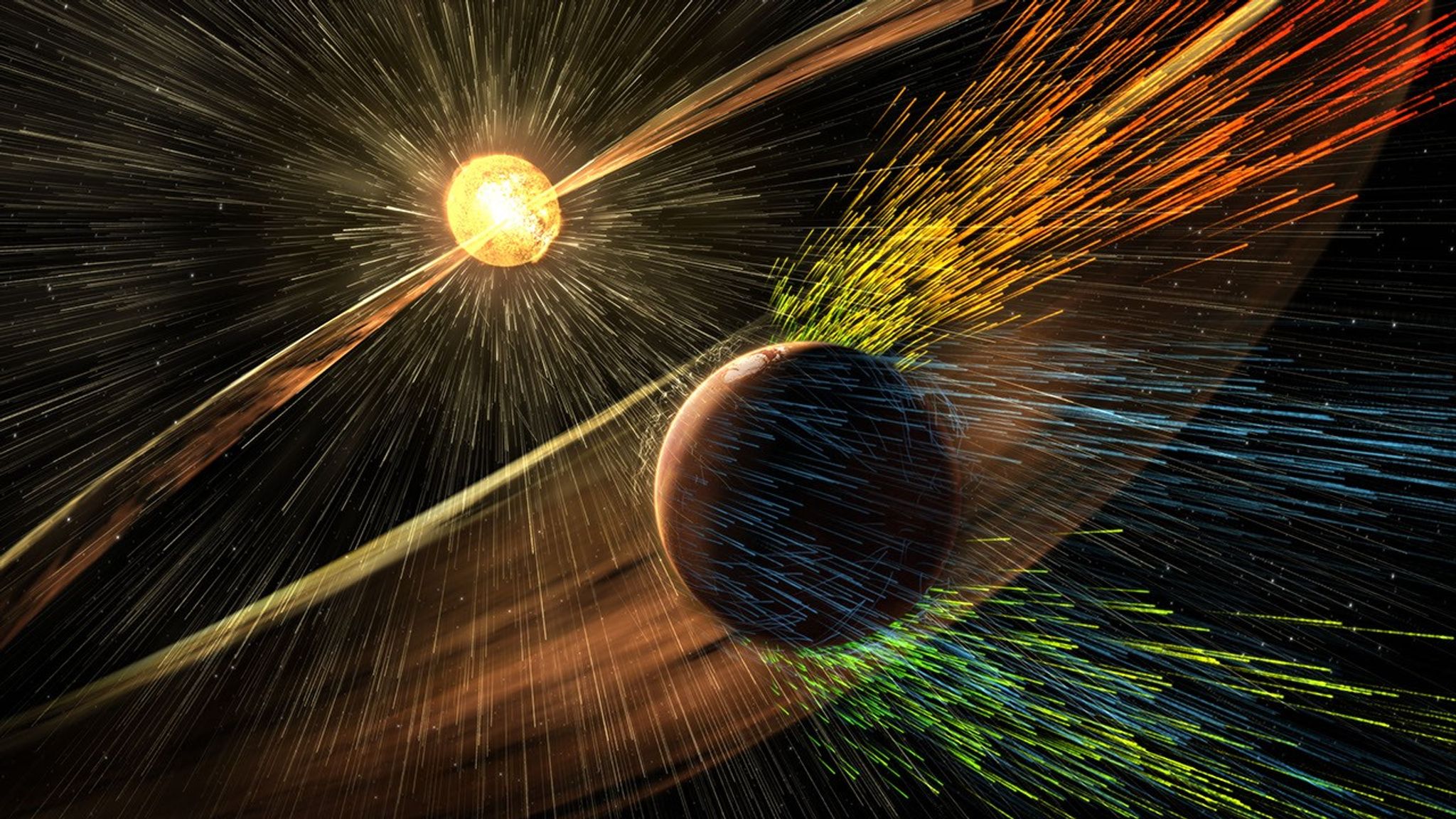
Scientists working with NASA’s Mars Atmosphere and Volatile Evolution MAVEN mission have identified a crucial mechanism behind some of Mars’ most distinctive auroras,…
Scientists working with NASA’s Mars Atmosphere and Volatile Evolution (MAVEN) mission have identified a crucial mechanism behind some of Mars’ most distinctive auroras, showing that they are powered by the same basic magnetic engine that sparks auroral light on Earth—only compressed into far smaller regions.
The finding, reported Thursday in Nature Communications, links Martian auroras to a scaled-down version of the “Dungey cycle,” a process long known to drive the flow of plasma and energy through Earth’s magnetosphere. On Earth, when the Sun’s magnetic field encounters the planet’s global magnetic shield, the two systems can “reconnect,” reshuffling magnetic field lines and pumping energy into the magnetosphere and magnetotail. That chain of events accelerates charged particles, including electrons, and funnels them back into the upper atmosphere, where their collisions generate auroras.
Mars, however, lacks the sweeping, planet-wide magnetic bubble Earth enjoys. Instead, it hosts patchwork magnetic strongholds: intensely magnetized sections of crust scattered across the surface. These localized fields—essentially miniature magnetospheres—are relics of an early era roughly 4 billion years ago, when molten rock cooled while an ancient global magnetic field still existed. That global field later vanished, and Mars became more vulnerable to the solar wind, a change tied to the gradual stripping of its atmosphere.
MAVEN has for years observed auroras concentrated above those crustal magnetic regions—tight, localized light shows that resemble Earth’s polar auroras in their connection to magnetic topology. Yet the detailed physics of how the necessary electrons were energized remained uncertain. The new analysis indicates that magnetic reconnection over these crustal “islands” can set up a compact Dungey-like circulation pattern, effectively acting as a small-scale particle accelerator that powers the auroral emissions.
“We knew that magnetic reconnection was happening at Mars but did not expect it to be like the Dungey cycle,” said Shaosui Xu, the study’s lead author and an associate research physicist at the University of California, Berkeley’s Space Sciences Laboratory.
To piece the mechanism together, the team combined measurements from multiple MAVEN instruments. The spacecraft’s Magnetometer and Solar Wind Electron Analyzer helped determine magnetic configurations and infer associated electrical currents. The STATIC instrument—short for Suprathermal and Thermal Ion Composition—was used to track plasma flows in the Martian ionosphere. Xu said the researchers “pushed the limit of STATIC” to extract the needed observations, calling it the final key to explaining the localized auroras.
The result does more than solve a Martian mystery. It demonstrates that the Dungey cycle is not confined to large, global magnetospheres like Earth’s; similar dynamics can operate in much smaller magnetic systems, expanding scientists’ expectations for where comparable processes might occur across the solar system.
“This is a remarkable result that changes how we think of Martian auroras and is another important step toward understanding why Mars and Earth have evolved so differently despite being governed by the same underlying physics,” said Shannon Curry, MAVEN’s principal investigator at the University of Colorado Boulder’s Laboratory for Atmospheric and Space Physics.
Although MAVEN itself is no longer operating—NASA reported the spacecraft lost contact on Dec. 6, 2025, and on June 3 declared the mission unrecoverable—its archive continues to yield discoveries that inform current research and shape future Mars exploration.