Alphabetical listing can skew recognition by repeatedly placing early-letter surnames first, boosting career rewards in economics and even influencing award outcomes like the Grammys.
Years ago, I argued that economics suffers from what might be called an “alphabet effect”: when a field routinely lists coauthors in alphabetical order, the first letters of a surname can quietly shape careers. At the time, the profession’s norm was straightforward—papers typically named authors A-to-Z. But that seemingly harmless convention came with measurable consequences.
In economics departments, faculty members with last names starting earlier in the alphabet have been found to enjoy an advantage in the markers that define elite status. They are more likely to receive tenure at top institutions. They are also disproportionately likely to be elected fellows of the Econometric Society. Even the most rarefied recognition in the discipline appears to tilt in the same direction—economists with early-alphabet surnames show up strikingly often among Nobel laureates. The pattern is hard to miss once you start looking for it.
Crucially, this is not a universal feature of academic life. The effect does not appear in psychology, a field that does not rely on alphabetical ordering in the same way when assigning author credit. That contrast is important: it suggests the imbalance is not driven simply by the distribution of names in the population, but by professional practices that repeatedly place some people “first” and others “later,” over and over, across papers, citations, and reputational shorthand.
Despite growing awareness, the alphabet’s influence has not disappeared. In economics, alphabetical ordering remains the default expectation. The American Economic Association has introduced a partial workaround: coauthors can now indicate that their ordering is random by adding a special ⓡ symbol next to the names—for example, “Ray ⓡ Robson.” The option is a nod to the concern that author order is often interpreted as a signal of contribution, even when it is not intended that way. Still, the broader equilibrium remains intact: most papers continue to present names alphabetically, and readers continue to infer priority from position.
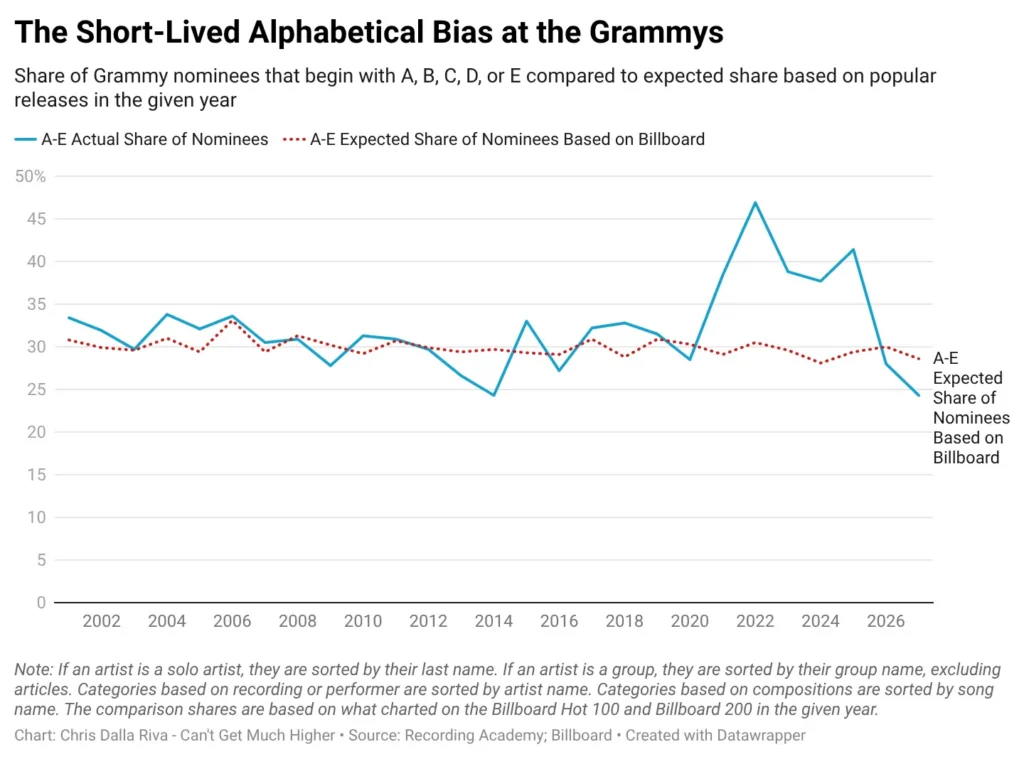
Evidence of the same dynamic has also surfaced outside academia. Economist Chris Dalla Riva has pointed to a striking case involving the Grammy Awards. From 2021 through 2025, Grammy nominees were, in practice, presented in alphabetical order—though the exact implementation has some complications, as Dalla Riva details. During that period, winners’ names skewed toward the beginning of the alphabet: nominees whose names started with A, B, C, D, or E won at a suspiciously high rate compared with how common those initials were among artists appearing on the Billboard charts.
The implication is not that voters or judges consciously favor “A” over “Z.” Rather, when people evaluate lists, attention and memory can be shaped by ordering—especially in settings where many options must be scanned quickly. If those lists are systematically alphabetized, the same subset of names repeatedly appears near the top, where cognitive advantages are easiest to come by.
Why it matters
Alphabetical conventions look neutral, but they can create persistent, compounding advantages in competitive systems—from academic promotion to high-profile awards. When recognition and career outcomes depend on visibility, small biases in ordering can translate into meaningful differences over time. Watch for whether more institutions adopt explicit randomization or contribution-based ordering—and whether evaluators learn to discount position on an alphabetized list.