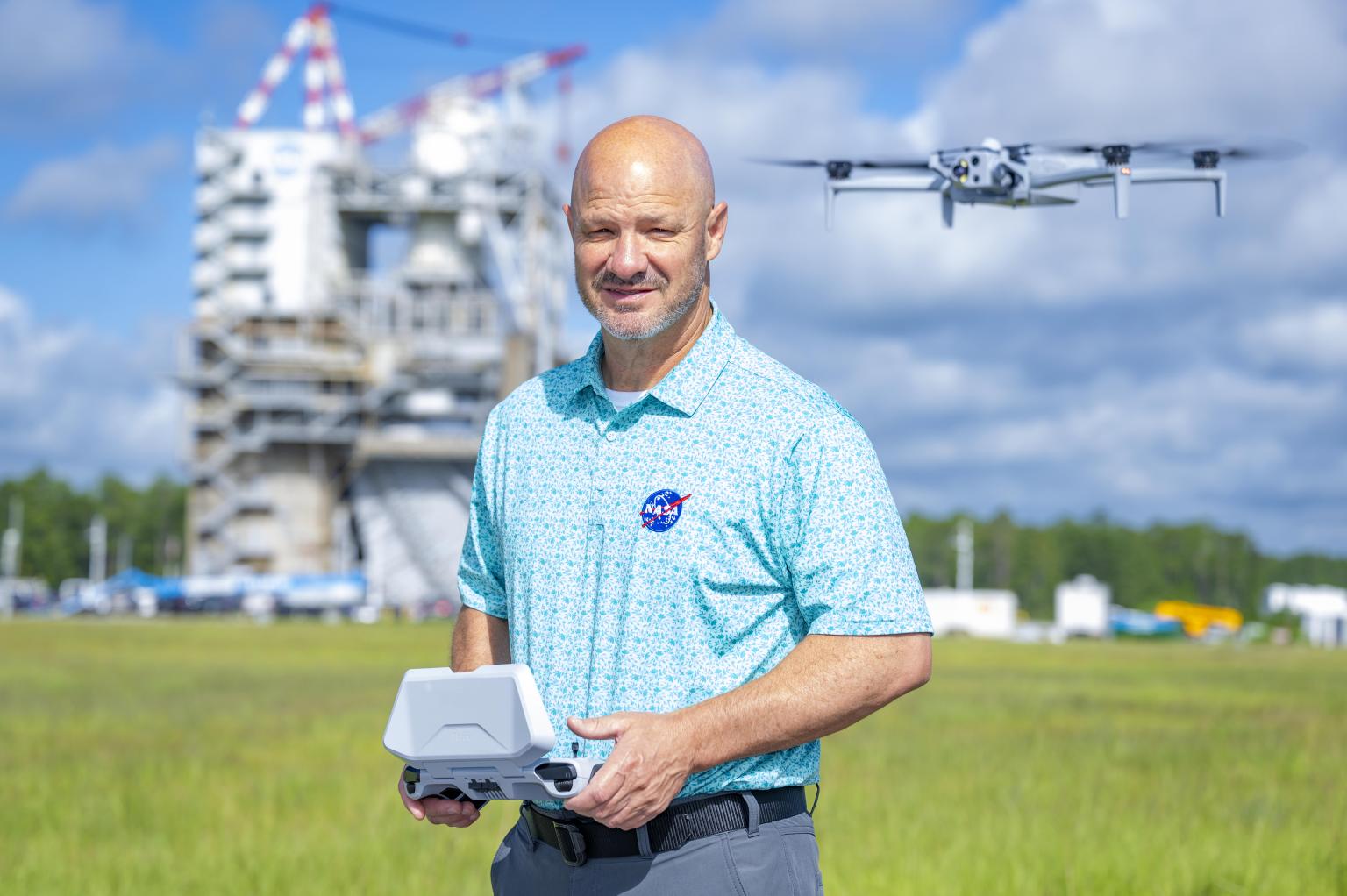
Jason Peterson is accustomed to managing range operations at NASA’s Stennis Space Center near Bay St. Louis, Mississippi.
Jason Peterson is accustomed to managing range operations at NASA’s Stennis Space Center near Bay St. Louis, Mississippi. But Artemis II asked more of him—placing the Mississippi native at the center of the effort to bring the mission’s most watched moments to audiences around the world.
For Peterson, the assignment carried an improbable symmetry. He grew up in DeLisle, just a short drive from Stennis, where the roar of rocket tests was part of daily life. “You would hear NASA testing, the windows would shake,” he recalled. Working for the agency once seemed unimaginable, he said, yet it became the destination of a winding career route.
After school he worked as a welder, then went to college and later joined the U.S. Air Force. That decision, he said, was where his trajectory toward NASA truly began. Peterson went on to spend 24 years in the Air Force and Air National Guard, specializing in airfield and air-to-ground range operations. He later added civilian aviation experience as an aircraft dispatcher at the Airbus Final Assembly Line—training, he believes, that prepared him for the relentless pace of Artemis II. The mission demanded 12- to 16-hour days as teams coordinated complex video and communications coverage for both launch and recovery.
Peterson supported the group tasked with delivering live video and communications feeds for the liftoff of NASA’s Space Launch System rocket, which carried the Artemis II crew—NASA astronauts Reid Wiseman, Victor Glover, and Christina Koch, along with Canadian Space Agency astronaut Jeremy Hansen—aboard the Orion spacecraft. Over nearly 10 days, the crew executed a record-setting lunar flyby, reaching a maximum distance of 252,756 miles from Earth.
His work culminated in the Pacific Ocean recovery operation aboard the USS John P. Murtha, where Peterson became the first person on the ship to visually acquire Orion as it returned. Operating one of six cameras used for live coverage, he relied on a high-resolution, multi-sensor system that included thermal imaging. By combining the ship’s heading with Orion’s predicted path, he located the capsule within minutes and kept it in frame as it descended.
The reentry profile left little margin for distraction. Orion began atmospheric interface at roughly 400,000 feet above Earth, traveling close to 35 times the speed of sound, and was about 1,956 statute miles from its eventual splashdown location off the coast of California. Peterson tracked the spacecraft from the first deployment of the small parachutes designed to stabilize and slow the capsule, through the opening of the main parachutes, and all the way to the ocean landing. The task, he said, requires total concentration—keeping the target centered, sharp, and steady as conditions rapidly evolve.
Weeks earlier, Peterson’s focus had been on Florida. At NASA’s Kennedy Space Center in the days before launch, he worked with the team conducting end-to-end checks, staging communications systems, and preparing drone and fixed-wing camera assets. On April 1, Artemis II launch day, they unloaded and assembled high-resolution sensors, connection terminals, routers, monitors, fiber lines, and drone gear. Drones were flown ahead of liftoff to capture crowd scenes and aerial perspectives, then positioned for the critical launch sequence as the SLS rose from the pad.
Once the rocket was on its way, the team packed up, returned to their facility, and offloaded the day’s video. Peterson arrived in San Diego on April 4 with the crew already more than halfway to the Moon. In the final days before splashdown, the team installed high-fidelity cameras and supporting equipment to ensure the public could witness the astronauts’ return on April 10.
With Artemis II completed, NASA’s next major step will be Artemis III, which will again launch four astronauts from Kennedy aboard Orion atop the Space Launch System, building on the April crewed test flight and pushing the Artemis program toward its next milestone.