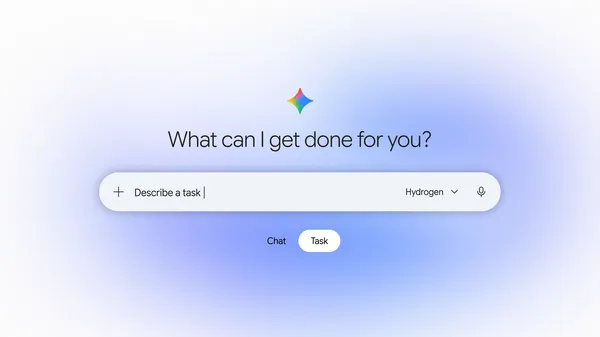
Google has upgraded Gemini into a task-focused assistant that can book appointments, place calls and shop by connecting to email, calendars and payments, with data kept isolated.
Gemini is moving beyond answering questions and into the role of a hands-on digital assistant that can complete real-world chores—placing phone calls, organizing schedules, helping manage household bills, and even purchasing items on your behalf.
Google says it has upgraded Gemini to take on “complex tasks” such as booking appointments, handling recurring to-dos like grocery shopping, and assisting with bill management. The new capabilities work by letting Gemini connect to services many people already use every day—email, calendars, and payment methods—so it can draw on existing information rather than asking users to re-enter details. Google emphasizes that these workflows run in isolated environments designed to keep personal data protected.
The company is making the new task-oriented experience available through multiple entry points. Users can switch the Gemini app interface from Chat mode to Task mode, send requests by text message on Android or iOS, or forward messages to gemini@google.com for Gemini to process and act on.
Josh Woodward, Google’s vice president overseeing Labs, the Gemini app, and AI Studio, said the intent is to offload everyday “life admin”—from managing grocery lists to reviewing and interpreting bills—by securely using information already stored in Google apps. In practice, that means Gemini can read relevant messages, identify constraints from a calendar, and then carry out actions such as proposing times or completing bookings.
Google is positioning the update for people whose days are crowded with classes, meetings, and school drop-offs, arguing that automation should save both time and money. The rollout begins now at no cost for “hundreds of millions” of users across the U.S., Japan, Korea, Canada, Australia, and India, powered by what Google calls its Gemini 4 Hydrogen model. A separate set of advanced features is also beginning to roll out, starting in the U.S.
The company also makes a strategic pitch: if your email, calendar, passwords, photos, files, and payment cards already live inside Google’s ecosystem, Gemini can function as a more seamless personal assistant because the sensitive data is already stored with Google—removing the need to route it through third-party systems.
Google offered a few examples of how the upgraded assistant works in day-to-day situations. After a minivan’s check-engine light appeared, Woodward described asking Gemini to contact the two closest dealerships and find an early Friday morning service slot sometime in the coming month. Because Gemini already knew the vehicle model—a 2019 Honda Odyssey—and the user’s location through Google’s “Personal Intelligence,” it identified nearby options using Google Maps, called both dealerships simultaneously, waited on hold, and booked an appointment at a location that schedules visits rather than relying on walk-ins. Gemini then found an open time on the user’s Google Calendar and added the appointment, completing the full loop in under five minutes. Google notes that Gemini discloses it is an AI when contacting businesses, that businesses can opt out, and that Gemini will not share payment or private account information without explicit user permission.
In another case, a surprise $389 electricity bill prompted an analysis request. With user permission and a new Google Password Manager integration, Gemini accessed a utility portal and reviewed historical statements found in email. It flagged a heat pump turning on around 4 p.m.—coinciding with peak pricing—as the key driver of the jump.
For shopping, Gemini can compare products using Google’s Shopping Graph, ask follow-up questions (such as preferred wattage or color), and complete checkout through a Google Pay integration. Google says Gemini can make these purchases using an “Agent Payments Protocol (AP2)” and is working with partners including American Express.
Why it matters
If Gemini can reliably execute multi-step tasks—calling businesses, analyzing bills, and paying or purchasing items—it could shift AI assistants from “chatbots” to practical automation tools for households and small businesses. The biggest stakes are trust and control: users will watch closely how permissions, disclosures, and data isolation work in real scenarios. The next test will be whether these features scale smoothly across regions and whether businesses embrace—or resist—AI-generated calls and transactions.