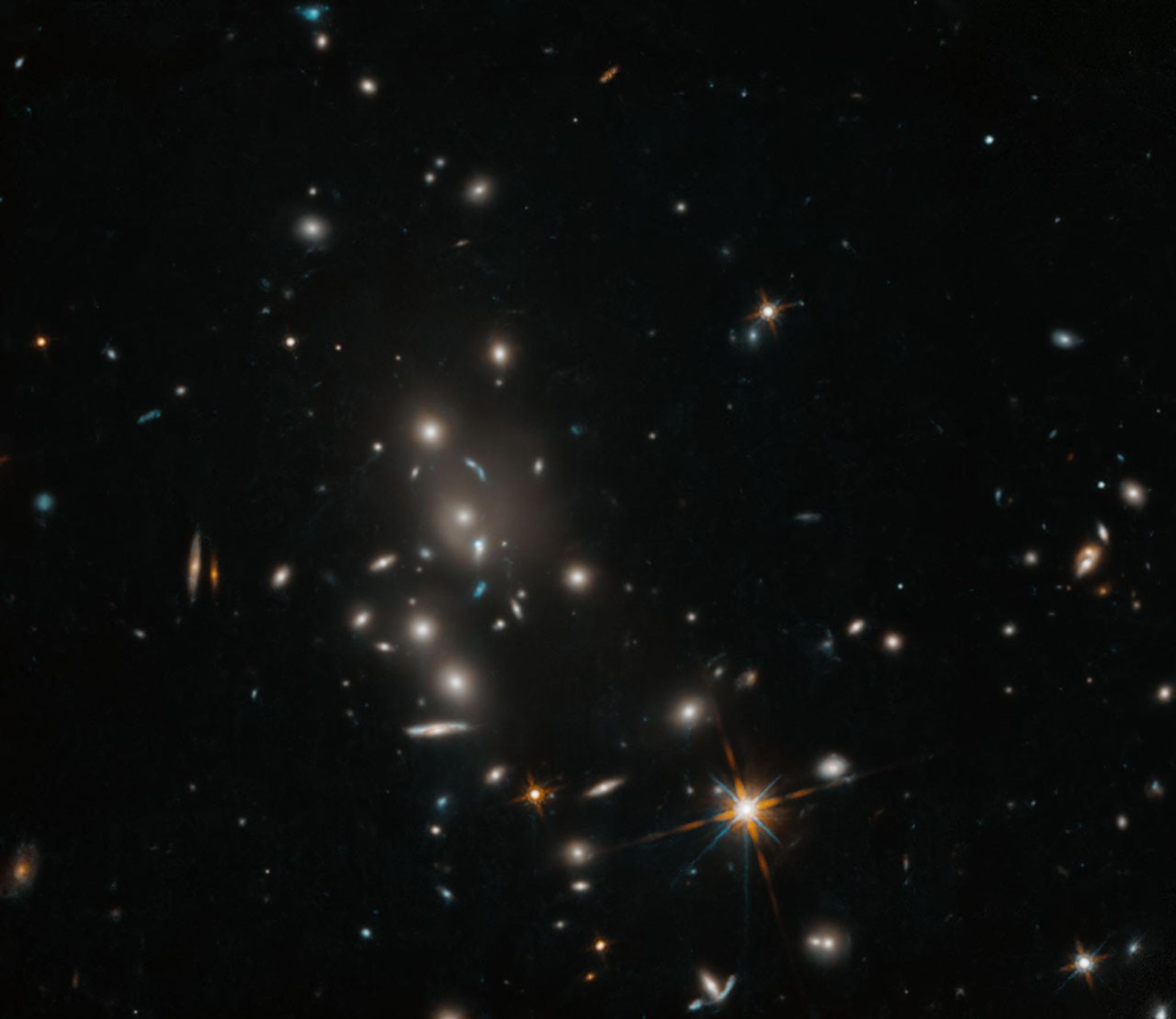
In a new Hubble Space Telescope view, a dense gathering of galaxies fills the frame, with the richest concentration appearing toward the image’s center-left.
In a new Hubble Space Telescope view, a dense gathering of galaxies fills the frame, with the richest concentration appearing toward the image’s center-left. The galaxies span a range of shapes and sizes—some smooth and rounded, others more structured—hinting at the complex history of growth and encounters inside a massive cluster.
The scene also contains a handful of nearby stars from our own galaxy. They stand out immediately because they appear as bright points crossed by sharp, outward-reaching streaks. Those streaks are known as diffraction spikes, an optical effect produced when light from a compact source bends around the support structures that hold Hubble’s secondary mirror in place. The spikes are not physical features in space; they are a signature of the telescope’s design that helps distinguish foreground stars from far more distant galaxies.
Hubble recorded the galaxy cluster, known as MACS J1141.6-1905, using both visible and infrared wavelengths. The image combines observations from two separate Hubble programs focused on some of the most massive galaxy clusters—systems that are conspicuously bright in X-rays. Such intense X-ray emission is a hallmark of extremely hot gas trapped in the cluster’s deep gravitational well, and it often signals a particularly hefty cluster capable of producing strong gravitational lensing.
Both programs targeted these bright X-ray clusters in part to search for galaxies far beyond them. The gravity of a massive cluster can warp spacetime enough to magnify and distort the light from more distant objects aligned behind it, acting as a natural “lens” that makes faint, remote galaxies easier to detect. By using clusters as cosmic magnifiers, astronomers can probe the distant universe more effectively than they could with a telescope alone.
The observing teams also aimed to investigate what is happening in the crowded central regions of such clusters. The core of a massive cluster is a dynamic environment where galaxies and hot gas can interact, merge, and exchange energy—processes that shape both the cluster’s present-day appearance and its long-term evolution.
Beyond the immediate scientific goals, the observations add to one of astronomy’s most important public resources: the Hubble data archive. With roughly 1.7 million observations and growing, the archive serves as a long-lived reference library for researchers. Because the telescope has been operating for 36 years, astronomers can revisit older datasets with improved analysis techniques and new computational tools, often extracting discoveries that were not possible at the time the images were first taken.
MACS J1141.6-1905 lies about four billion light-years from Earth in the constellation Crater, the Cup. Since its launch in 1990, Hubble has repeatedly transformed scientists’ view of the cosmos, and images like this—collected for specific investigations but preserved for future reuse—continue to expand what researchers can learn from its decades of observing.