NASA has chosen a new heliophysics mission concept aimed at sharpening forecasts of space weather by tracing how motions and disturbances in Earth’s atmosphere ripple upward into near-Earth space.
NASA has chosen a new heliophysics mission concept aimed at sharpening forecasts of space weather by tracing how motions and disturbances in Earth’s atmosphere ripple upward into near-Earth space. The project, called DAPHNE—short for Dynamic Atmosphere-Ionosphere Explorer—will investigate the atmospheric processes that can ultimately affect technologies such as GPS, satellites operating in low Earth orbit, and the safety of astronauts.
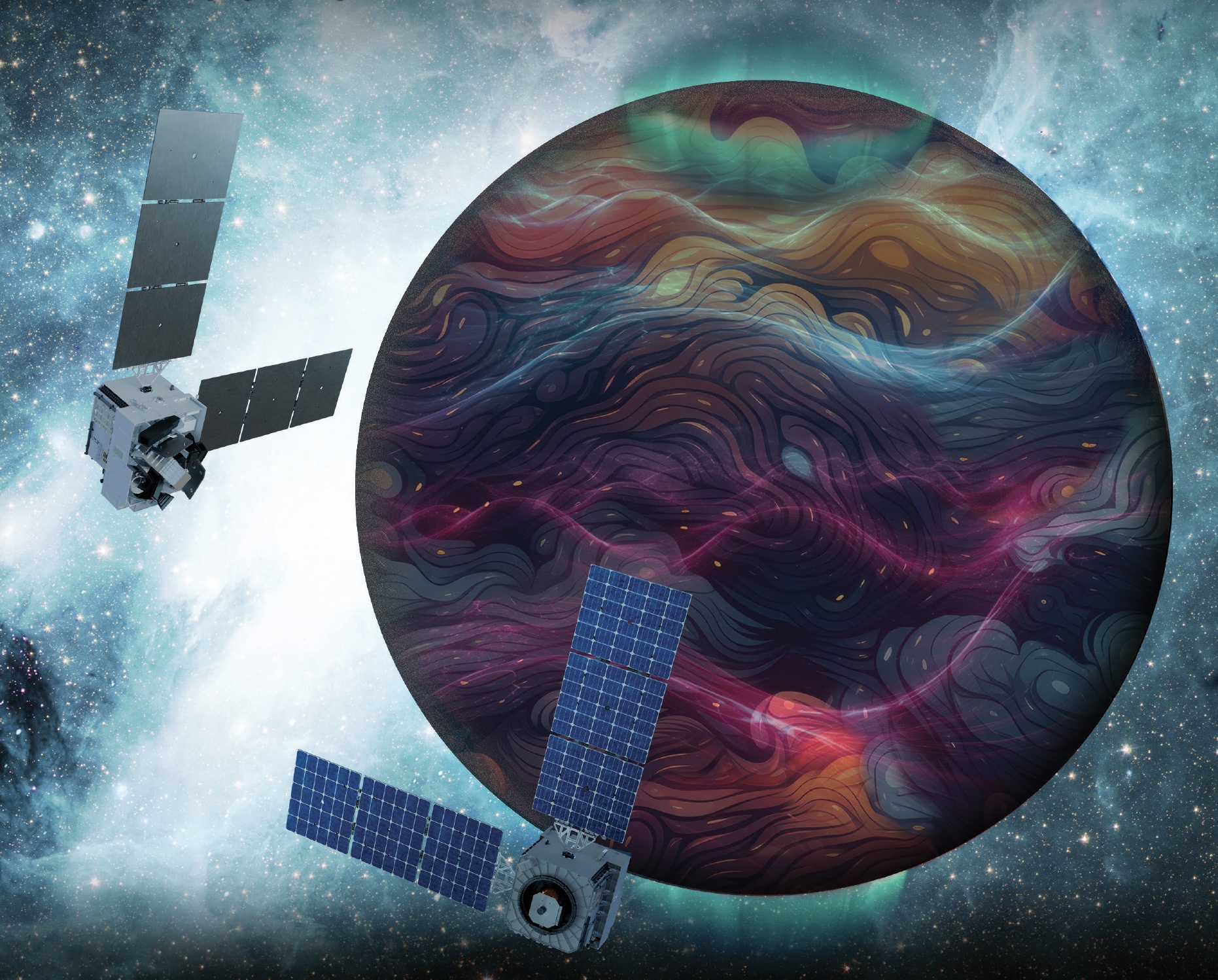
With its selection, DAPHNE will move into Phase B, the stage focused on detailed planning and design for both the spacecraft and mission operations. The mission is built around a pair of identical satellites flying in coordination. By making measurements at multiple points at the same time, the twin spacecraft are designed to reveal how variability in the lower atmosphere influences the upper atmosphere, where space weather effects are strongly expressed.
NASA leaders say the effort is part of a broader push to strengthen the nation’s ability to anticipate space-weather-driven disruptions. Nicky Fox, associate administrator for NASA’s Science Mission Directorate, said the agency is working toward a “space weather-ready” future, emphasizing that improved knowledge of Earth’s atmospheric behavior can translate into better preparedness for impacts felt both on the ground and in orbit. Fox also noted that as NASA prepares for human exploration beyond the protective reach of Earth’s magnetic field—toward the Moon, Mars, and farther—DAPHNE will add to the agency’s distributed fleet of science missions across the solar system, delivering data intended to help planners predict and lessen space weather risks.
Scientifically, DAPHNE targets a critical boundary region: the thermosphere and ionosphere. In this tenuous shell surrounding the planet, the neutral gases of the atmosphere transition into ionized plasma. Conditions there are continually shifting, shaped by energy and particles from the Sun, by dynamics internal to near-Earth space, and by waves and other variability that originate lower in the atmosphere. These coupled influences can change atmospheric density and the behavior of charged particles—factors that play into satellite drag, radio-signal propagation, and other effects that matter for navigation and communications.
The mission’s “low-risk, high-return” approach centers on coordinated measurements of key thermospheric properties, including neutral winds, temperature, and composition. By connecting these observations with information about energy inputs coming from the lower atmosphere, DAPHNE is intended to deliver fundamental physical insights that can be folded into models and ultimately improve prediction of space weather impacts.
DAPHNE is led by Aimee Merkel at the Laboratory for Atmospheric and Space Physics at the University of Colorado Boulder. The project will undergo a confirmation review in 2027, when NASA will evaluate technical progress and the availability of funding. If the mission is confirmed, NASA estimates that total costs—excluding launch—would be capped at $250 million in fiscal year 2023 dollars. The earliest possible launch is 2029.
The concept was originally submitted in response to an announcement of opportunity for the DYNAMIC (Dynamical Neutral Atmosphere-Ionosphere Coupling) mission. Funding and management oversight are provided through NASA’s Solar Terrestrial Probes program at the agency’s Goddard Space Flight Center in Greenbelt, Maryland.