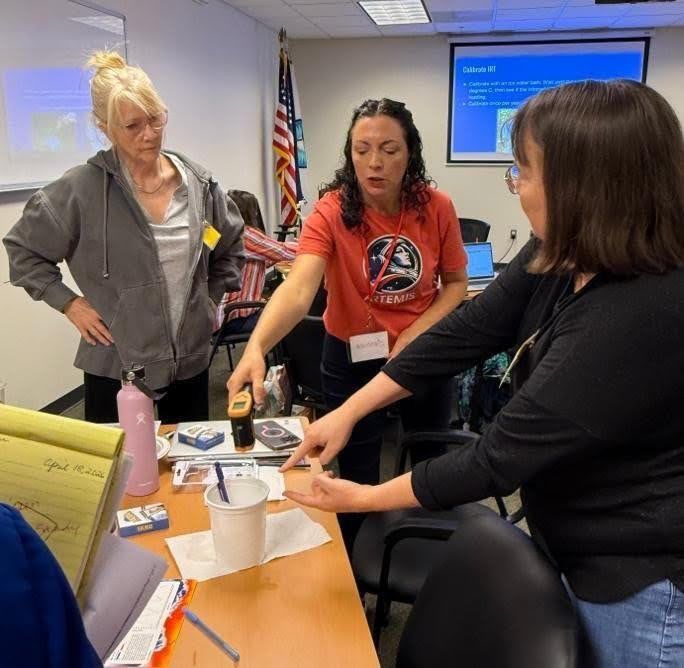
Thirty-eight science teachers from seven school districts across Virginia’s Tidewater region are working with local partners to bring NASA-supported Earth science into classrooms—and into the community.
Thirty-eight science teachers from seven school districts across Virginia’s Tidewater region are working with local partners to bring NASA-supported Earth science into classrooms—and into the community. The effort links NASA eClips, a resource hub designed to help educators teach with authentic NASA science, with the GLOBE (Global Learning and Observation to Benefit the Environment) Program, which trains participants to collect and analyze environmental measurements as part of citizen science.
The collaboration, supported through NASA’s Science Activation Program, is designed to strengthen what organizers describe as a regional STEM ecosystem: a network that connects school instruction, community-based science efforts, and NASA expertise. Community organizations—including the Elizabeth River Project—have joined educators in building learning experiences that translate Earth systems concepts into real-world investigations.
Teachers took part in a three-hour professional learning session held either March 7 or April 18, 2026, at the National Institute of Aerospace in Hampton, Virginia. The sessions emphasized practical investigations that align with Virginia’s Science Standards of Learning, focusing on weather and climate, land cover, and Earth’s energy budget.
During the workshops, participants examined how different types of land cover can affect surface temperatures, explored the role clouds play in atmospheric conditions, and investigated how soil functions within environmental systems. Activities were grounded in NASA eClips instructional materials and GLOBE measurement protocols, giving teachers classroom-ready approaches while also reinforcing the underlying science.
A central element was building confidence with field tools and data quality. Educators calibrated and used instruments such as infrared thermometers and multi-day minimum/maximum thermometers—skills aimed at ensuring that student-collected data are reliable and comparable. The group also analyzed the urban heat island effect, a phenomenon in which built environments can run hotter than surrounding areas.
To make atmospheric science more tangible, teachers participated in interactive demonstrations, including a movement-based “cloud dance” activity and a lesson illustrating cloud opacity. They also practiced submitting observations through the GLOBE Observer mobile app, which enables users to contribute standardized environmental data.
Organizers say the initiative reflects two years of deliberate partnership-building among NASA eClips educators from the National Institute of Aerospace’s Center for Integrative STEM Education (NIA-CISE), GLOBE scientists based at NASA Langley Research Center, regional school divisions, and community organizations. The goal is sustainability: ensuring that the collaboration persists beyond individual workshops and becomes embedded in local curricula and outreach.
Financial support has been key. The Coastal Virginia STEM Hub—funded by the Virginia General Assembly—has helped expand access by underwriting educator stipends and supporting the purchase of equipment, including weather instrument shelters and soil kits. In a cross-sector component that further ties education to hands-on problem-solving, the instrument shelters were built to GLOBE specifications by Career and Technical Education (CTE) students in Hampton City Schools and Norfolk Public Schools, allowing students to contribute directly to scientific infrastructure that will be used by their peers.
As participating school divisions and community groups integrate NASA eClips content and GLOBE practices into teaching and outreach, the partnership aims to ensure more students gain experience with authentic, data-driven science. The larger vision is a connected STEM network in which learning extends beyond the school day, linking classrooms with community science and NASA resources.
NASA eClips, led by NIA-CISE, is supported by NASA through cooperative agreement award NNX16AB91A and is part of NASA’s Science Activation Portfolio.